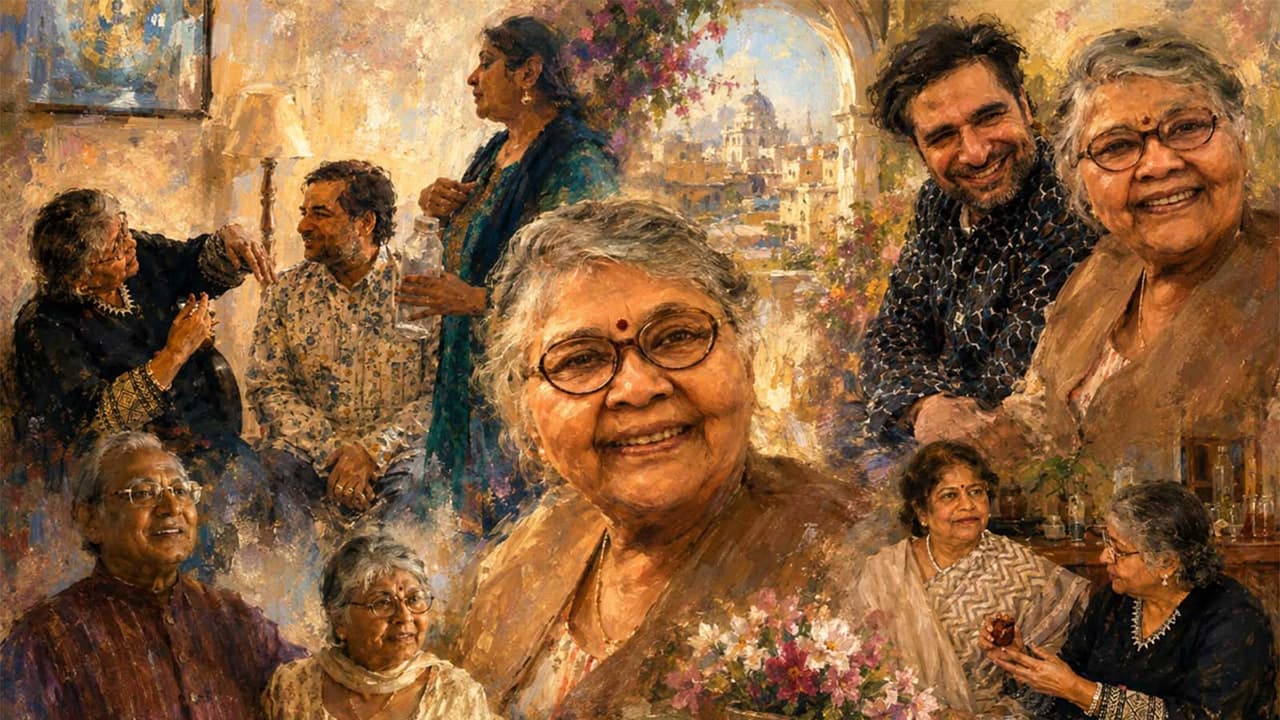
In a poignant tribute, author Suvir Saran remembers his aunt, Sunita Bua. He reflects on how her death made her geographically unlimited, and how her spirit lives on through shared recipes, acts of generosity, and the love she instilled in others.
Kinship Was Not a Diagram. It Was Practice.
My Sunita Bua was actually my father’s cousin. But Indian families have never needed genealogy to tell them the truth about relationships. She was his sister because they lived as siblings. And therefore she was our Bua. Kinship was not a diagram. It was practice. Perhaps all meaningful relationships are. A mother is partly biology and overwhelmingly mothering. A friend becomes family by showing up. A sibling is made as much by shared memory as shared DNA. An aunt becomes Bua because she behaves like one.
Sunita Bua behaved like one magnificently. She fed. She fussed. She remembered. She teased. She travelled. She tasted. She discovered. She returned bearing recipes, stories, surprises and gifts. Most importantly, she knew what people liked. That sounds like a small thing until the person who remembered dies. Then you understand its enormity. To remember what another person likes is to say: I noticed you. I remembered you. You mattered even when you weren’t in the room.
There were pickles I loved that would somehow be made in time for me to carry back to America. Recipes I wanted to learn were taught with ready, reckless generosity. No guarding of secrets. No precious performance around family formulas. No possessiveness about culinary knowledge. She shared with the glorious carelessness of someone who understood that generosity does not diminish us. It multiplies us.
A Table That Measured Seasons
Her table changed with the seasons. Before supermarkets persuaded us that every ingredient should be available everywhere, always, homes understood time through taste. Winter announced itself through one set of dishes, summer through another. Mangoes marked months. Pickles were calendars. Preserves were memory made edible. I could measure seasons through Sunita Bua’s table. And she brought everything out with such glee. The sparkle before you tasted. The smile after you approved. That naughty, mischievous smirk that suggested she already knew you would ask for seconds. She did not merely feed you. She celebrated your appetite.
Watching her across decades was also watching India change. Our access grew. Travel expanded. Ingredients arrived. Horizons widened. Bua travelled, tasted, absorbed, adapted. Her repertoire became larger, her curiosity richer, her table wider. She did not become less herself by discovering the world. She became more herself. There is a lesson in that. We often mistake identity for something that must be protected by walls. But perhaps the strongest identities are windows. They encounter the unfamiliar without fear. They look, listen, taste, learn- and enlarge. Sunita Bua enlarged.
And then came the quieter years. Time began asking different things of her. The woman who had moved through life with such appetite, animation and command gradually needed the world around her to become gentler. And those who loved her made it so. She remained cared for, cherished, chic, correct, surrounded. There remained that sweetness, that smile, that unmistakable something that announced: Sunita.
Where We Live: In One Another
Watching someone we love enter a more fragile season raises a metaphysical question. If parts of the familiar person become harder for us to reach, where does the person go? I have come to believe the answer may be: nowhere. Because we make the mistake of believing a human life exists only inside the human being living it. It does not. We live in one another. Part of my father lives in me. Part of Sunita Bua lives in her husband, children and grandchildren; in her relatives and friends; in people she fed and fussed over; in those who travelled with her, laughed with her, learned from her, were loved by her.
Memory is distributed. Perhaps love is the place where we keep one another safe. A recipe is one such place. A gesture is another. A sentence you suddenly hear yourself saying exactly as they did. The way you season something. Fold something. Welcome someone. Pack for a journey. Set a table. The dead have curious hiding places. Sometimes they hide in pickle jars.
After my father died, my sister Seema said something astonishingly simple: “He hasn’t gone anywhere. He is in our DNA.” She was right. Science makes that literally true for children. Grief makes it infinitely larger. Those we love enter a DNA beyond chromosomes. They become encoded in behaviour. Which is why grief ambushes us in such ordinary places. Not necessarily at funerals. Sometimes at supermarkets. You see a jar. You smell a spice. A song begins. Someone laughs in a familiar register. A dish arrives at the table. And for one impossible, exquisite second, the dead walk straight back into the room.
Eating as Communion
Proust needed a madeleine. Indians have several thousand possibilities. Food may be one of humanity’s most sophisticated technologies of memory because it refuses to remain intellectual. A photograph summons the eyes. Music recruits the ears. Food conspires with everything — aroma, taste, texture, temperature, sight, sound, season, company. A recipe can resurrect a room. This is why I cannot think about Sunita Bua without thinking about eating. Not eating as consumption. Eating as communion. Her hospitality contained a philosophy: there was room for you. Something had been remembered for you. Something had been prepared because you were coming. Is there a more elemental definition of love? I knew you were coming, so I made something. Religion has built cathedrals around more complicated propositions.
Imagination vs. The Unbearable
And so, amid the sadness, I find myself imagining heaven rather irreverently. I imagine those who left before her waiting. Ashok Chacha. Ajit Chacha. Munni Mausiji. Papa. Brijbir Mamaji. Deepa Bua. Yashvir Tauji. Usha Bua. Our sprawling, celestial parliament of ancestors and loved ones. I picture them seeing Sunita Bua arrive- eyes widening, mouths watering. Because heaven is about to be reorganised. The food will improve. The tables will be gussied up. Travel plans will become considerably more ambitious. The conversations will get louder. The laughter longer. The meals larger. The hospitality more exacting. Someone will discover that what had previously been considered perfectly adequate simply will not do. Sunita has arrived.
This is not theology. I possess no secret map of the afterlife. It is love using imagination to negotiate the unbearable. Perhaps that is one of imagination’s noblest purposes.
The Simple Inventory of a Life
Humanity has spent millennia wondering what comes after the final breath. Reincarnation. Resurrection. Paradise. Liberation. Reunion. Dissolution into cosmic consciousness. Philosophy asks. Religion answers. Science measures what it can. Grief sits quietly between them. It says: I do not know where you are. But I know what you left here. And what we leave is rarely what the world spends our lifetime teaching us to accumulate. Not the designation on a visiting card. Not the square footage. Not the bank balance. Not the applause. Not the follower count. At the end, the inventory becomes almost embarrassingly simple. How did people feel around you? Were they diminished or enlarged? Judged or welcomed? Frightened or freer? Did you notice them? Did you remember? Did you share? Did you make room? Did you leave someone feeling that their arrival mattered?
Sunita Bua did. With a naughty smirk, a sweet smile, a generous hand and a glorious appetite for life, she left people feeling seen, felt, fed and folded into her world.
Death is Subtraction and Multiplication
Perhaps this is why death is simultaneously subtraction and multiplication. One body disappears. A thousand memories awaken. One voice falls silent. A hundred stories begin speaking. One kitchen closes. Recipes migrate. One traveller completes her journey. Her ways of seeing continue travelling through everyone she taught to look. The body, which we thought contained the person, turns out to have been merely one of their addresses. The others were us.
This Sunday, somewhere in the world, somebody is grieving someone. A mother. A father. A spouse. A sibling. A child. An aunt. A friend who quietly crossed the invisible border into family. Your person will not have been Sunita Bua. Perhaps they never made pickles. Perhaps they burned toast. But there will be something. A phrase. A perfume. A terrible joke. A Sunday ritual. A song. A recipe. A chair nobody quite wants to sit in yet.
At first grief tells us these things prove somebody is gone. Give grief time. One day the same things begin telling us something else. They were here. They mattered. They loved. They were loved. They altered us. And perhaps this is the closest thing human beings are granted to immortality: not living forever, but living deeply enough in others that something of us refuses to die. Maybe eternity is not endless time. Maybe eternity is consequence. A kindness continuing. A recipe travelling. A generosity inherited. A table made larger because somebody once made room for us at theirs.
Sunita Bua has lost her address. But she has entered our gestures, our journeys, our kitchens, our conversations, our cravings, our celebrations. She is no longer somewhere. And perhaps that is why I can now find her everywhere.
(ANI/Suvir Saran)
Disclaimer: Suvir Saran is a Masterchef, Author, Hospitality Consultant And Educator. The views expressed in this article are his own.
(Except for the headline, this story has not been edited by Asianet Newsable English staff and is published from a syndicated feed.)