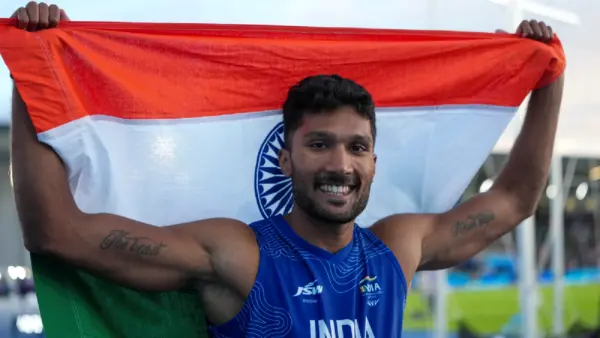
After completing a victory lap of the Scotstoun Stadium to celebrate a decathlon bronze medal, Tejaswin Shankar stood in the middle of the arena to relish the moment.
Then he did what Novak Djokovic famously does after winning Wimbledon.
Tejaswin, the first Indian to win a Commonwealth Games medal in decathlon, plucked some grass from the turf and chewed it. Severe pain because of tendinitis in his right knee – or jumpers’ knee in athletes’ parlance – had forced Tejaswin to pull out of the high jump. His chances of a decathlon medal seemed all but over, but redemption was swift.
“It was surreal. For a few seconds, I was still wondering how I won a Commonwealth medal with one-and-a-half legs. I started walking to the stand where my wife and mom were sitting. Someone gave me an Indian flag. We took a victory lap. An Indian security guard said he felt proud. I felt like it was a movie. Then I went to the infield, and like Djokovic, ate some grass,” Tejaswin told The Indian Express.
Olympic medallists Damian Warner (silver) and Lindon Victor (gold) were among the 12 competitors. Before he shed tears of joy, Tejaswin had bawled like a child three days earlier when his knee acted up. Video clips of him crying in the mixed zone emerged, but that is only half the picture.
“When I walked into the mixed zone, I was asked a question. I spoke three sentences. I went behind a banner, and started sobbing like a baby. I am usually good at keeping my emotions to myself. I was 100 percent convinced that the decathlon was also over for me,” Tejaswin said.
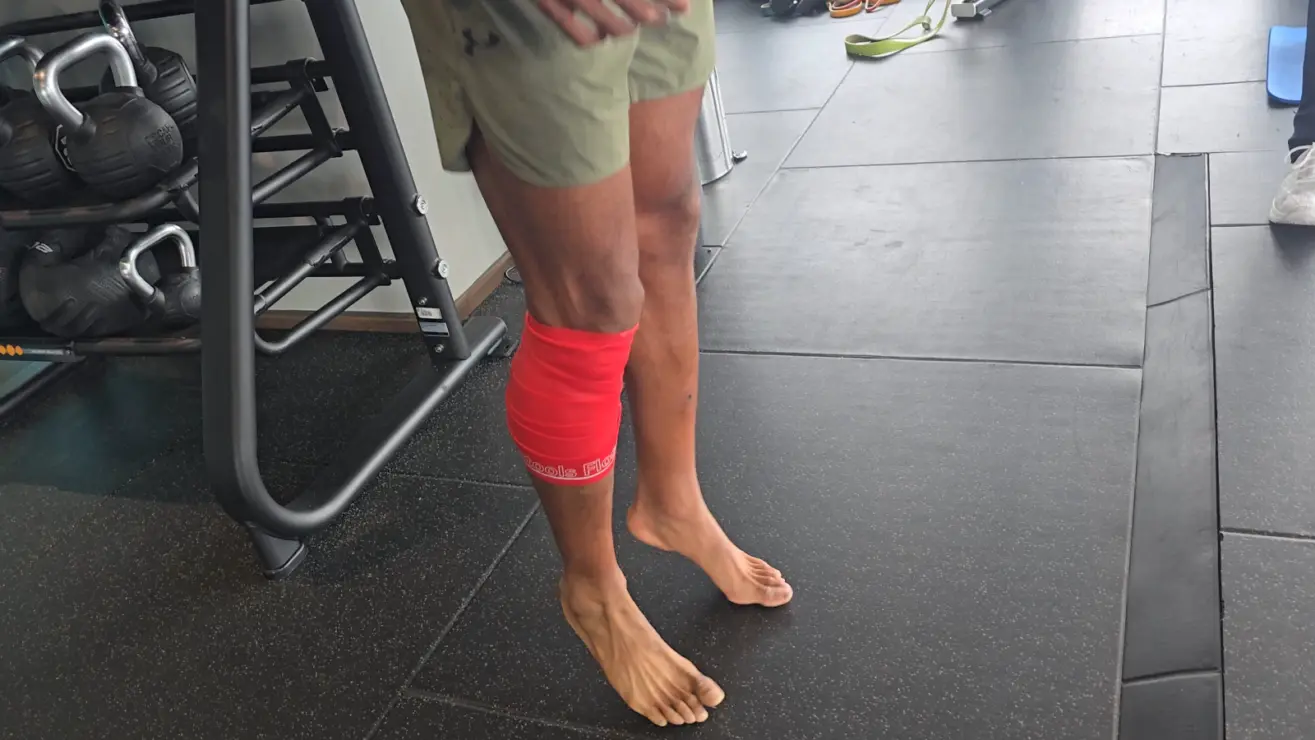 Tejaswin Shankar wears a knee brace in Glasgow. (Credit: Special Arrangement)
Decathlon was scheduled to start two days later. That night, Tejaswin was on ChatGPT searching for a ray of hope. He slept only at 3am and woke up by 6am. He spent the morning thinking how he would spend time around Indian teammates in Glasgow, knowing that he had done nothing of note.
The diagnosis of Dinshaw Pardiwala, the team doctor, was comforting.
“Dr Pardiwala did some tests and said there was no rupture. The negative was that the knee was very inflamed so even if I competed in the decathlon, I would be in severe pain,” the athlete recalled.
“Pain can be managed but it depends on how your body responds, the doctor said. Painkillers will bring the pain down, and the hope was that the adrenaline would take over. I was wondering if it would be better to skip the CWG and focus all my energy on the Asian Games.”
Following this, strength and conditioning coach Wayne Lombard and India team physio Mayur Thakkar resurrected his CWG. The latter asked Tejaswin if he wanted to fight or not.
“I half-heartedly said yes. Mayur guaranteed me that I would be ready to start the decathlon on July 30.”
Thakkar and Lombard spent eight hours a day, for the next two days, to get Tejaswin ready to compete. The South African found a rehabilitation clinic in Quarriers village, which had a hyperbaric oxygen chamber and red-light therapy. “The village was about 40-45 minutes from our hotel. We did whatever we could to fix the knee in the short span of two days. Physio Mayur’s soft tissue treatment helped. All these things came together,” Tejaswin said.
The clinic posted on Instagram about Tejaswin’s visit when he won a medal. He replied, thanking them.
On the first morning of the competition, Tejaswin rolled his ankle while on the treadmill. Luckily for him, it was just a scare. During the first event, the 100 metres, his mind was all over the place and he forgot to stay low in the drive phase (first 30 metres).
“I was just flustered. Once the race was over, only then did I realise that the decathlon’s first event was over. Because at that time, I was more worried about the knee.”
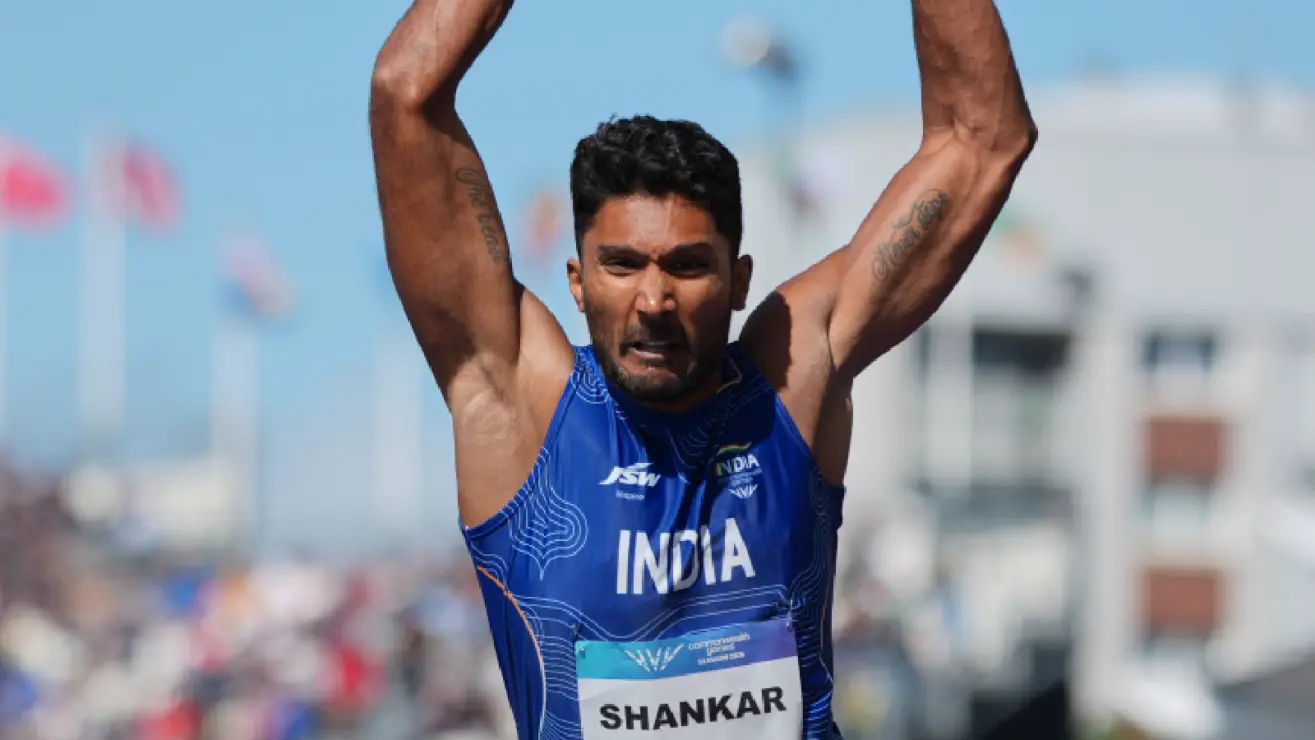 India’s Tejaswin Shankar competes in the men’s decathlon long jump at the Commonwealth Games in Glasgow, Scotland, Thursday, July 30, 2026. (AP Photo/Alastair Grant)
Long jump boost
However, his fortunes improved in the long jump. A personal best of 7.82 metres was a boost.
“It was much needed and put me back in contention. My first jump was decent… around 7.40 metres. I had a bad landing and a half-hearted take-off, a whole shoe length behind the (take-off) board. So I decided to make the most of the next jump. When the reading came out I knew I was back in contention. That single moment flipped everything. I was back in the competition mentally.”
Ahead of the decathlon high jump, Tejaswin was worried about aggravating the pain in his knee.
“In both the long jump and high jump, I have the same leg (right) for take off. That is why I was more worried about these two events. In high jump, at that particular angle when I plant my foot, I feel the pain. I was also experiencing post-traumatic stress due to what had happened two days prior. I could slowly feel the pain coming back. I took limited jumps. Once I crossed 2.15m, I tried to clear 2.18 and then 2.21. It was a gamble.”
After day one, Shankar was in second place but despite a personal best in the discus throw (40.44m), he slipped to fourth after the pole vault – the third-last event. But the javelin throw changed his fortunes.
“The only time I thought I was in contention for a medal was after the javelin. Because I had to throw over 50 metres in order and the guy above me (Sammy Ball) has a better personal best in the 1,500m. In javelin, I executed the plan with 53.12 metres and Sammy threw only 44 metres (44.88 metres), though he is a 50-53 metre thrower. So after javelin, I got a good lead over him, and he had to do something miraculous (in 1,500m) to get the bronze.”
The biggest takeaway for Tejaswin was how he bounced back when everything seemed lost.
“I proved that in the face of adversity, I can still figure it out. This experience is what is needed if you want to compete with these guys at the Olympic Games and World Championships. In those competitions, it is not about who has the better personal best but who is able to manage emotions.”