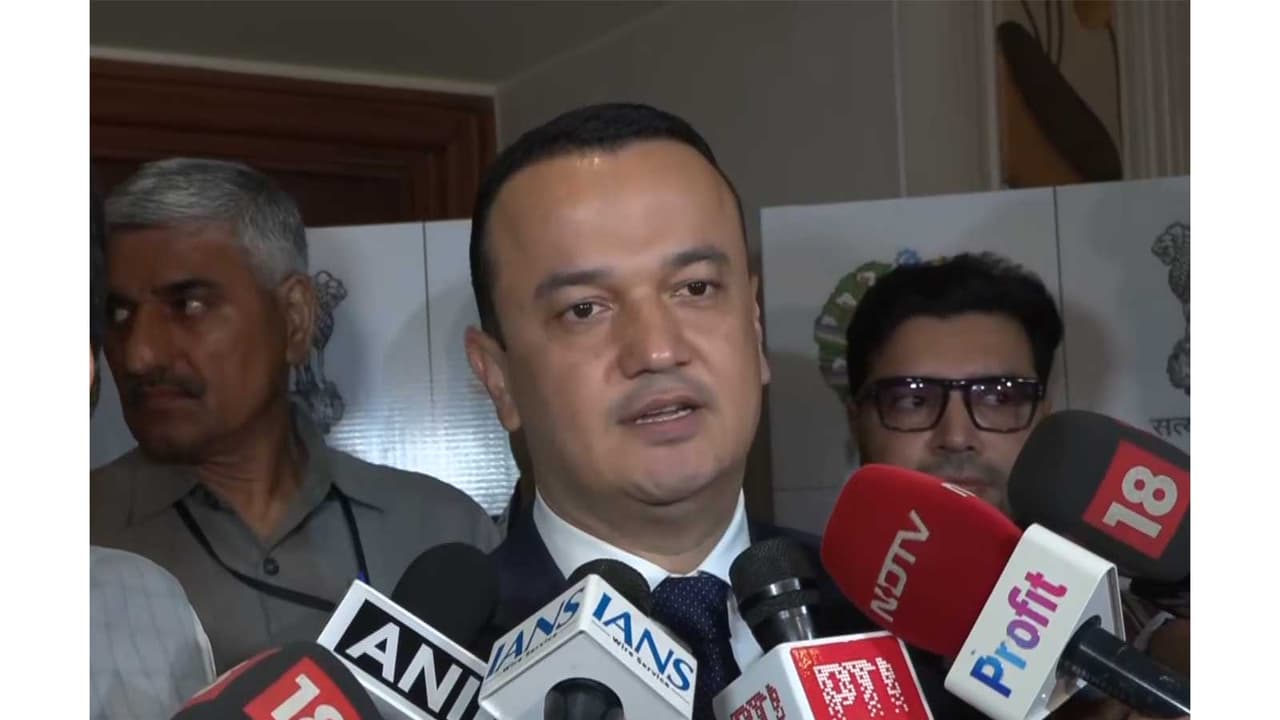
Uzbekistan invited Indian firms to invest in its mining and metallurgy sector, including gold, copper, and critical minerals. The Central Asian nation is targeting a bilateral trade volume of USD 2 billion with India by next year.
Uzbekistan has invited Indian companies to invest in its mining and metallurgy sector, offering opportunities in gold, copper, uranium, critical minerals and rare earth elements, while projecting bilateral trade with India to reach USD 2 billion next year.
Addressing more than 200 business representatives at the India-Uzbekistan Business Forum in New Delhi alongside Union Commerce and Industry Minister Piyush Goyal, Uzbekistan’s Minister of Investment, Industry and Trade, Laziz Kudratov, said the Central Asian nation is keen to bring Indian technology, expertise and capital into its mineral and metals sector.
“First, of course, is mining and metallurgy. We discussed with Minister Goyal opportunities that Uzbekistan possesses. We are top 10 globally in terms of gold, copper, uranium deposits. We have almost all types of critical minerals and rare earth elements. We would be happy to discuss and to bring Indian technologies, know-how, and capital to develop steel production, deep processing of copper, and rare earth metals,” Kudratov said.
Highlighting the growing economic partnership, Kudratov said bilateral trade grew by 30 per cent last year to cross USD 1.3 billion for the first time and expressed confidence that it would touch USD 2 billion next year. “We expect this next year we will be reaching USD 2 billion and then we should join efforts to increase our trade to USD 3-5 billion in coming years,” he said.
Currently, around 400 Indian companies operate in Uzbekistan, with a joint project portfolio exceeding USD 5 billion.
Key Sectors for Expanding Cooperation
Besides mining and metallurgy, Kudratov identified chemicals, renewable energy, pharmaceuticals and the automotive sector as key areas for expanding India-Uzbekistan economic cooperation.
Chemical Industry
On the chemical industry, he said Uzbekistan is among the region’s largest fertiliser producers and invited Indian firms to expand fertiliser manufacturing in the country to serve both Indian and third-country markets. “Another area is the chemical industry. We are one of the largest regional producers of fertilizers. And we would be happy to cooperate not only in trade, but also talk to Indian companies on the expansion of fertilizer manufacturing in Uzbekistan in order to supply the mended products, not only for Indian markets, but also for the third countries together,” he said.
Renewable Energy
Kudratov also outlined Uzbekistan’s renewable energy ambitions, noting that the country plans to increase the share of renewables in its energy mix from 30 per cent to 54 per cent by 2030, creating opportunities in solar and wind power, battery storage and data centre development supported by low-cost green electricity.
Pharmaceutical Sector
In the pharmaceutical sector, where Uzbekistan imports more than USD 3 billion worth of medical products annually, he invited Indian companies to establish joint manufacturing of medicines and vaccines, citing ongoing collaborations with Dr. Reddy’s and Cipla.
Automotive Sector
Highlighting opportunities in the automotive sector, Kudratov said Uzbekistan manufactures around 500,000 vehicles annually through facilities operated by General Motors, BYD and Kia Motors, and called on Indian companies to localise production of automotive components and industrial equipment.
He said both governments are working to improve trade facilitation, enhance market access and reduce administrative barriers to strengthen bilateral business ties.
According to the Embassy of India in Tashkent, India is among Uzbekistan’s top 10 trading partners, with bilateral trade reaching USD 1.32 billion. India’s major exports include pharmaceutical products, mechanical equipment, vehicle parts, services, optical instruments and mobile phones, while imports from Uzbekistan comprise fruit and vegetable products, fertilisers, juices, lubricants and services.
Building Resilient Value Chains
Speaking at the forum, Jaidev Rajnikant Shroff, CEO of United Phosphorus Ltd, said India’s manufacturing and technology strengths complement Uzbekistan’s abundant natural resources and strategic location. “The complementariness between our economies are stronger than ever before. Combining India’s innovation, manufacturing capabilities, and technology expertise with Uzbekistan’s strategic location with abundant natural resources, we have an extraordinary opportunity to build resilient value chains,” Shroff said. (ANI)
(Except for the headline, this story has not been edited by Asianetnews Editorial staff and is published from a syndicated feed.)