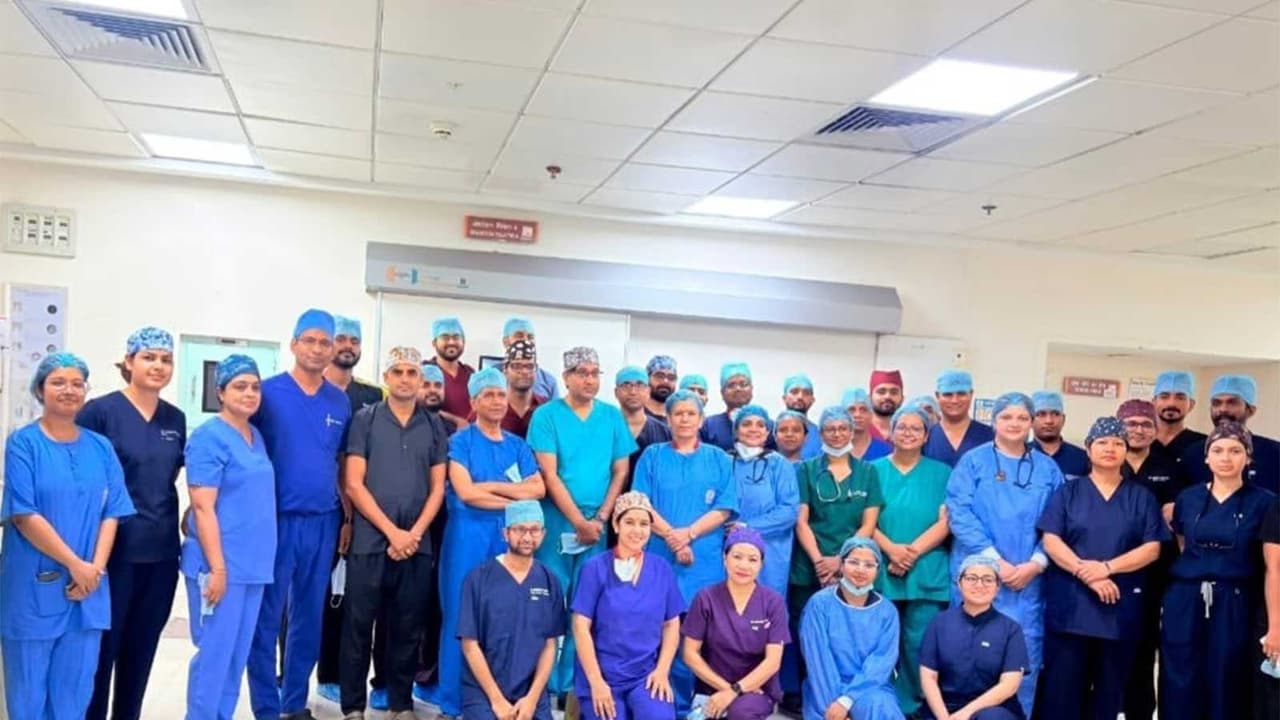
Delhi’s VMMC & Safdarjung Hospital has performed the world’s first robotic systemic atrioventricular valve replacement on an adult with the rare conditions of ccTGA and Dextrocardia, marking a historic milestone in global cardiac surgery.
A Historic Milestone in Cardiac Surgery
Under the stewardship of VMMC & Safdarjung Hospital Director Dr Kavita Sharma, the institution has achieved a historic milestone in global cardiac surgery. The Department of Cardiothoracic & Vascular Surgery (CTVS) has successfully performed the World’s First Robotic Systemic Atrioventricular (AV) Valve Replacement in an adult patient with Congenitally Corrected Transposition of the Great Arteries (ccTGA) with Dextrocardia. This pioneering achievement places VMMC & Safdarjung Hospital at the forefront of advanced robotic cardiac surgery and reaffirms the institution’s commitment to clinical excellence, innovation and cutting-edge patient care in India’s public healthcare system.
The pioneering, minimally invasive procedure was successfully executed by an expert surgical team led by Professor (Dr.) Anubhav Gupta, Director Professor and Head of the Department of CTVS. The patient suffered from a rare combination of structural anomalies, including ccTGA, which is a birth defect where the heart’s lower chambers are reversed, forcing the weaker right ventricle and its associated AV valve to pump blood to the entire body under high systemic pressure, and Dextrocardia, which is a condition where the heart is entirely flipped and points toward the right side of the chest instead of the left. Over time, this systemic AV valve leaked severely, putting the patient at risk of a failing heart. The heart function had already deteriorated, making the surgery even more challenging.
Engineering a New Surgical Approach
A detailed 3D reconstruction of the CT scan was undertaken to meticulously plan the procedure. To conquer this structural puzzle, Professor Anubhav Gupta and his team engineered a completely new procedural path.
Standard robotic mitral valve replacements are performed through the right side of the chest. However, because this patient’s heart had Dextrocardia, the team successfully utilised a specialised left-sided approach, precisely mirroring the standard right-sided robotic technique. Operating through tiny ports without splitting the patient’s breastbone, the surgical team utilised high-definition 3D visualisation and robotic arms to achieve unmatched precision inside the flipped chest cavity.
Benefits of the Minimally Invasive Technique
This masterful adaptation offers immense clinical benefits, including no bone-splitting, leaving the chest wall fully intact, minimal blood loss and drastically lower infection risks, significantly less post-operative pain, and a highly accelerated recovery timeline.
A Landmark for Indian Public Healthcare
This landmark operation marks the first time in medical literature that a robotic system has been adapted through a left-sided approach to replace a Systemic AV Valve in a ccTGA patient with Dextrocardia.
This historic breakthrough reflects the vision, institutional stewardship and unwavering commitment of VMMC & Safdarjung Hospital towards innovation in advanced patient care. It further underscores the world-class expertise available within India’s public healthcare sector, demonstrating that premier national institutions like VMMC & Safdarjung Hospital continue to lead global innovation in robotic cardiac surgery. (ANI)
(Except for the headline, this story has not been edited by Asianetnews Editorial staff and is published from a syndicated feed.)