The Danish drugmaker reported on Friday that its experimental cardiovascular drug ziltivekimab failed a key late-stage trial, marking a significant pipeline setback in its efforts to diversify beyond blockbuster obesity and diabetes treatments.
- Earlier this month, Novo Nordisk also filed a lawsuit against rival Eli Lilly.
- However, the company also got its obesity pill approved in the EU.
- Novo Nordisk is scheduled to report second-quarter results around early August.
Shares of Novo Nordisk fell in July after three consecutive months of gains, owing to a failure of its experimental drug in a late-stage trial, coupled with its lawsuit against rival Eli Lilly & Co.
The stock closed down 9% on Friday and nearly 2% in July, marking its first month of clocking losses after March.
Latest Drug Pipeline Setback
On Friday, the Danish drugmaker reported that its experimental cardiovascular drug ziltivekimab failed a key late-stage trial, marking a significant pipeline setback in its efforts to diversify beyond blockbuster obesity and diabetes treatments.
The ZEUS late-stage trial, involving more than 6,300 patients with atherosclerotic cardiovascular disease, chronic kidney disease, and inflammation, tested once-monthly ziltivekimab against placebo. While the drug reduced inflammation markers as expected, it showed no meaningful reduction in major adverse cardiovascular events (MACE)—including cardiovascular death, non-fatal heart attack, or non-fatal stroke. Safety was generally comparable, though serious infections were higher with the drug.
The outcome will trigger a non-cash impairment charge in the third quarter but leaves the company’s adjusted operating profit outlook for 2026 unchanged, Novo said. Two additional ziltivekimab trials in heart failure and post-heart attack patients are continuing, with results expected in the first half of 2027.
Ziltivekimab, acquired through a 2020 deal, had been viewed as a potential growth driver outside Novo’s core obesity and diabetes franchise. The failure increases pressure for acquisitions or other pipeline advances amid intensifying competition and pricing headwinds.
Competitive And Market Pressures
July also highlighted competitive tensions. On July 21, Novo Nordisk filed a lawsuit against Eli Lilly, alleging misleading national advertising for Lilly’s GLP-1 drugs that used outdated or mismatched dose comparisons to claim superiority over Wegovy and Ozempic. Novo is seeking an injunction and corrective ads.
These developments come against a backdrop of pricing pressure in the U.S. and competition from Lilly’s tirzepatide products, which have weighed on investor sentiment throughout 2026. Novo itself has guided for adjusted sales and operating profit declines of around 4-12% at constant exchange rates this year.
Positive Regulatory Progress
Not all news was negative. On July 15, the European Commission granted marketing authorization for the Wegovy pill as the first oral GLP-1 receptor agonist for weight management across the entire European Union. It is indicated for adults with obesity or overweight plus at least one weight-related comorbidity, used alongside a reduced-calorie diet and increased physical activity.
This marked the fifth regulatory approval for the oral formulation, following the US, UK, UAE, and Bahrain. The decision was based on the OASIS clinical program, where the pill delivered around 17% mean weight loss versus ~3% with placebo.
The same day, the EC also approved the higher-dose Wegovy 7.2 mg injection in a single-dose pen, already available in the US as Wegovy HD, which showed a near 21% mean weight loss.
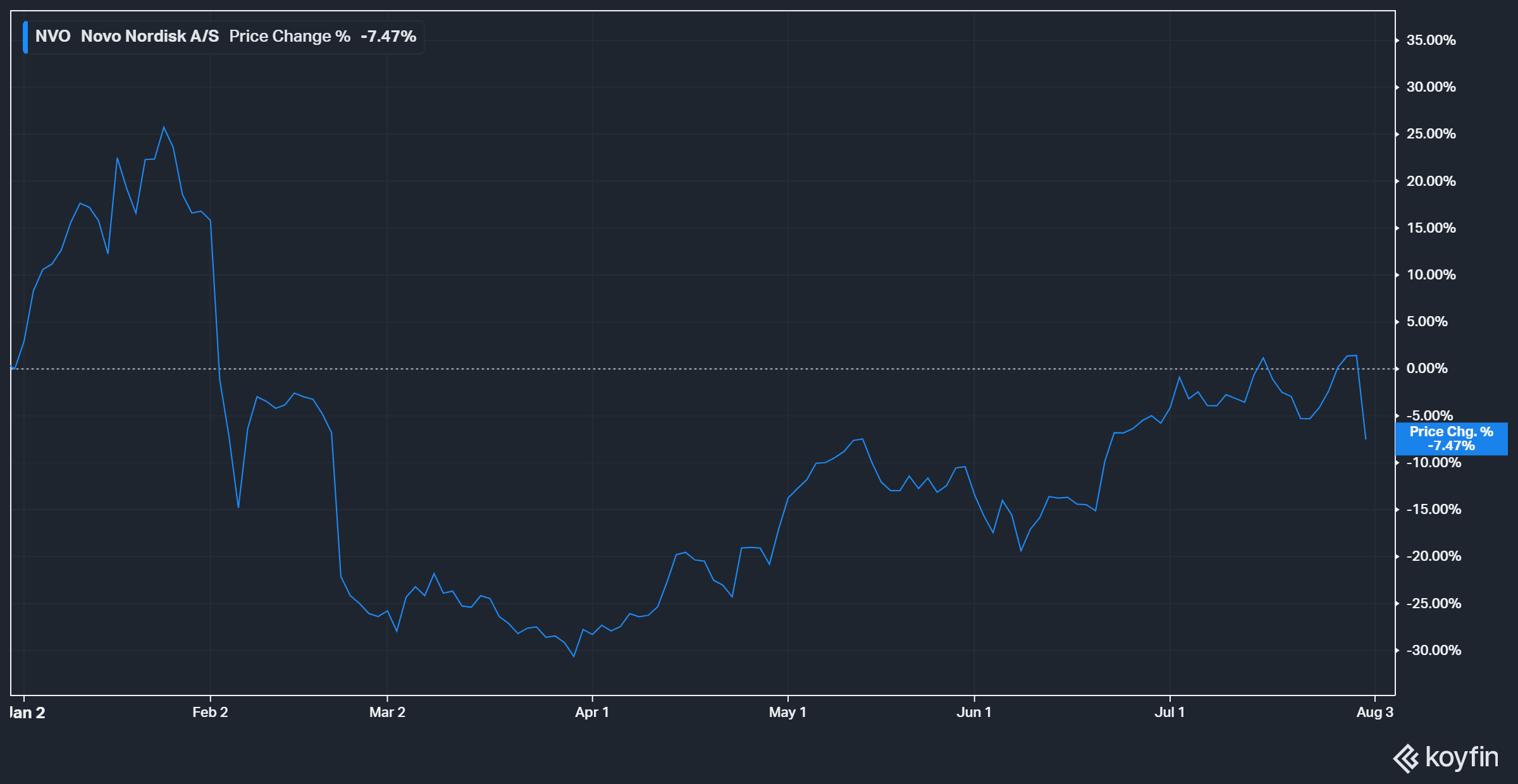
NVO has been volatile in 2026. After sharp declines earlier in the year following the cautious full-year outlook, shares recovered ground through mid-year. The core GLP-1 business, including Wegovy volume growth and oral uptake, remains the primary support, even as pipeline diversification faces hurdles.
The company’s own buybacks have helped underpin the shares during periods of pressure. The Board approved a program of up to around $2.3 billion (DKK 15 billion) to run over the 12 months beginning February 4, 2026. By July 24, 2026, the company had already repurchased roughly 25.9 million B shares for a total of around $1.10 billion (DKK 7.16 billion).
Upcoming Catalysts
Investors are now awaiting several near-term events.
Novo is scheduled to report second-quarter results around early August. According to data from Fiscal AI, the company is expected to report revenue of DKK71.5 billion for the June quarter, down from DKK76.9 billion a year ago. Earnings per share are expected to come in at DKK5.04, below the DKK5.96 reported in the corresponding quarter of 2025.
Commercial rollout of the oral Wegovy in additional European markets and higher-dose formulations could also provide volume upside in the second half.
Pipeline progress on CagriSema, a semaglutide-cagrilintide combination showing strong weight-loss and glycemic data in prior trials, remains a key focus, with regulatory pathways advancing. Remaining ziltivekimab readouts in 2027 and potential business development deals for new therapeutic areas will also shape the longer-term narrative.
How Did NVO Retail Traders React?
On Stocktwits, retail sentiment around NVO stock rose from ‘neutral’ a month ago to ‘extremely bullish, while retail chatter stayed at ‘high’ levels.
NVO stock has fallen 7% year-to-date.
For updates and corrections, email newsroom[at]stocktwits[dot]com.<
Exchange Rate: DKK1=$0.15<