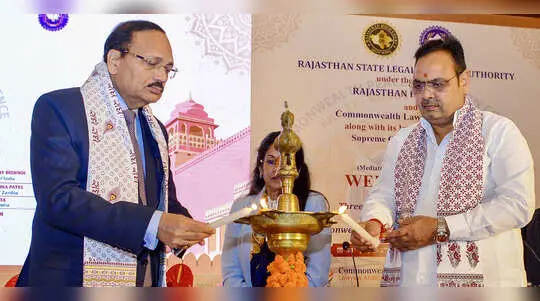
Chief Justice of India (CJI) on Friday cautioned against leaving online mediation entirely to artificial intelligence, saying AI may carry a human voice but cannot display “human empathy and apology”.
He said that online mediation should be conducted predominantly by trained mediators.
Addressing the inaugural session of the Commonwealth Peace Mediation Conference 2026 in Jaipur, the CJI said technology and online dispute resolution could help extend mediation services to the remotest corners of the Commonwealth but human intervention would remain indispensable.
“I welcome that pragmatic idea, but with one caution that you can effectively address through your software mechanism. Online mediation may not be left entirely to AI-based software.
“They may carry a human voice but won’t be able to display human empathy and apology. I recommend that online mediation should be conducted predominantly by trained mediators only,” he said. The CJI also said that mediation should no longer be viewed as subordinate to litigation.
“Mediation must no longer be treated as a lesser cousin of litigation, waiting outside the courtroom for its turn,” he said.
“It has earned, through the persistence of practitioners like many of you and also now with the statutory backup of the Mediation Act, a seat at the same table as the court. The two are not competitors; they are complimentary to each other,” he added.
CJI on Courts and Mediation
Describing the relationship between courts and mediation, Chief Justice Kant said, “The court gives us certainty, precedent, and the final word when all else fails. Mediation gives us the space to write our own ending, before the last word ever needs to be spoken.” He said peace and the rule of law should not be viewed as opposing concepts.
“Peace is not the absence of law. Peace is one of law’s finest achievements,” he said.
He said that despite mediation being applied across a wide range of disputes, from neighbourhood disagreements to international conflicts, the fundamental principles remained unchanged.
“Somebody has to listen more than they speak. Somebody has to translate anger into interest, and interest into an option that both sides can live with,” the CJI said.
He said that mediation is not a soft skill but one of the hardest skills that the legal profession asks of anyone to learn through vigorous training and self-acquired experience.
Recalling his childhood in a village in Haryana, the CJI said disputes were often resolved through community dialogue long before the concept of Alternative Dispute Resolution became widely recognised.
“When two families quarreled… they sat under a tree with the village elders and talked until the matter was resolved. Nobody called it ‘Alternative Dispute Resolution’ in those days.
“We called it panchayat. It was mediation before the word became fashionable,” he said.
CJI on Real Test of Peace
The CJI said the real test of peace was not the signing of documents but whether relationships could endure after a dispute was resolved.
“That, to my mind, is the truest test of any peace. Not whether the paperwork is signed, but whether the neighbours can still share a cup of tea the next morning,” he said.
Justice Kant said the conference would deliberate on family, workplace, commerce, infrastructure, criminal justice, community, environmental and climate mediation, as well as global peace-building.
He expressed hope that the proposed Jaipur Declaration on Peace Mediation would become a practical document guiding legal professionals and mediators across jurisdictions.
Rajasthan High Court Acting Chief Justice SP Sharma said mediation should be used as a tool to promote social harmony and strengthen public faith in institutions.
“Over the next three days, we will deliberate on this very idea,” he said.
Sharma also said the modern legal system should not only deliver justice but also ensure the participation of people at the grassroots.
Union Minister of State for Law Arjun Ram Meghwal, Chief Minister Bhajanlal Sharma and Zambia Supreme Court Judge Abha Nayar Patel also attended the programme.
The three-day conference, which will conclude on August 2, is being organised by the Rajasthan State Legal Services Authority (RSLSA) to promote mediation as an effective mechanism for dispute resolution.
Representatives from 52 Commonwealth countries are participating in the event.