As geopolitical tensions continue to reshape the global order, New Delhi is preparing to host one of its most significant diplomatic gatherings in recent years, with Chinese President Xi Jinping and on September 12-13.
The summit, to be hosted under India’s BRICS chairmanship, is expected to bring together leaders of the expanded grouping at a time when conflicts in Ukraine and West Asia, shifting global trade dynamics and intensifying strategic competition among major powers are dominating the international agenda.
Putin’s participation has already been confirmed by the Kremlin. Kremlin aide Yury Ushakov said the Russian leader will travel to New Delhi for the two-day summit, marking his second visit to India in less than a year after attending the 23rd India-Russia Annual Summit in December 2025. Russian officials have also indicated that a bilateral meeting between Putin and Xi is planned on the sidelines of the summit.
According to media reports, Xi’s visit, while yet to be officially announced by Beijing, is widely expected after diplomatic exchanges between New Delhi and Beijing. If the visit materialises, it will be Xi’s first trip to India since the informal summit at Mamallapuram in October 2019, preceding the military standoff along the Line of Actual Control and the deadly Galwan Valley clashes in 2020 that plunged bilateral ties to their lowest point in decades.
During the summit, meetings between Xi, Putin and Indian Prime Minister Narendra Modi are also anticipated in September. The meeting comes at a crucial time amid ongoing conflicts in the Gulf involving the US, Israel and Iran and the prolonged war between Russia and Ukraine.
When the three leaders meet last and what were the outcomes
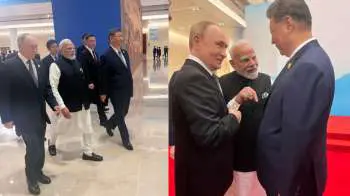
This will also mark the first meeting of PM Modi, Putin and Jinping since they came together on the sidelines of the Shanghai Cooperation Organisation (SCO) Summit in Tianjin in 2025.
During the SCO summit, the three leaders exchanged views amid a gradual thaw in India-China ties following progress in border disengagement, while Modi and Putin reviewed the India-Russia strategic partnership.
Modi and Xi agreed to sustain high-level dialogue, improve people-to-people exchanges and work towards stable bilateral ties despite unresolved boundary issues. The SCO leaders also adopted the Tianjin Declaration, reaffirming their commitment to strengthening regional security, expanding economic cooperation, improving connectivity and jointly combating terrorism, extremism and separatism.
India at centre stage, key issues at hand
The possibility of Xi’s visit comes after gradual efforts by both countries to stabilise relations following military disengagement at several friction points and renewed diplomatic dialogue. While the boundary dispute remains unresolved, officials from both sides have resumed high-level engagements, signalling a cautious attempt to rebuild ties without compromising their respective strategic positions.
India’s hosting of both Putin and Xi carries significance beyond bilateral diplomacy. As chair of the expanded BRICS grouping, New Delhi is expected to steer discussions on reforming global governance institutions, strengthening cooperation among emerging economies, enhancing the use of local currencies in trade, improving development financing and advancing the priorities of the Global South.
The summit will also provide an opportunity for leaders to exchange views on ongoing conflicts, energy security, supply chains and the evolving international economic landscape.
The expanded BRICS now comprises Brazil, Russia, India, China, South Africa, Egypt, Ethiopia, Iran, the United Arab Emirates and Indonesia, making it one of the world’s largest geopolitical and economic groupings by population and share of global GDP.
With two of the world’s most influential leaders expected in New Delhi amid heightened global uncertainty, the September summit is likely to be closely watched for both its diplomatic optics and any substantive outcomes on international security, economic cooperation and India’s growing role as a bridge between competing global power centres.