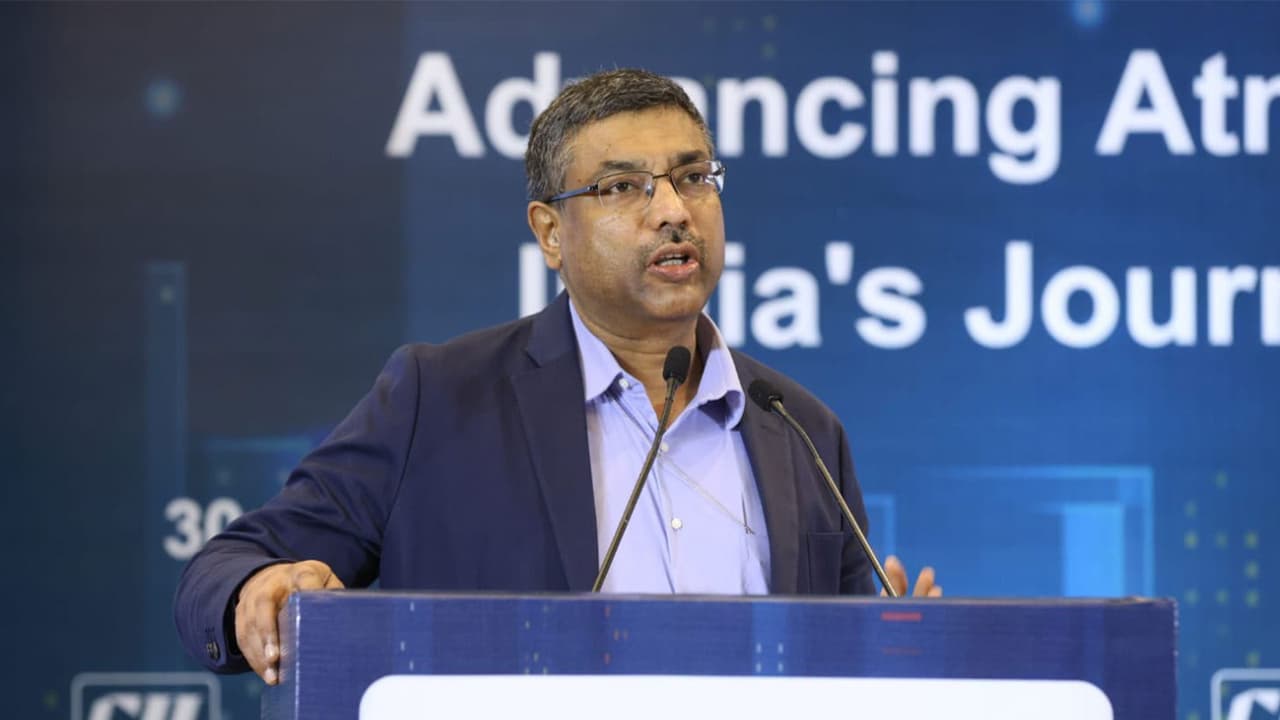
MeitY Secretary S Krishnan announced the launch of India Semiconductor Mission 2.0 with a Rs 1,27,500 crore outlay, calling 2026 a turning point. Three semiconductor units are in production, with more projects in the pipeline.
India’s semiconductor sector is entering a “landmark year,” with the government formally rolling out the India Semiconductor Mission 2.0, backed by an outlay of Rs 1,27,500 crore, S Krishnan, Secretary, Ministry of Electronics and Information Technology (MeitY), said while speaking at the CII Conference on Advancing Atmanirbharta in Semiconductor Design and Manufacturing.
Turning Point for Indian Semiconductors
Describing 2026 as a turning point for the industry, Krishnan noted that Prime Minister Narendra Modi has already inaugurated three semiconductor units — Micron’s facility and Tata’s plant at Sanand, along with CG Power, all of which have moved into commercial production. Two more units are expected to go on stream before the end of the year, while 12 additional projects approved under the India Semiconductor Mission are in the pipeline. Of the 24 companies approved under the Design Linked Incentive (DLI) scheme in ISM 1.0, 15 have already raised venture capital funding, he said.
Government Backing and Program Scope
Krishnan revealed that the Union Cabinet, roughly two days prior, had cleared two major MeitY programmes ISM 2.0 and the mobile phone manufacturing scheme, together amounting to Rs 1.90 lakh crore, calling it a reflection of “a very deep commitment” from the government after extensive internal deliberation and industry consultation.
Key Focus Areas of ISM 2.0
Krishnan said the establishment of fabs, ATMPs (Assembly, Testing, Marking and Packaging) and OSATs (Outsourced Semiconductor Assembly and Test) will continue to be central to ISM 2.0. Building on the three fabs currently under construction from ISM 1.0, the government hopes to add four to five more, including a logic fab, a memory fab, a display fab, and two to three compound semiconductor fabs. Advanced packaging, he added, will also remain a key focus area, given eight units are already coming up under ISM 1.0, three of which are already in production.
The biggest differentiator from ISM 1.0, Krishnan said, is a broader “ecosystem approach” covering equipment, materials, gases and chemicals aimed at drawing a wider cross-section of Indian industry into the sector, including precision manufacturing and high-purity chemical production, in partnership with countries such as Japan.
Addressing R&D and Skilling Gaps
On research and development, Krishnan said the government has studied global models including Europe’s IMEC, the US Center for Semiconductor Research in Albany, and Singapore’s A*STAR, to shape India’s own R&D ecosystem. He explained that the current focus on mature, legacy chip technology reflects both cost considerations and India’s early stage in semiconductor manufacturing, with plans to move up the value chain over time.
Skilling remains a critical gap, Krishnan said, noting that while India holds 20 per cent of the global semiconductor design workforce, it lacks sufficient experienced manpower for fab and ATMP operations an area the government intends to ramp up rapidly.
Restructured Design and Supply Chain Strategy
On the design front, Krishnan announced that the restructured DLI scheme under ISM 2.0 will, for the first time, open eligibility to larger companies beyond startups and MSMEs, given that the earlier Rs 50 crore support cap was insufficient for viable chip design. A new co-investment mechanism will allow government funding to crowd in venture capital and private equity financing, with market mechanisms, not government selection, determining which companies receive support.
Citing the example of CCTV camera manufacturing, where security concerns over foreign chip components prompted new sourcing restrictions, Krishnan said two DLI-supported companies are now making chips for CCTV systems in partnership with Indian manufacturers, a model the government hopes to replicate in other sensitive segments, alongside efforts to build end-to-end trusted supply chains.
A Long-Term Vision
Krishnan cautioned that global semiconductor leaders like Taiwan built their industry over roughly six decades, while India’s focused push is barely five years old. He said sustained government-industry collaboration over the next decade to fifteen years will be essential for India to become a serious player in the space.
He concluded by inviting industry stakeholders to reconvene at Semicon India in September, where further details of ISM 2.0 are expected to be showcased alongside updates on newly inaugurated units. (ANI)
(Except for the headline, this story has not been edited by Asianetnews Editorial staff and is published from a syndicated feed.)