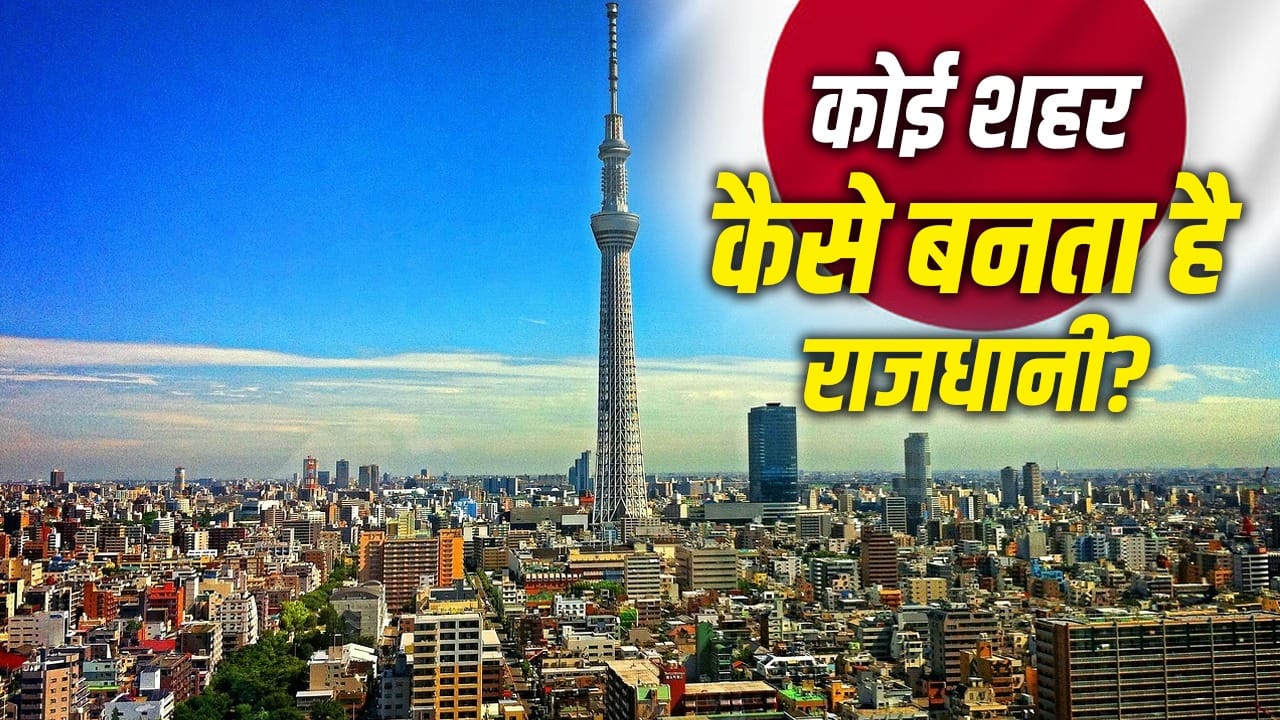
Japan has taken a big step towards building a second capital. For this, Parliament has approved a legal framework. This does not mean that Tokyo’s capital status will be lost. Tokyo will remain the main capital of Japan in future also. But in any major crisis, another city will be able to handle the government and administration of the country. This decision is not just about changing buildings or cities. This is an issue related to disaster management, economy, population and political balance.
Let us understand with the help of this new initiative started in Japan, how does a city become the capital? Why does Japan need a second capital? Which cities are involved in this race?
What is a capital after all?
The capital is the city where the main political system of the country works. Normally Parliament is held there. There is the office of the Prime Minister or the President. Big ministries and central administration are also located in the capital. The capital is not just the address of the government. It is also the center of power, identity and decision making of the country. However, the model of capital is not the same in every country. In some countries a single city handles all the work. In some places the administrative and economic centers are separate. South Africa is an example of this. There, legislative, judicial and administrative roles are divided in different cities. Therefore becoming the capital is not just a matter of history or tradition. This is also decided by administrative need and national strategy.
There are many reasons behind choosing a city as the capital. The first reason is political importance. The city may be close to the ruling class, parliament, or the center of historical power. The second is geographical location. If the city is in the middle of the country, has easy access and has better security, then its claim becomes stronger. Another strong reason is infrastructure.
The capital needs good road networks, railways, airports, communication systems, hospitals, offices and housing. Thousands of government employees have to work. The capital needs the support of large-scale financial and business infrastructure. Banks, companies, data networks and communication systems are also important. The government must continue to function even during times of war, earthquake, flood, sea storm or any major crisis, hence disaster risk has become a big parameter in the modern era.
Which four cities or regions are in the race?
There are four major contender cities in the race for the second capital. These include Osaka, Fukuoka, Aichi-Nagoya and Sapporo.
Osaka: Second largest economic center after Tokyo
This is considered to be at the forefront. It is the second largest metropolitan area in Japan after Tokyo. It is also a big economic centre. Osaka has a strong transportation network. There are big industries, companies, universities and government offices here. The administrative and economic size of the city makes it a natural contender. Osaka also faces a big challenge. According to a government seismological assessment, about one-third of Osaka’s land could be flooded in the event of a major earthquake.

Osaka.
Fukuoka: disaster risk lower than Tokyo
This city is located in the south-west part of Japan. It is also an important city in terms of trade and contacts with other parts of Asia. The Governor of Fukuoka has talked about making a claim at the level of the entire province. Preparations are being made there by involving local bodies and the business community. The advantage of Fukuoka is that it is far from Tokyo. Therefore, the possibility of the same disaster affecting both cities simultaneously may be reduced. But it will have to prove that it has a large enough government structure to run the central administration.

Fukuoka.
Aichi and Nagoya: counting among Japan’s major industrial areas
Aichi Prefecture and its main city Nagoya are also in the running. It is counted among the major industrial areas of Japan. Activities related to manufacturing, automobile and supply chain are strong here. The governor of Aichi has claimed that Nagoya and the surrounding area have all the facilities needed for a second capital. Nagoya’s location is relatively central on the main island of Japan. This can make access to different parts of the country easier. Its economic strength is also great. Nevertheless, not only the industry but also disaster risk and government operational capacity will be important in the selection.

Sapporo is in the northern island of Hokkaido.
Sapporo: distance from Tokyo big side
It is in Hokkaido, the northern island of Japan. This is the most geographically diverse option among the contenders. The biggest argument in favor of Sapporo is distance. If a disaster like an earthquake or tsunami occurs in Tokyo, it may be less likely to have the same impact on Hokkaido. There are already many branch offices of the central government in the Hokkaido region. The officials there argue that there is already some understanding and arrangement in the government system. But the challenge of Sapporo is also clear. It is away from the main political and business centers of the country. Cold weather and distance can make emergency operations difficult.
Will Tokyo’s power diminish?
The chances of this happening immediately are less. Tokyo will remain the main political and economic center of Japan. But in the long run, a part of the investment may go to other cities. New government offices, technology centers, transportation projects and companies may expand in other areas. With this, Japan’s economy can become more balanced.
In this way, it can be said that the plan for Japan’s second capital is a preparation for the future. Its main goal is not to remove Tokyo but to ensure that the country’s government continues to function after any major disaster. Osaka, Fukuoka, Nagoya and Sapporo all have their own strengths. The final decision will depend on disaster safety, administrative capacity, economic size and political consensus.

Tokyo, the capital of Japan.
Why is Tokyo so important in Japan?
Tokyo is the political, economic and administrative center of Japan. Parliament, Prime Minister’s Office, ministries and big financial institutions are located here. The presence of the world’s biggest companies, banks and media organizations also makes Tokyo very powerful, but this strength is also a risk. When too much government and economic activity is concentrated in a single city, a disaster can affect the entire country.
Tokyo generates about one-fifth of Japan’s economic output. About 30 percent of the country’s population lives in the capital region. If Tokyo is unable to function for a long time, government, business, transportation, banking and communications could be seriously affected.

The recent earthquake in Japan caused devastation.
Why did Japan need a second capital?
Japan is known for earthquakes. This country is situated around several tectonic plates. Therefore there remains a danger of earthquake and tsunami here. The Japanese government’s concern is that a major earthquake in the Tokyo metropolitan area could bring the country’s administration to a halt.
According to an assessment, the probability of a magnitude 7 earthquake in the Tokyo area in the next 30 years is considered to be about 70 percent. If this happens, the Prime Minister’s Office, Parliament, ministries and financial institutions may be affected. Electricity, internet, roads and communication services may also be disrupted. That is why Japan is looking for a city or region that can act as a backup in case of emergency. From there important decisions of the government can be taken. Some ministries can function. There should be continuity of national administration.
What will happen in the new system?
The law passed by Japan does not directly declare any one city as the second capital. It only sets the process and structure of selection. States or provinces can present their claims. They have to show that their area is relatively safe from disasters. There is adequate government infrastructure there. Has economic potential. Population and administrative resources are also sufficient.
The area selected should be capable of becoming a center of political, administrative and economic activities in times of crisis. This does not mean that all ministries or parliament will immediately withdraw from Tokyo. Initially some offices, data systems, disaster-control centers and administrative facilities can be developed.
Also read: How does the warning system alert seconds before an earthquake in Japan?