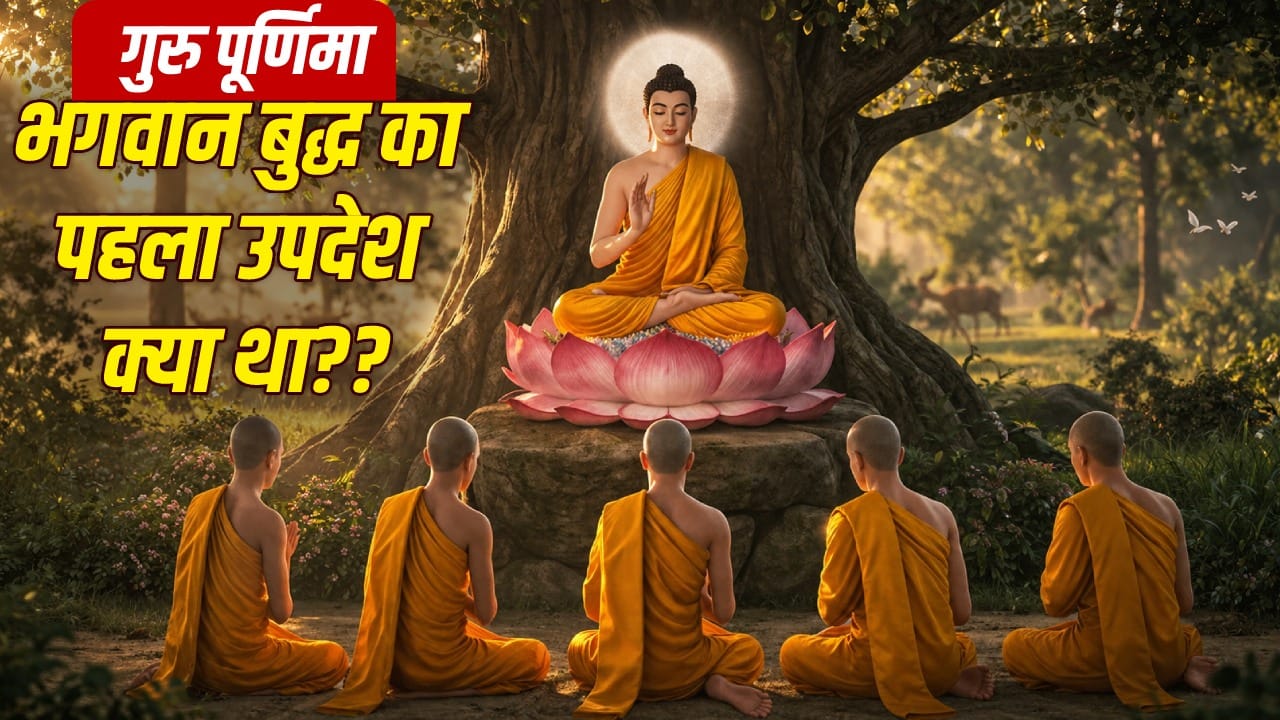
Guru Purnima has special significance in Buddhist tradition.Image Credit source: AI Generated
The festival of Guru Purnima is being celebrated today (29th July). This festival is included in every religion in some form or the other. This is a festival of India’s ancient knowledge tradition. This day gives an opportunity for respect, gratitude and introspection towards the Guru. In Hindu tradition it is also called Vyas Purnima. Maharishi Vedvyas is remembered on this day. He is linked with the compilation of Vedas and the composition of Mahabharata.
Let us understand in the name of Guru Purnima how the first sermon of Buddha in Sarnath laid the foundation of Guru Purnima in Buddhism? What did he say in his sermon? How is this day celebrated in Buddhism, what is the importance of Guru Purnima in other religions?
Lord Buddha gave his first sermon on this day
This full moon has special significance in Buddhist tradition also. On this day Lord Buddha gave his first sermon. This incident happened in Sarnath. At that time Sarnath was called Rishipattan or Mrigadaya. This first sermon of the Buddha is called Dhammacaccakappavattana Sutta. Its meaning is to speed up the cycle of religion. Therefore Guru Purnima is not just a day of Guru-worship. This is also a day to put knowledge into practice. The Sarnath incident established Buddha as a great teacher, guide and compassionate guru.
Therefore it was decided to show people the right path
Prince Siddhartha saw sorrow, disease, old age and death in his life. These experiences disturbed him from within. He abandoned the palace, family and comforts. He set out in search of truth. He performed rigorous penance for many years, but he understood that knowledge is not attained by merely torturing the body. After this he adopted the path of a balanced life. He attained enlightenment while meditating under the Peepal tree in Bodh Gaya. After this he was called Buddha. After attaining enlightenment, Buddha first wanted to remain silent for some time. He felt that the truth was very deep. People won’t understand this. Then out of compassion he decided to show the path to the people.

Lord Buddha preached to his five companions in Sarnath. Photo: AI Generated
First sermon in Sarnath
Buddha reached Sarnath in search of his five old ascetic companions. There he preached to five of his former companions. These five monks were Kaundinya, Bhaddiya, Vappa, Mahanam and Assaji. Earlier he was angry with Buddha. They felt that Siddhartha had given up penance. But he was impressed after seeing the calm personality and brilliance of Buddha. Buddha told him that two extremes should be avoided in life.
The first extreme is to indulge in sensual pleasures and the second is to cause unnecessary pain to the body. Buddha said that both the paths are not right. He suggested a balanced path. This was called the middle path. This path later became the basic teaching of Buddhism. Kaundinya first understood the teachings of Buddha. He is considered the first monk in the Buddhist tradition. In this way the Buddhist Sangha was also started in Sarnath.
What are the four noble truths?
The most important part of the Buddha’s first sermon is the Four Noble Truths. They teach us to understand life and sorrow.
- First Noble Truth: There is sadness in life. Birth, illness, old age, death, separation and non-fulfillment of desires cause sorrow.
- Second Noble Truth: The cause of suffering is thirst. Trishna means excessive desire, greed and attachment. We want to hold on to things, people, position and pleasures. This increases suffering.
- Third Noble Truth: An end to suffering is possible. When craving ends, the mind finds peace. This state has been called Nirvana.
- Fourth Noble Truth: There is a way to end suffering. This is called the eightfold path. This is the path of right thoughts, right conduct and right way of life.

The Sarnath incident established Buddha as a great teacher, guide and compassionate guru. Photo: Pexels
What is the teaching of the Eightfold Path?
Buddha described the Eightfold Path as a practical path of life. This includes a total of eight things.
- One: Right vision. It means looking at life with the right understanding.
- Two: Right resolution means having compassion, non-violence and good thoughts in the mind.
- Three: Right speech. Avoiding lies, harsh words and backbiting.
- Four: Right action means doing such work which does not harm anyone.
- Five: Right livelihood means living with honesty and morality.
- Six: Due efforts. To give up bad habits and increase good qualities.
- Seven: Right memory. Be conscious of your thoughts, words and actions.
- Eight: Right Samadhi. To stabilize and calm the mind through meditation.
These teachings given by Lord Buddha are useful even today. They show a person the path of restraint, peace and responsibility.
How was the foundation of Guru Purnima laid?
Guru Purnima is mainly associated with Maharishi Vedvyas in Hindu tradition. Therefore it is also called Vyas Purnima. But in the Buddhist world this day is considered very sacred because of the first sermon of Buddha. In Sarnath, Buddha did not limit his knowledge to himself. He passed it on to his disciples. He did not just say religious things. He told the practical path to be free from suffering. For this reason he is a great guru for Buddhists.
It is more appropriate to say that the first sermon at Sarnath deepened the spiritual meaning of Guru Purnima. This incident established the Guru as the giver of knowledge, the remover of ignorance and the one who shows the right path of life. Buddha’s message was that Guru is not respected merely by offering flowers. True faith is to adopt the teachings of Guru in life.
Celebration of Guru Purnima in Buddhism
In the Buddhist community, this day is remembered at many places as Dhamma Day or Dharmachakra Pravartana Day. Sarnath is the main center of this occasion in India. Here devotees visit Dhammekha Stupa and other Buddhist sites. People light lamps in front of the Buddha statue. Offer flowers. Let us remember the three gems. Triratna means Buddha, Dhamma and Sangha. On this day, Buddhist monks recite Dhammachakkappavattana Sutta. People listen to Buddha’s teachings. Let’s meditate. Let’s take a pledge of compassion, non-violence and truth. Collective prayers are held in many monasteries. Food, clothing or other assistance is given to the needy. Donation is considered an act of virtue. Some people take a special pledge to stay away from non-vegetarian food, intoxication and violence. Monks and nuns also discuss the importance of discipline, study and service on this day.
Guru Purnima in Hinduism
Guru Purnima has great significance in Hindu religion. It is dedicated to Maharishi Vedvyas. He is considered a great teacher of the Indian knowledge tradition. On this day students respect their teachers and spiritual leaders. Guru puja takes place in ashrams and temples. People touch the feet. Let’s take blessings. Religious texts are recited. Many people start new study, meditation or self-study from this day. In Hindu tradition, Guru is considered to take one from ignorance to knowledge. Guru awakens wisdom, humility and right vision within the person.
What is the importance of Guru in Jainism and Sikhism?
Guru’s position is very high in Jainism also. Jain monks, sadhus and acharyas show the path of religion. They teach restraint, non-violence, truth and self-purification. On the occasion of Guru Purnima, many Jain families listen to religious sermons and pay respect to their gurus. Even in Sikhism, the importance of Guru is paramount. In the Sikh tradition, after the ten human Gurus, Guru Granth Sahib is considered the eternal Guru. Guru means to lead life towards truth, service, equality and devotion to God. Many spiritual traditions of India agree that the path to knowledge becomes easier with the guidance of a Guru. The Guru does not just give information to the person. It gives perspective on life.
In simple words, the most beautiful message of Guru Purnima is to gain knowledge, be humble and make the lives of others better with that knowledge. This is the message of Buddha of Sarnath. This is the true tribute to the Guru.
Also read:What is the fire cloud, which increased the danger after the fire in France?