Japan’s early warning system alerts seconds before an earthquake.
Earthquakes are common in Japan. Recently an earthquake of 7.1 magnitude occurred there. A tsunami warning has been issued there. If it had been any other country, an earthquake of this intensity would have caused devastation, but this does not happen often in Japan. Japan, which faces about two thousand earthquakes every year, has now almost conquered it. This country has developed such technology which provides warning before an earthquake occurs. People become alert. Or we can also say that Japan has developed a complete eco-system to deal with earthquakes, which includes everything from technology to vigilance.
Come, let us understand the story of Japan’s earthquake warning system, how does the alert reach a few seconds before the earthquake? How does the bullet train stop automatically?
Why is the earthquake risk so great in Japan?
Japan is situated on the banks of the Pacific Ocean. Here many tectonic plates of the Earth meet each other. These plates create constant pressure. Sometimes this pressure breaks suddenly. Then a strong earthquake occurs. One and a half to two thousand earthquakes are felt here every year. Meaning we face earthquakes every day. Happens many times. Japan has seen many devastating earthquakes in history. The Kanto earthquake of 1923 killed more than a million people in the Tokyo area. Thousands of people were killed in the 1995 Kobe earthquake. More than 18 thousand people lost their lives in the 2011 Tohoku earthquake and tsunami. After this incident, Japan further strengthened its disaster preparedness.

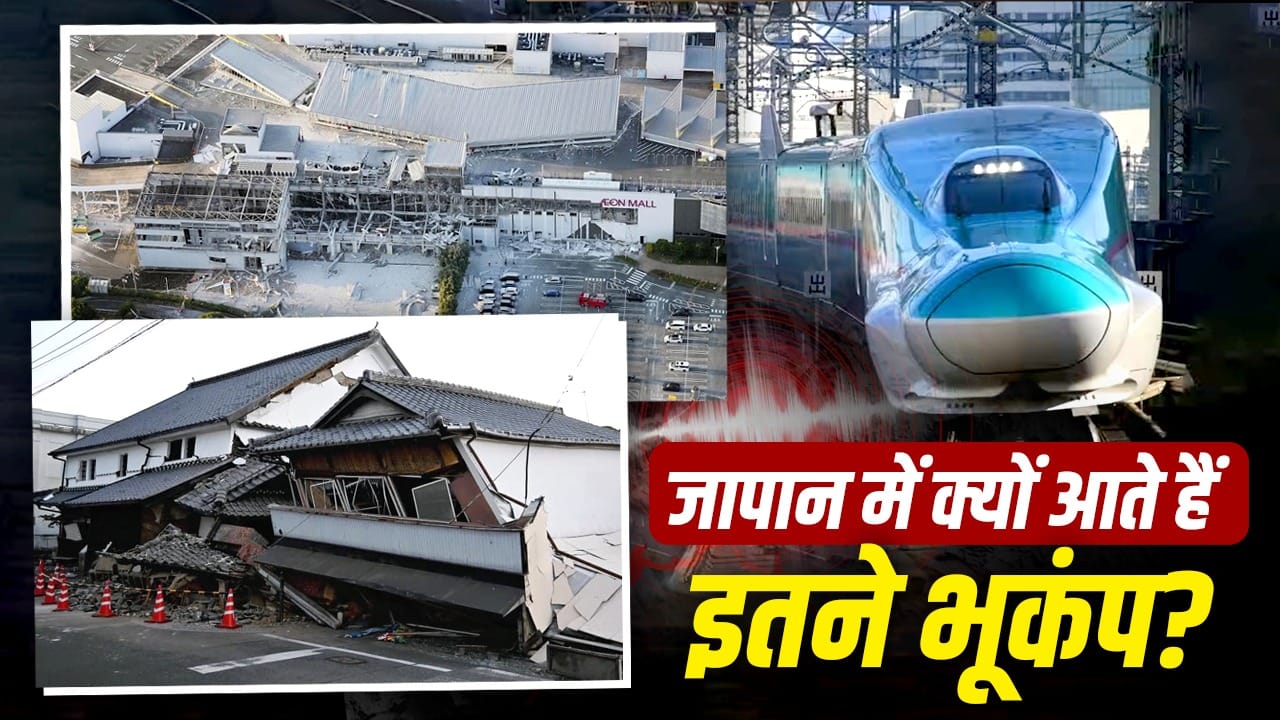
Mall collapsed in Japan.
How does the warning system work?
During an earthquake, different types of waves emerge from the earth. The wave that reaches first is called P-wave. It moves relatively fast. Generally its shock is less. After this come S-wave and surface waves. These can cause more harm. Buildings shake a lot. Items may fall. Railway tracks may shake. This is the most dangerous time.
Japan’s weather agency and related organizations have installed highly sensitive sensors across the country. These sensors also record slight vibrations of the ground. As multiple sensors capture the P-wave, computers rapidly analyze the data. The system tries to understand where earthquakes are active. What can be its intensity? Which cities are going to be hit by strong tremors? After this the warning is sent through TV, radio, mobile phones, public loudspeakers and digital networks.
How does the alert reach people so fast?
In Japan, a warning is not just a message. It is sent simultaneously through several mediums. A loud alarm may sound on the mobile phone. Warnings may be shown between TV programs. The message can be played on the radio. Announcements can be made at railway stations and schools. Alerts generally ask people to take immediate precautions. Like, save the head. Go under the sturdy table. Step away from the window. Stay away from sources of gas or fire. If you are outside, stay away from walls and electric poles. But not every person gets equal time. In places which are very close to the epicenter of the earthquake, strong tremors can occur even before the alert. People in distant cities may get a few seconds or sometimes more. So this is not a prediction. This is an immediate warning sent after the earthquake starts, before the strong shock reaches.
🇯🇵 More than 50 people were injured in one of the prefectures on Kyushu Island in Japan after powerful 7,1 earthquakes
Japanese Prime Minister Sanae Takaichi reported that the tremors caused fires, damage to roads and bridges, as well as the collapse of buildings.
nhk reported pic.twitter.com/hTFjhdZPl1
— Visegrád 24 (@visegrád24) July 28, 2026
How does the bullet train stop automatically?
Japan’s Shinkansen bullet train runs very fast. Its speed can exceed 200 kilometers per hour on many routes. A sudden earthquake can become a big risk for such a fast train. That is why the rail network has been linked to the earthquake warning system. Sensors have been installed in and around the railway line. When sensors detect initial seismic waves, the system sends a signal to the train control center. After this the power supply can be controlled. The train driver gets a warning. The automatic braking system gets activated in many situations. The train does not stop completely immediately, because a high-speed train needs distance to stop, but it starts slowing down rapidly.
This system reduces the possibility of accident. The train may be slowed down before reaching a bridge, tunnel, turn or weak point. After an earthquake, railway tracks, power lines and bridges are inspected. Many times the service is stopped until the investigation is completed.
Not just the train, preparation of the entire society
In Japan, warning systems are not used only for railways. In many factories, heavy machines can shut down automatically. Employees in hospitals get alerts. Children practice regularly in schools. There is a safe evacuation plan in offices. There is security system in the lift also. Many elevators try to stop at the nearest floor at the signal of an earthquake. Special rules have been made to ensure that people do not get trapped. Even at home, emphasis is laid on preparation. The shelves are attached to the wall. Heavy TVs and furniture are secured. An emergency bag is kept ready. Water, dry food, torch, medicines and important documents can be kept in it.
What should be done after receiving the warning?
One should not panic after hearing the alert. It is not always a good idea to run out. The head and neck should be protected first. If you’re in a room, duck under a sturdy table. Stay away from windows, glass and high shelves. If you are on a train, follow the instructions of the staff. If you are on the road, stop the vehicle at a safe place. Keep distance from bridges, tunnels, electric wires and high walls. If you are near a beach and feel a strong earthquake, pay attention to tsunami warnings. Go towards higher and safe place. These precautions can be useful not only in Japan but in any country.
Along with technology, awareness is also important
Japan’s system is an important example for the world. But technology alone cannot save every life. Sensors can send warnings. Can stop the train. Machines can be shut down. But people should also know what to do after the alert. Proper response, strong buildings, regular drills and reliable information systems are essential during earthquakes. Japan has understood that disaster cannot be completely prevented, but its impact can definitely be reduced. This is the real strength of the earthquake warning system. It buys a few seconds and many times, those few seconds become the difference between life and death.
Also read: What is fire cloud, which increased the danger after the fire in France?