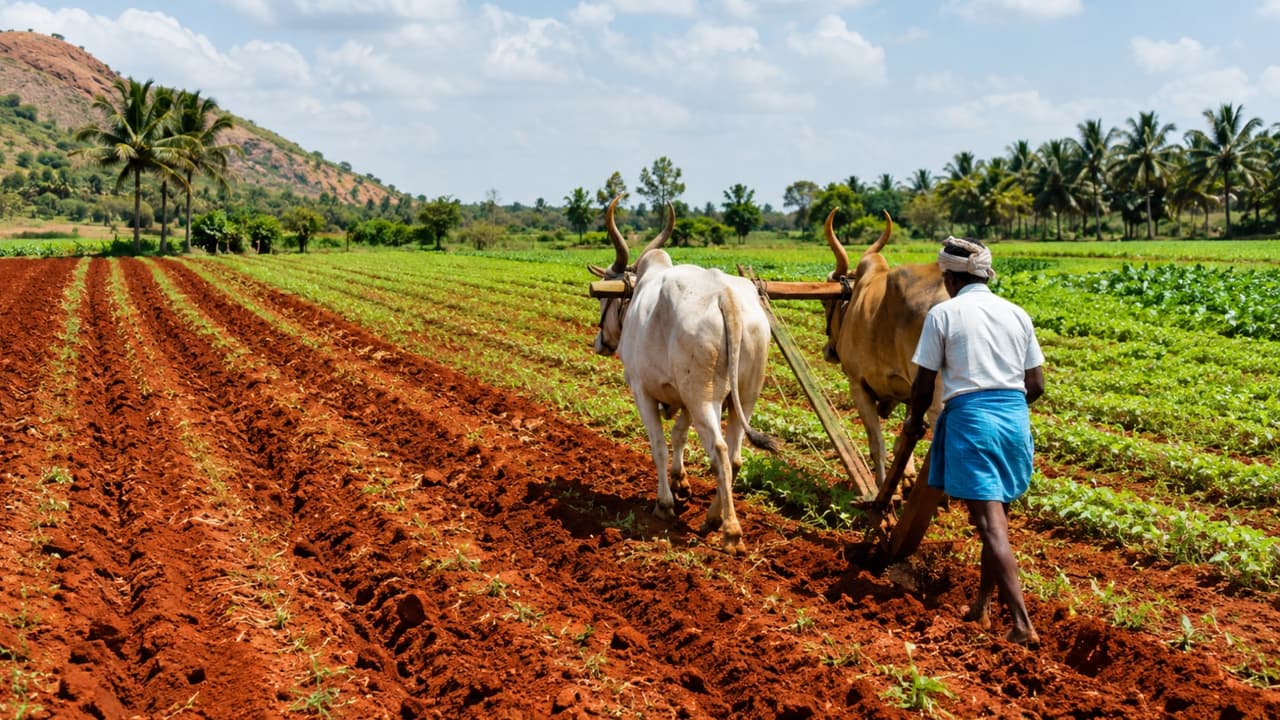
Crops in Red Soil: Do you know which crops grow best in red soil? Know its specialty. Which crops give bumper production and which mistakes should be avoided? Where is red soil found?
Red Soil Farming: Farming in India largely depends on the quality of the soil. Different types of soil are found in different parts of the country, such as black soil, alluvial soil, laterite soil and red soil. Among these, red soil is one of the best soils. Let us know which crop is best in red soil? Red soil drains water quickly and has few nutrients. Therefore, such crops are good in this, which require less water.
What is red soil?
The color of red soil appears red due to the high amount of iron oxide. This soil is usually formed by the breakdown of rocks like granite and gneiss. This soil is mainly found in Tamil Nadu, Karnataka, Andhra Pradesh, Telangana, Odisha, Chhattisgarh, Jharkhand, parts of Maharashtra and Madhya Pradesh.
What is the specialty of red soil?
- It absorbs water quickly and also drains out quickly.
- It contains less nitrogen, phosphorus and organic matter.
- Potash and iron are available in abundance.
- Good yield is achieved when proper fertilizer and irrigation are provided.
Which crops grow well in red soil?
1. Groundnut
Red soil is considered best for groundnut cultivation. Water does not stagnate in this soil, due to which there is less risk of the peanut roots rotting. Groundnut is grown on a large scale on red soils in many southern states of India.
2. Millet and Jowar
Coarse grains like millet and jowar give good yields even with less water. Therefore red soil is better for them. Today, when coarse grains are being called “superfoods”, the importance of their cultivation has increased further.
3. Pulses
Cultivation of pulses like arhar (tur), moong, urad and gram is also good in red soil. If there is a good drainage system in the field then the quality of these crops remains better.
4. Cotton
Where the red soil is slightly deeper and fertile, cotton is also cultivated. Although black soil is better for cotton, in many areas red soil also gives good results.
5. Oilseeds
Apart from groundnut, oilseed crops like sesame and sunflower also grow well in red soil.
6. Fruits and Gardening
If there is irrigation facility, many fruit plants can also be planted in red soil. As –
- Mango
- Guava
- Orange
- Grape
- Cashew
In South India, cashew plantations are found in large numbers in areas with red soil.
Read this also- Why are lemon and chillies hung on shops and vehicles?
Can paddy and wheat also grow?
Yes, but for this adequate irrigation and fertilizers are necessary. Paddy needs more water, whereas red soil releases water quickly. Therefore, without good irrigation system, paddy cultivation can be difficult.
How can the yield of red soil be increased?
- Apply organic fertilizer or cow dung manure in the field.
- Make up for the deficiency of nitrogen and phosphorus with fertilizers.
- Adopt crop rotation.
- Store rain water.
- Get soil testing done and give nutrients accordingly.
Read this also- Why are there white and yellow lines on the road?
Some facts about red soil…
- According to the Indian Council of Agricultural Research (ICAR), about 18% of the total geographical area of India is covered with red and yellow soils.
- Red soil is the predominant soil type in large parts of Tamil Nadu and Karnataka, India.
- The pH of red soil generally ranges between 5.5 to 7.0, so in many places it is slightly acidic.
- The high amount of iron oxide in red soil gives it red color, but it is low in nitrogen and humus.
Content Source: Indian Council of Agricultural Research (ICAR), Indian Agricultural Research Institute (IARI), National Bureau of Soil Survey & Land Use Planning (NBSS&LUP), Food and Agriculture Organization (FAO), NCERT Geography (Class 11) – India: Physical Environment, Ministry of Agriculture & Farmers Welfare, Government of India.