Nio bought about 18.24 million CXMT shares through Nio Power Technology, with the position subject to an 18-month lockup.
- Nio’s $23 million CXMT stake was worth about $132 million at Monday’s close, implying a paper gain of more than $100 million.
- CEO William Li reportedly attended CXMT’s listing dinner, highlighting the close relationship between the two companies.
- CXMT supplies automotive-grade LPDDR4X and LPDDR5X memory used across several Nio models and supports its Shenji NX9031 chip platform.
U.S.-listed shares of Nio Inc. (NYSE) snapped a seven-day losing streak on Monday as ChangXin Memory Technologies (CXMT), China’s largest memory-chip maker, made a blockbuster market debut that lifted the value of the EV maker’s investment.
Nio’s U.S.-listed shares jumped 3% on Monday, though the stock remains on track for a third straight monthly decline.
Nio Scores Big on CXMT IPO
The rally in CXMT turned Nio’s $23 million investment into a stake worth about 894 million yuan ($132 million) at Monday’s close, creating an unrealized gain of 736 million yuan, or over $100 million. Nio founder, chairman and CEO William Li had also apparently attended CXMT’s listing appreciation dinner in Shanghai on Sunday, putting a spotlight on a partnership that has become increasingly important as memory costs rise across the auto industry, CnEVPost noted.
Nio participated in CXMT’s IPO through unit Nio Power Technology (Hefei), which invested 158 million yuan and received about 18.24 million shares. CXMT finished its first session at 49 yuan, up 466% from its 8.66-yuan offer price. While the surge multiplied the value of Nio’s holdings, the gain remains on paper since shares are subject to an 18-month lockup. Nio was also the only EV manufacturer in the strategic placement, alongside investors such as Xiaomi, Chery, Alibaba Cloud, ZTE, Tencent and Meituan.
Why CXMT Matters To Nio Beyond The IPO
The investment is closely tied to Nio’s supply chain rather than being a standalone financial wager. CXMT works with Nio on automotive-grade LPDDR4X and LPDDR5X memory, which is increasingly important for smart cockpits, driver-assistance systems and onboard computing. Its memory products are already used across several Nio models, including the ONVO L60, ES6, ES8, ET5 and ET7. Nio’s in-house Shenji NX9031 intelligent-driving chip is also compatible with LPDDR5X.
That relationship has become more valuable as memory prices climb. Li has said memory has become one of Nio’s biggest cost pressures this year as automakers compete with AI infrastructure, smartphones and consumer-electronics makers for capacity.
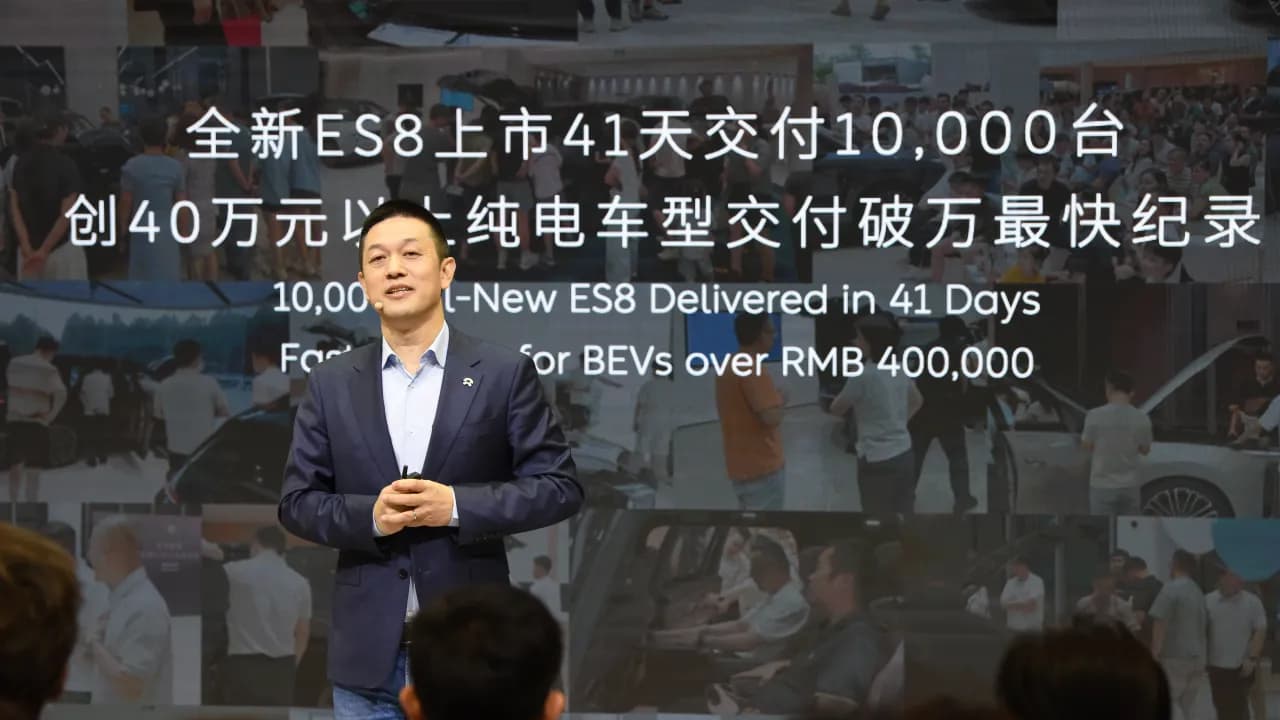
Earlier this month, he said higher raw-material costs had added nearly 20,000 yuan to the cost of each ES8 SUV. Passing the full increase on to buyers would theoretically require a roughly 30,000-yuan price hike. Nio has instead been working with suppliers to limit the impact on vehicle pricing.
CXMT Sets STAR Market IPO Record
CXMT raised 57.9 billion yuan, or about $8.5 billion, in its IPO, setting a record for Shanghai’s STAR Market. Total proceeds could rise to 66.6 billion yuan if the greenshoe option is fully exercised. The Hefei-based company held nearly 8% of the global dynamic random-access memory (DRAM) market in the fourth quarter of 2025, ranking fourth worldwide. Its low-power double data rate (LPDDR) revenue hit 40.7 billion yuan in 2025, more than doubling from a year earlier.
How Do Retail Traders Feel About NIO?
On Stocktwits, retail sentiment for NIO slipped to ‘bearish’ from ‘neutral’ levels a week ago amid a 236% jump in 24-hour message volumes.
One user said, “If accounting rules require NIO to revalue the investment following the IPO, the gain could materially boost reported net income, even though it’s non-operating. Analysts will focus on the core EV business, but this hidden asset is hard to ignore. Worth watching closely when NIO reports earnings.”
View this Stocktwits post
Another user was bullish on NIO, saying: “CXMT sells DRAMs. CXMT is right next to NIO. NIO is an investor in CXMT.”
View this Stocktwits post
Nio’s U.S.-listed stock has declined 6% over the past year.
For updates and corrections, email newsroom[at]stocktwits[dot]com.<