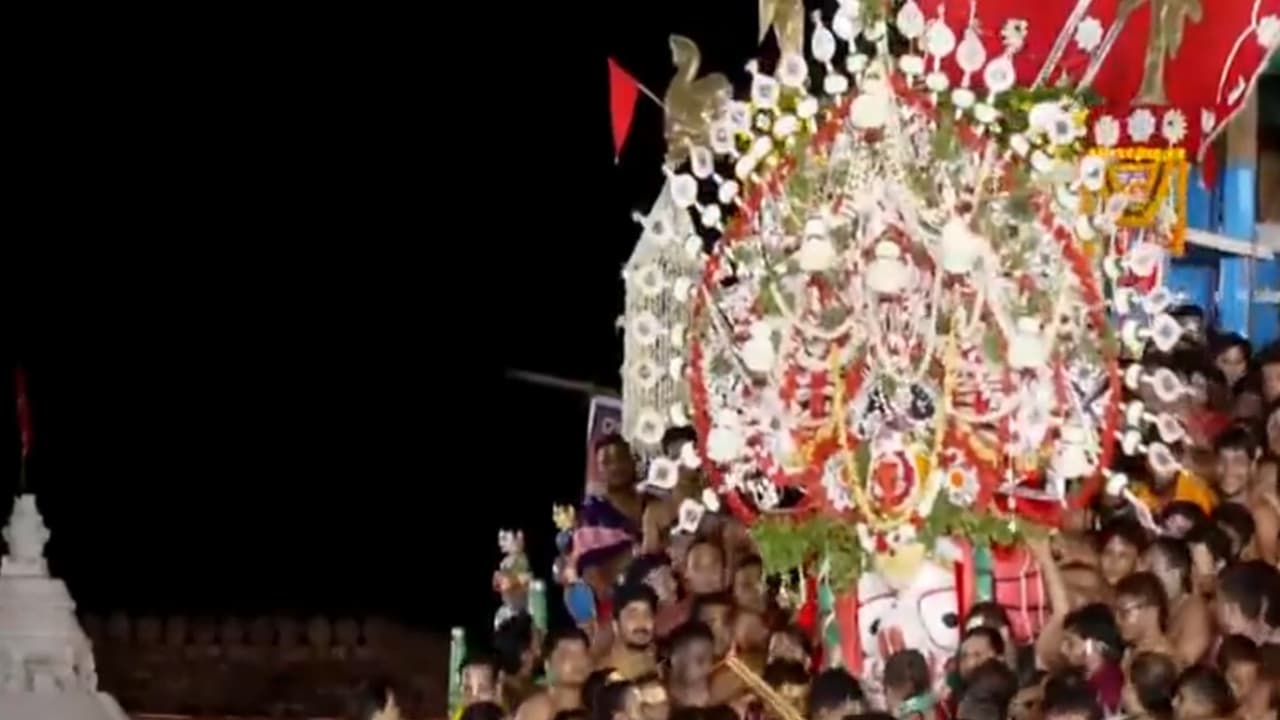
The 2026 Jagannath Rath Yatra concluded with the ‘Niladri Bije’ ritual in Puri. The festival saw a record-breaking turnout of an estimated 50 lakh devotees, with all rituals performed as scheduled, according to the SJTA.
The 2026 Jagannath Rath Yatra concluded on Monday with the ‘Niladri Bije’ ritual, as Lord Jagannath, Lord Balabhadra, and Devi Subhadra returned to the sanctum sanctorum of the Srimandir (Jagannath Temple) after their nine-day sojourn. The Shree Jagannath Temple Administration (SJTA) termed the festival a massive success, noting a record-breaking turnout of devotees.
Record Turnout and Successful Coordination
Addressing reporters on the conclusion of the festivities, Arabinda Kumar Padhee, Chief Administrator of the SJTA, said, “We had the blessings of Mahaprabhu that all the rituals were performed as scheduled. We are extremely grateful to each and every servitor who supported us.”
The Chief Administrator also extended his appreciation to the coordinated efforts of the State and district machinery. “We are deeply grateful to the district administration, police administration, my colleagues in the Shree Jagannath Temple Administration and various organs of government for their very generous support,” he added.
Padhee highlighted the unprecedented scale of the gathering this year, stating that the pilgrimage city saw a historic influx of visitors. “We are also grateful to the people of Puri, because this time the footfall crossed all records. As per our preliminary estimation, about 50 lakh devotees visited the Yatra,” he said.
The Divine Quarrel of ‘Niladri Bije’
The ‘Niladri Bije’ ritual marks the final stage of the Rath Yatra, where the deities are taken from their chariots back into the temple in a ceremonial procession known as ‘Pahandi.’ The main aspect of the Niladri Bije ritual is the heavenly love and affection between Lord Jagannath and his wife, Goddess Laxmi.
The Niladri Bije was not a smooth affair for Lord Jagannath. Goddess Laxmi was annoyed as she was not allowed in the Gundicha temple. So she allowed Lord Balabhadra, Goddess Subhadra, and Lord Sudarshana to enter the temple, but when Lord Jagannath tried to enter the temple, she gave orders to her servitors to close the Jaya Vijaya gate of the Singhadwar.
Goddess Lakshmi was furious over Lord Jagannath not taking her along during the annual sojourn. An exchange of words breaks out between the Devadasi (women servitors) representing Lakshmi and Badagrahi Daitas and other Daitapatis representing Lord Jagannath.
Later, Lord Jagannath assures Goddess Lakshmi that he will not repeat it again. Thereafter, Goddess Laxmi directs the opening of the Jaya-Bijay doors for him. At last, Goddess Lakshmi looks to the south, and both exchange looks. The Bhittarchha servitors untie the nuptial knot and offer Bandapana. In order to pacify his better half, Lord Jagannath offers Rasagolas to Goddess Laxmi.
Preceding Rituals: Suna Bhesha and Adhara Pana
On July 26, Suna Bhesha or Rajrajeswari Bhesh was performed.
Niladri Bije follows the Adhara Pana ritual in which the deities were offered a special pana on their respective chariots. The temple servitors offered the drink in long earthen pitchers to the Trinity after performing ‘Sodosha Upachar Pooja’. The pots were kept in such a way that they did not touch the lips of the deities.
Soon after the offering late in the evening, the earthen pots were broken on the chariots, spilling the entire drink on the platform. These pots were broken to liberate the evil souls, spirits, and other invisible beings residing in the chariots.
About the Jagannath Rath Yatra
Monday was the last day, and Lord Jagannath offered Rasagulla to the Goddess, and she allowed him to enter the temple like a common man.
The Jagannath Rath Yatra, one of India’s biggest and most revered religious festivals, is celebrated every year in Puri, Odisha. During the festival, Lord Jagannath, along with his siblings Balabhadra and Subhadra, is taken in grand chariots from the Jagannath Temple to the Gundicha Temple. Lakhs of devotees gather to pull the towering chariots, believing it brings divine blessings and spiritual merit.
This year’s Rath Yatra – the 149th Rath Yatra – began on July 16, and the nine-day festival concluded with the Bahuda Yatra on July 24. The deities are scheduled to ceremonially re-enter the Jagannath Temple on July 27. (ANI)
(Except for the headline, this story has not been edited by Asianet Newsable English staff and is published from a syndicated feed.)