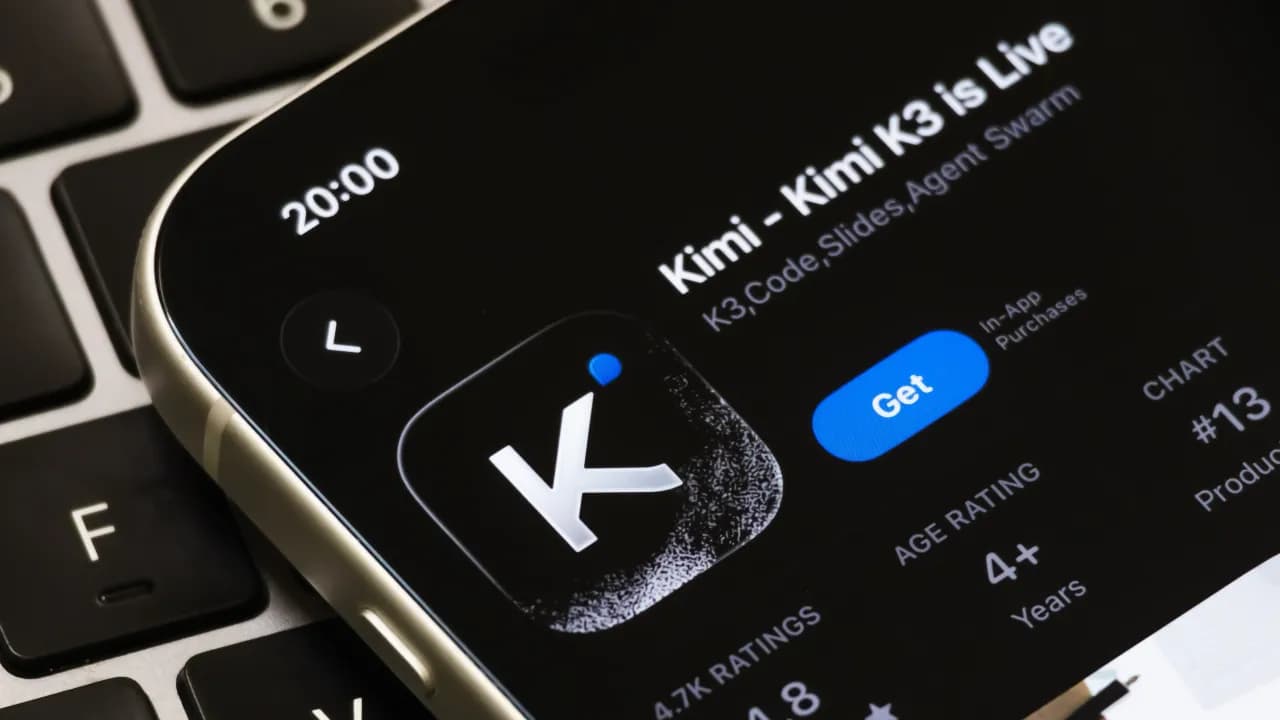
Moonshot AI is expected to release its breakthrough Kimi K3 model as open-weight software on Monday, according to Bloomberg.
- Kimi K3, which combines near-frontier AI performance with low costs, has gained remarkable recognition since its launch on July 16.
- Chinese open-weight AI models are rapidly gaining traction as competitors to proprietary systems from the top American AI firms.
- Investors are closely watching developments at OpenAI and Anthropic – and the broader AI industry – as they move toward a public listing.
China’s Moonshot AI is expected to release its breakthrough Kimi K3 model as open-source software, allowing developers to freely download and modify it, Bloomberg reported. The move is likely to accelerate adoption and increase competitive pressure on offerings from U.S. AI leaders such as OpenAI and Anthropic.
The Beijing-based company is due on Monday to release the model’s weights, after the company’s founder Yang Zhilin said he wants to win users by focusing on openness and greater availability than competing US proprietary systems.
Kimi K3, which combines near-frontier AI performance with low costs, has gained remarkable recognition since its launch on July 16. Developers have praised its strong coding, reasoning, and agentic capabilities, with its release reinforcing the rapid progress of China’s AI ecosystem.
Open-Weight AI Debate
Chinese open-weight AI models are rapidly gaining traction as competitors to proprietary systems from the top American AI firms. At the same time, policymakers and industry leaders in the U.S. are debating whether access to Chinese-developed AI models should face tighter restrictions.
U.S. Treasury Secretary Scott Bessent said last week that the Trump administration would look into whether Chinese companies were stealing American intellectual property, and stated that the government has “the ability to sanction them because of this theft,” according to a CNBC report.
In response, more than 20 companies, including Nvidia and Microsoft, issued a letter urging policymakers to avoid “premature restrictions” on open-weight artificial intelligence models that would “stifle competition or drive innovation overseas.”
Nvidia CEO Jensen Huang and Microsoft CEO Satya Nadella both shared the letter on their personal social media accounts, supporting the open model-weight model strategy. Tesla and SpaceX founder Elon Musk also amplified the letter on social media, writing that it has his “full support” in a post on X.
New AI From OpenAI, Anthropic
Anthropic unveiled Claude Opus 5 on July 21, followed by OpenAI’s launch of GPT-5.6 on July 24, marking the latest advances from the two U.S. AI leaders. In contrast, Google has yet to launch its much-anticipated Gemini 3.5 Pro model, with reports of a delay emerging last week as DeepMind works to improve its coding performance.
The setback has left Google relying on updated, lower-cost Gemini Flash models while rivals continue to push ahead with their most capable AI systems.
OpenAI, Anthropic Racing To IPO
Investors are closely watching developments at OpenAI and Anthropic – and the broader AI industry – as they move toward a public listing, setting up a potential IPO showdown.
Both companies confidentially filed IPO paperwork with regulators last month, before reports emerged that OpenAI may delay its listing until next year rather than the previously expected fourth-quarter timeline.
OpenAI now broadly trails Anthropic, based on the most recently disclosed numbers. In April, Anthropic said it tripled its annual revenue run rate to $30 billion, surpassing OpenAI’s ARR of about $24 billion.
Anthropic is valued at $1.12 trillion, compared to OpenAI’s private market valuation of $847.96 billion, according to data from Nasdaq Private Market. On Stocktwits, retail sentiment was ‘neutral’ for OpenAI, ‘bullish’ for Anthropic, and ‘extremely bullish’ for GOOGL.
For updates and corrections, email newsroom[at]stocktwits[dot]com.