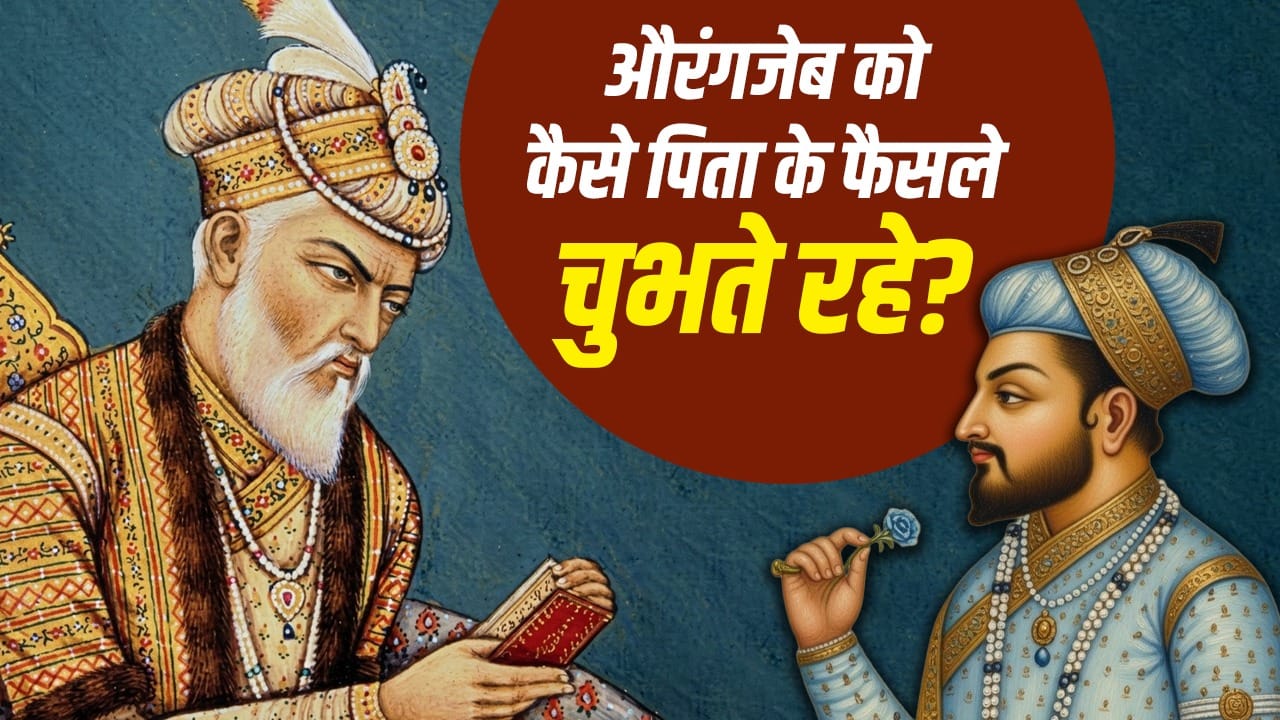
Aurangzeb and father Shahjahan.
Shahjahan was kind to his elder son Dara, while on the other hand, Aurangzeb was trying hard to prove himself better than Dara to get his father’s support. By spending thirty-two lakhs on Dara’s wedding in 1633, Shahjahan had left behind the grandeur of all the weddings of the Mughal family. On the other hand, after a few months of this marriage, Aurangzeb defeated a big elephant in a competition. Shahjahan was impressed by his bravery. But only Dara remained close to his father in the court. On the other hand, Aurangzeb was constantly kept busy with responsibilities and wars at other places away from Agra.
Aurangzeb was always keen on this. However, the experiences of war campaigns helped him to win over his brothers in the battle for the throne. He also settled the account of his neglect by imprisoning his father Shahjahan. Read some stories related to Mughal emperor Aurangzeb.
Craving for throne from an early age
At an early age, the tussle between Shahjahan’s sons Dara, Aurangzeb, Murad and Shuja for the throne started. From the very beginning, Shahjahan was more fond of his elder son Dara Shikoh. Dara’s scholarship and behavior had greatly influenced him. Shahjahan’s efforts to keep Dara close to him most of the time and keep him informed about the matters of governance had given a message among the courtiers that only Dara would inherit the throne. But it was not easy for Dara’s three brothers to accept this.

Mughal emperor Aurangzeb.
In fact, there was no tradition among the Mughals of the eldest child being the natural heir. He believed in the tradition that every member of the family would have equal rights in attaining political power. Akbar limited this custom to the sons of the emperor instead of all the members of the family. Obviously, in such a situation, there was an opportunity for Shahjahan’s sons to prove their right to the throne on the basis of their skill and strength.
Shahjahan was in favor of Dara from the beginning
In this tussle of succession, Shah Jahan was clearly in support of his elder son Dara Shikoh. In every matter related to Dara, Shah Jahan was more generous towards him than the other sons. The grandeur of Dara’s first marriage in 1633 and the incalculable expenses incurred in it made it a memorable wedding of the Mughal family. Thirty-two lakh rupees were spent on it, which was a huge amount at that time.

Mughal emperor Shahjahan kept his son Aurangzeb away from Agra.
According to European traveler Peter Munde, the glamor of this wedding forced the eyewitnesses to clench their teeth. The sky of Agra was filled with fireworks of this occasion. The details of the splendor and splendor of this marriage are recorded in Shah Jahan’s diary “Padshahnama” available in Windsor Palace, England. To celebrate the marriage of his favorite son, Shahjahan had opened his treasury and distributed a lot of gifts.
Defeating the elephant gave proof of courage
At the time of this marriage, Aurangzeb was only fourteen years old. He also wanted his father Shahjahan to pay attention to him also. Within a few months he got his chance. The royal family loved watching elephant fights. Hindi names were given to elephants fighting among themselves.
Two huge elephants named Sudhakar and Suratsundar were facing each other. Dara was not interested in it. He was not even at the spot. The remaining three brothers on horses, Aurangzeb, Shuja and Murad, were following them to see the battle closely. Suddenly the elephant named Sudhakar got upset and attacked Aurangzeb. In response, Aurangzeb hit him on the head, which further enraged him. He moved forward crushing Aurangzeb’s horse. Shahjahan’s court poet Abu Talib wrote, “Aurangzeb’s spear flashed like lightning and fell on Sudhakar’s head. Due to the impact of the spear, the elephant convulsed and his madness subsided.”

Dara Shikoh.
Responsibilities away from the court as a reward for bravery
Shahjahan praised Aurangzeb’s courage. He remembered his personal incident of 1610, when he had killed an uncontrollable lion in the presence of his father Jahangir. This bravery of Aurangzeb inspired Shahjahan to send him away from Agra to fulfill other responsibilities and lead wars, instead of keeping him close to the court. Aurangzeb’s 22 years between 1635 and 1657 were spent between protecting the Mughal Sultanate and expanding it. During this period, he fought the battles of Balkh, Bundelkhand and Kandahar and took over the rule of Gujarat, Multan and Deccan. Aurangzeb continued to prove his ability in matters ranging from the battlefield to the governance of the provinces, but his father Shahjahan’s decisions to keep him away from the Agra-Delhi court continued to prick him.
Love made me miserable with Heerabai
Aurangzeb, who was entrusted with great responsibilities and difficult campaigns at an early age, generally stayed away from the royal splendor and pleasures of love. The reason for this was his temperament. But in 1653, such an occasion came when he saw Heerabai Zainabadi plucking mangoes and became angry at her. He had gone to his aunt’s place in Burhanpur. Singer and dancer Heerabai’s beauty and youth cast such a spell on him that he fell in love with her at first sight.
Aurangzeb laid his head at her feet and broke his oath of never touching alcohol for the rest of his life, at the insistence of Hirabai. However, according to some historians, the cup of wine reached Aurangzeb’s lips but before he could taste it, Hirabai stopped him. These colors of love could not last long in the life of Aurangzeb, who generally lived a dry life, because within a year, Heerabai passed away. He was buried in Aurangabad. In the opinion of historians, if Hirabai had lived longer, it is possible that a more humane and gentle side of Aurangzeb’s personality would have been visible. But after the death of Hirabai, the same strict, religious and disciplined personality of Aurangzeb got permanently recorded on the pages of history.
Those first ten years of rule!
During the life of his father Shahjahan, he fought bloody battles for the throne. The other contenders, the three brothers, were removed from the way. Father imprisoned. He is remembered as an autocratic ruler. He is most criticized among the rulers of the Mughal dynasty due to the imposition of Jizya tax on Hindus and the destruction of temples. But Audrey Truschke writes in his book “Aurangzeb – Truth and Fiction”, “In the first ten years of his occupation of the throne of Mughal rule, Aurangzeb was a fan of those customs which were taken from Hindu customs. He used to give darshan of Riya from the window of the palace every day. According to the solar and lunar calendar, he used to donate equal weight of gold and silver etc. on his birthday. In reality, this is the Tuladaan tradition of Hindus. During this time, Bakhtawar Khan was also interested in music, but in the next decades he stopped giving royal patronage to other genres.
Not a single step without advice from astrologers
Interestingly, Aurangzeb, who had a very practical approach towards governance and its arrangements, had great faith in astrologers. According to Italian traveler Gemili Carrare, Aurangzeb did not take any major decision without consulting astrologers. However, there were also occasions when he implemented their opinions in his own way. Before his death in 1707, an astrologer suggested that the king could be cured of his illness by donating a diamond and an elephant. Instead, Aurangzeb distributed four thousand rupees among the poor.
Was there any change in Aurangzeb’s thinking towards Hindu religion and its scriptures in his last days? Audrey Truschke’s book claims that in 1690, a poet named Chandraman dedicated a Persian version of Ramayana named “Nargistan” and in 1705, Amar Singh dedicated a prose version of Ramayana, “Amar Prakash” to Aurangzeb. The author says that in his last days even Aurangzeb could not stay away from the Hindu traditions adopted by his ancestors.
Also read: Did the Mughals bring chess to India, who made the Pachisi board?