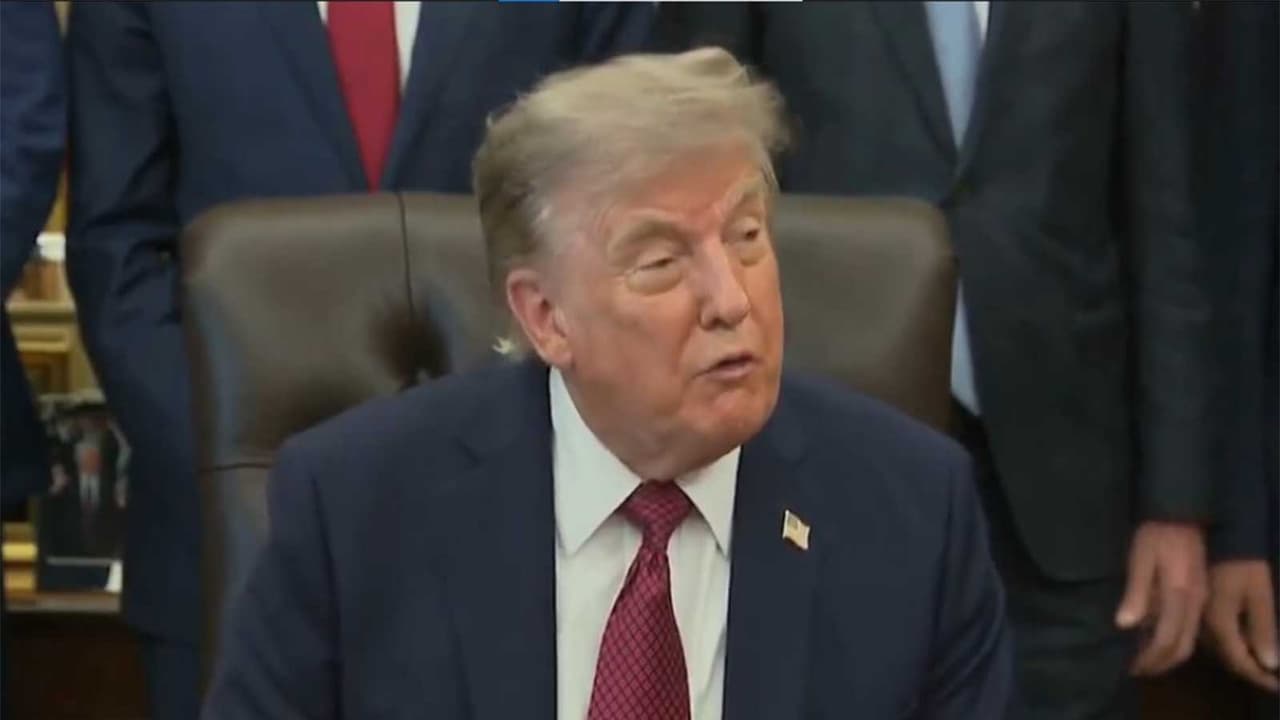
US President Donald Trump has said that the nuclear deal with Saudi Arabia will be approved only if it joins the Abraham Accords normalizing relations with Israel. He said that now Iran is not a major threat to Saudi.
Washington DC [अमेरिका]July 25 (ANI): US President Donald Trump on Friday (local time) once again reiterated that Saudi Arabia must rejoin the Abraham Accords as a stringent condition for finalizing a bilateral civilian nuclear deal. He declared that Riyadh is no longer threatened by a major regional power like Iran, which led to its withdrawal. The “Abraham Accords” are a series of US-brokered diplomatic agreements beginning in 2020 that established formal political, economic, and security relations between Israel and several Arab countries, including the United Arab Emirates, Bahrain, Morocco, and Sudan.
Speaking during an address on US nuclear innovation, Trump made his recent comments a centerpiece of the proposed energy partnership and stressed that joining a regional normalization agreement with Israel is “very important for the future of the Middle East”. “To do that, they have to become members of the Abraham Accords… now is the time for them to do that,” Trump said. “They, and others, didn’t want to do it because of their problem with Iran. Now you don’t have that problem anymore. You don’t have that problem anymore, you don’t have a great power there anymore. They were the grandfather of the Middle East. They’re not really going to be that great grandfather anymore.” The President added, “At some point, they will be involved.”
The comments build on a statement Trump posted on Truth Social a day earlier, where he clarified that the energy framework would be strictly limited to non-military nuclear applications, as well as ruled out domestic uranium enrichment. “A civil nuclear agreement … will be approved, but is strictly subject to Saudi Arabia’s rejoining the much respected and successful Abraham Accords,” Trump wrote Thursday. “The United States does not oppose civilian (non-enhanced) nuclear facilities.”
Nuclear deal linked to diplomacy
Trump’s apparent stipulation comes after US Energy Secretary Chris Wright and Saudi Energy Minister Prince Abdulaziz bin Salman signed the historic civil nuclear energy deal, which has been submitted for legislative review in the US Congress. By linking the two issues, Trump has linked the civil energy partnership to a long-standing flashpoint in Middle East diplomacy.
Saudi Arabia’s stance
On the other hand, Riyadh has repeatedly reaffirmed that granting formal diplomatic recognition to Israel is dependent on a clear and credible roadmap toward an independent Palestinian state. Negotiations on a bilateral civil nuclear framework between Washington and Riyadh have spanned successive US administrations, although previous efforts have deadlocked over nonproliferation terms.
What is special in the draft agreement?
Unlike previous versions evaluated under former US President Joe Biden, the current draft does not oblige Saudi Arabia to sign the International Atomic Energy Agency’s Additional Protocol, which grants inspectors short-notice access to undeclared sites. The White House says the agreement strictly adheres to the US Atomic Energy Act and includes strong nonproliferation controls. Saudi officials have similarly said the alliance will accelerate national energy diversification while maintaining international security standards. The bilateral treaty, structured as a “123 Agreement”, aims to enable the construction of AP1000 nuclear reactors using American technology throughout the state. (ANI)
(Except for the headline, this story has not been edited by Asianetnews Editorial staff and is published from a syndicated feed.)