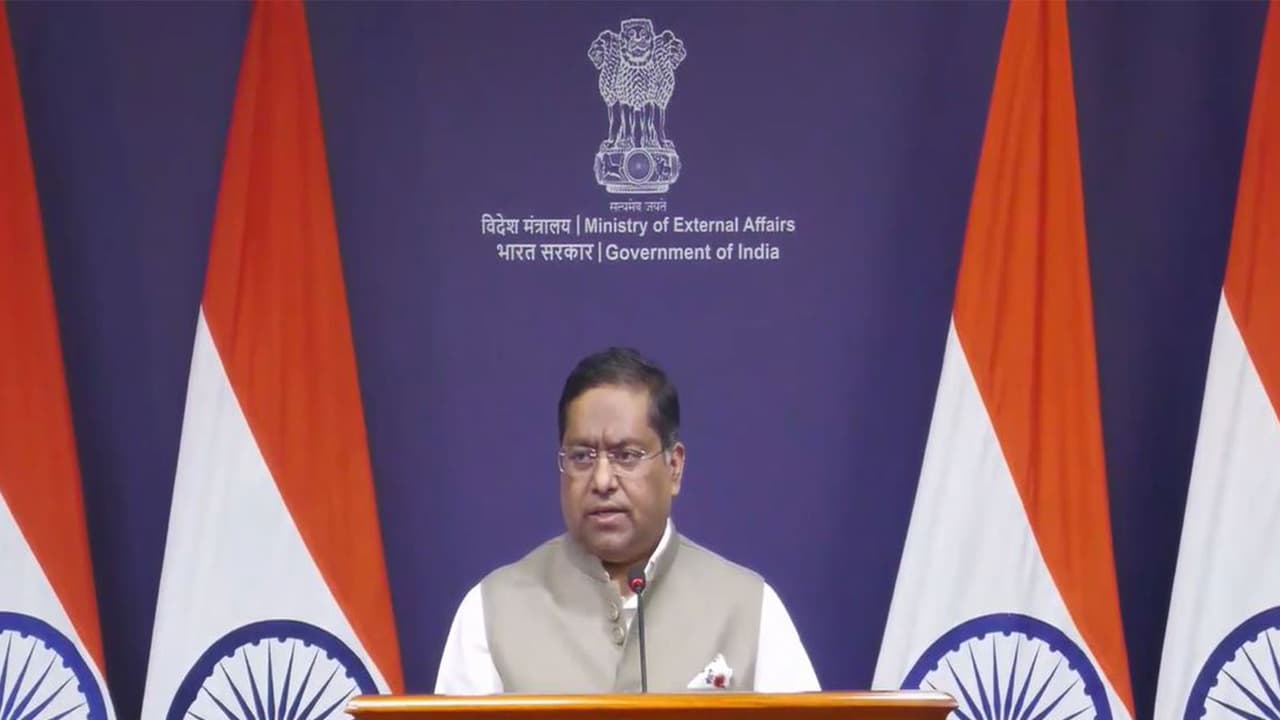
India’s MEA has accused China of infringing on its sovereignty by illegally occupying territories in Jammu and Kashmir and Ladakh since 1963. New Delhi raised firm objections against Chinese infrastructure projects in these Indian regions.
India Accuses China of Infringing on Sovereignty
The Ministry of External Affairs (MEA) on Friday accused China of infringing upon India’s sovereignty, asserting that Beijing is “illegally occupying” Indian territories in Jammu and Kashmir and Ladakh, while raising firm objections against Chinese projects in these regions.
Addressing a weekly press briefing, MEA spokesperson Randhir Jaiswal underlined New Delhi’s consistent position regarding territorial integrity, reiterating that India has consistently raised sovereignty concerns with Beijing. “EAM said that when it comes to sovereignty issues, it is actually India that should be and is raising them. India does not violate China’s sovereignty in any manner and has been consistent,” Jaiswal stated.
He further pointed to Beijing’s ongoing illegal presence and unilateral infrastructure initiatives in Indian territory. “But China has been in illegal occupation of Indian territories in Jammu and Kashmir and Ladakh since 1963, where India’s right is officially acknowledged even by China. There are Chinese projects on territories in Jammu and Kashmir that belong to India, and we object to that,” Jaiswal added.
Beijing’s Perspective on Bilateral Ties
The strong statements from New Delhi came a day after External Affairs Minister S Jaishankar held discussions with his Chinese counterpart Wang Yi on the sidelines of the ASEAN summit in Manila.
According to a readout released by the Chinese foreign ministry, Wang asserted that previous bilateral engagements between Chinese President Xi Jinping and Prime Minister Narendra Modi in Kazan and Tianjin had “guided China-India relations onto the right track of improvement and development.”
“China and India are partners, not competitors, and opportunities, not threats, for each other,” Wang was quoted as saying in the Chinese statement, which added that institutional mechanisms had gradually restarted, border regions had maintained peace and tranquillity, and bilateral trade had reached record levels. “These achievements have not come easily and should be cherished,” the Chinese Foreign Minister noted.
Characterising both nations as key representatives of emerging markets and the Global South, Wang expressed that both sides should “prioritise human well-being, demonstrate their responsibility as major powers, consolidate the positive momentum of bilateral relations, strengthen coordination and cooperation in international and regional affairs, and make positive contributions to promoting multipolarity and the democratisation of international relations.”
The Chinese foreign ministry readout further stated that Beijing remains willing to collaborate with New Delhi to execute leader-level consensus, maintain regular high-level interactions, broaden trade, media, and cultural links, handle sensitive friction points properly, and “explore a correct way for neighbouring major powers to coexist peacefully, based on mutual respect, mutual trust, common development, and common prosperity.” (ANI)
(Except for the headline, this story has not been edited by Asianetnews Editorial staff and is published from a syndicated feed.)