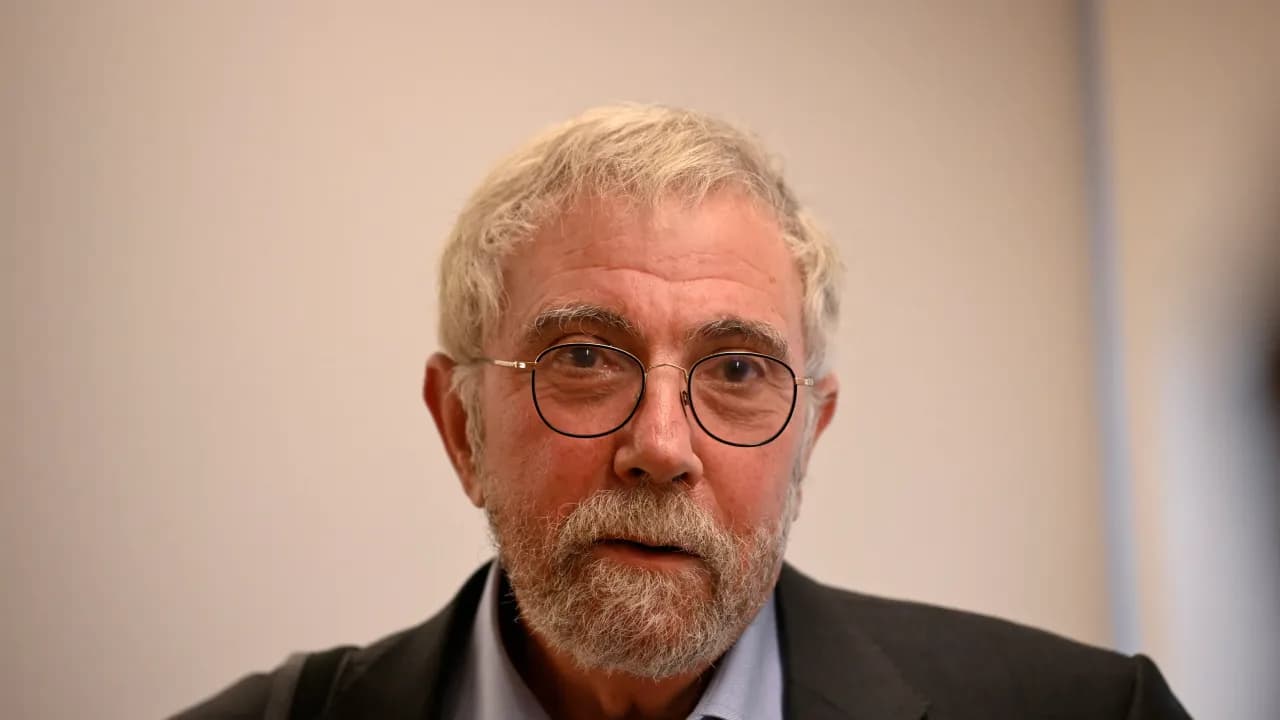
The Nobel Prize-winning economist argued that soaring gasoline refining costs are amplifying the economic impact of higher crude oil prices.
- The economist’s comments come amid an escalation in tensions between the U.S. and Iran, with Trump warning Iran that he will hold the country responsible for any subsequent attacks by the Houthi rebels in the Red Sea.
- Krugman said that the large refining margin means consumers are paying far more at the pump than crude prices alone would suggest.
- He warned that surging energy prices, combined with Trump’s new tariffs, could reverse recent progress on inflation and push interest rates higher.
Economist Paul Krugman warned that President Donald Trump’s war against Iran has resulted in refining costs soaring, thereby magnifying the economic impact of higher crude prices.
In a note published Thursday, the Nobel Prize-winning economist said crude oil prices hovering around $100 a barrel, combined with an unusually wide gasoline refining “crack spread” worth roughly another $40 per barrel, have left the world facing the economic equivalent of $140 per barrel for oil.
“Trump’s gratuitous war on Iran has turned into a remarkable quagmire — remarkable because the only thing keeping the war going is Trump’s vanity. He effectively lost the war in the first few days,” Krugman said.
The economist’s comments come amid an escalation in tensions between the U.S. and Iran. Trump said on Thursday that he will hold Iran responsible for any subsequent attacks by the Houthi rebels in the Red Sea, after an attack by the group on Saudi Arabian oil tankers in the region earlier this week.
He also added that the U.S. will inflict “major military punishment” upon Iran and the Houthis if they attack ships again.
Why Krugman Says It’s Like ‘$140 Oil’
Krugman argued that looking at crude oil prices alone understates the economic impact of the conflict. While benchmark crude has climbed to around $100 a barrel, he said the cost of turning crude into gasoline has also surged, with the refining “crack spread” widening to roughly $40 per barrel.
Combined, those two components amount to the equivalent of $140 oil, according to Krugman. He said that the large refining margin means consumers are paying far more at the pump than crude prices alone would suggest, making the economic shock significantly more severe despite oil remaining well below historical peaks in nominal terms.
The crack spread measures the difference between the price of crude oil and the value of refined products such as gasoline and diesel, serving as a key indicator of refinery profit margins.
Crude Oil Prices Ease
Crude oil prices eased on Friday after Brent soared past $100 a barrel on Thursday for the first time since May 20, 2026. U.S. West Texas Intermediate (WTI) crude futures expiring in September were down 2.97%, hovering around $89.45 a barrel. Brent crude futures expiring in September fell 3.13%, hovering around $97.54 a barrel.
The United States Oil Fund ETF (USO) and the ProShares Ultra Bloomberg Crude Oil ETF (UCO) were down about 2%.
Krugman Warns Of ‘Uglier’ Fallout If Iran Conflict Worsens
Krugman warned that the current energy shock could worsen significantly if the Iran conflict worsens. While he described the present situation as manageable, he said a broader regional war could disrupt energy supplies further and deepen the economic fallout.
He also cautioned that any escalation would likely drive up both crude prices and refining margins, amplifying the pressure on consumers and businesses. “Things could get much uglier if this war escalates,” Krugman wrote, arguing that the current equivalent of $140 oil may not represent the worst-case scenario.
The economist argued that surging energy prices, combined with Trump’s new tariffs, could reverse recent progress on inflation and push interest rates higher, intensifying the financial strain on households and businesses.
This comes days ahead of the Federal Open Market Committee’s (FOMC) meeting later this month. According to the CME FedWatch tool, the odds of a 25 basis point rate hike during the July meeting are currently at 35.8%, compared to odds of 64.2% that the Fed keeps rates unchanged.
At the time of writing, the SPDR S&P 500 ETF (SPY), which tracks the S&P 500 index, rose 0.37%, the Invesco QQQ Trust ETF (QQQ) gained 0.27%, while the SPDR Dow Jones Industrial Average ETF Trust (DIA) was up 0.46%. Retail sentiment around the S&P 500 ETF on Stocktwits was in the ‘extremely bearish’ territory.
For updates and corrections, email newsroom[at]stocktwits[dot]com.<