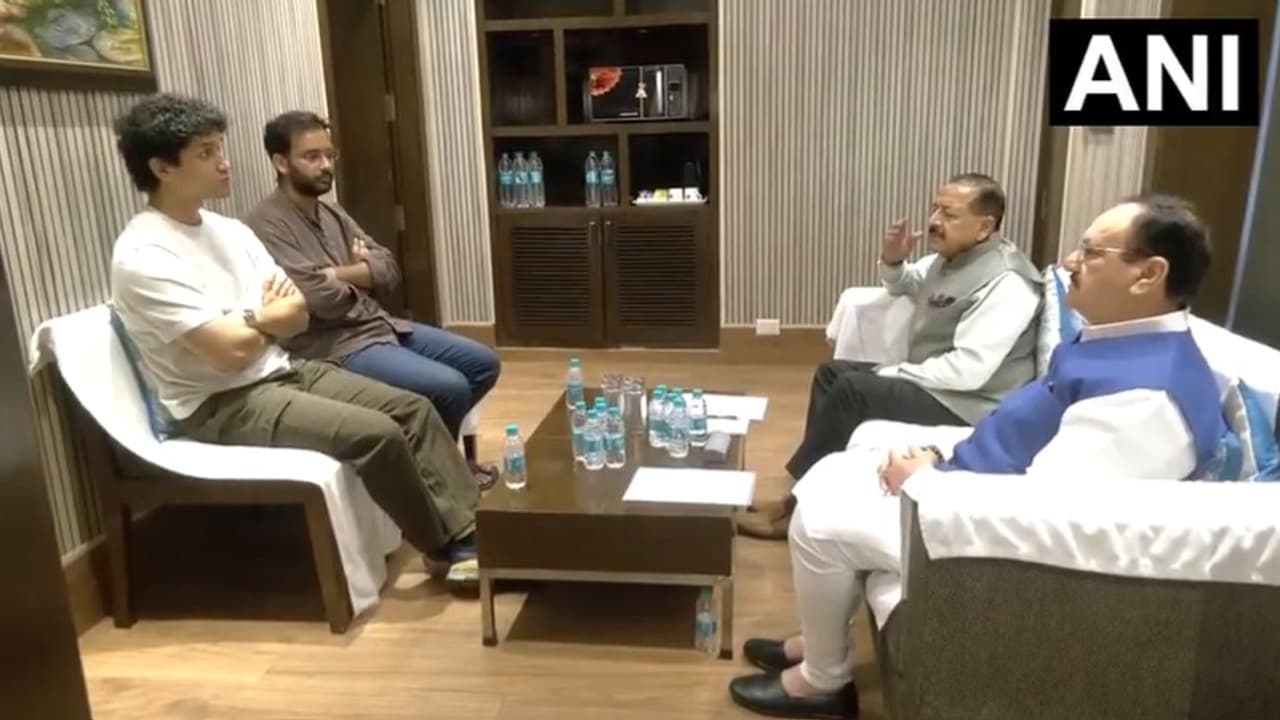
<p><strong>CJP has made it clear that the protest will not end unless Education Minister Dharmendra Pradhan resigns. After talks with two govt representatives, CJP spokespersons said government must either ask Pradhan to resign or remove him from office.</strong></p><img><p>Cockroach Janta Party (CJP), which is protesting at Delhi’s Jantar Mantar, said the government will take a decision on its demand for the resignation of Education Minister Dharmendra Pradhan by Saturday afternoon. After talks with government representatives, CJP spokespersons Saurav Das and Ashutosh Ranka reportedly said the government had agreed to their two other demands, but the protest would continue until a decision is taken on Pradhan’s resignation.</p><p>Amid the ongoing protests, a high-level meeting between CJP representatives and senior government leaders was held at Constitution Club in Delhi. </p><p>#WATCH | Delhi: A meeting held between Union Ministers JP Nadda and Jitendra Singh, and Cockroach Janta Party’s Chief Spokesperson Saurav Das and its National Spokesperson Ashutosh Ranka. pic.twitter.com/AYMu9RD8d8</p><p>— ANI (@ANI) July 24, 2026</p><p>CJP’s demands reportedly included an assurance that peaceful protesters would not face legal action and that adequate compensation would be provided to families of students affected by recent examination irregularities.</p><p>CJP founder Abhijeet Dipke has maintained that the group would not accept anything less than the resignation of Education Minister Dharmendra Pradhan and that the protest would continue.</p><p>The talks therefore appear to have opened a channel for dialogue, but they have not yet ended the confrontation between the protesters and the government.</p><img><p>Days after a forceful police crackdown on protesters during the July 20 ‘Chalo Sansad’ march in Delhi, the scene at Jantar Mantar looked very different today, (July 24, Thursday). Thousands of students and young protesters continued their agitation over alleged irregularities in the NEET-UG examination and other competitive exams. But inside the main protest area, the visible presence of police and security personnel was notably low.</p><p>A ground report by The Lallantop, India Today’s sister platform, found that most security personnel were stationed outside the barricades rather than inside the main protest zone. The crowd was largely being managed by volunteers and protesters themselves.</p><p>The change in approach comes after Delhi Police and Rapid Action Force personnel used lathis to disperse protesters who took part in the July 20 march towards Parliament. The police action drew criticism from protesters and supporters of the movement.</p><p>Some protesters have also alleged that pellet guns were used during the march. India Today Digital spoke to one protester whose medico-legal report reportedly recorded pellet injuries following the police action.</p><img><p>At Jantar Mantar on Thursday, the protest appeared to be running largely through a volunteer-led system.</p><p>According to The Lallantop’s ground report, volunteers were helping regulate the movement of people, managing queues and controlling entry and exit points. They were also helping journalists and visitors move through the crowded protest area.</p><p>With thousands of people gathered at the site, the role of volunteers appeared to have become important in keeping the area organised.</p><p>The report described the system as functioning almost on "auto-pilot". Protesters and volunteers appeared to be taking responsibility for maintaining order without a large number of police officers being visibly present inside the barricaded area.</p><p>However, the low police presence did not mean that security arrangements had been removed.</p><p>The protest site remained heavily barricaded from both ends. The narrow openings created bottlenecks, with large numbers of protesters trying to move in and out of the area.</p><p>The tight barricading also raised concerns about how quickly emergency vehicles could reach the protest site if a serious situation developed.</p><img><p>The ground report also highlighted concerns about basic facilities at Jantar Mantar. Two ambulances were reportedly parked inside the barricaded area. However, the narrow passages and heavy barricading raised questions about whether emergency vehicles would be able to move quickly through the crowded protest site when needed.</p><p>The condition of washrooms was another concern.</p><p>Washrooms near the protest area were reportedly not functioning because there was no running water. With thousands of protesters gathering at the venue, the lack of working sanitation facilities could create further difficulties for those staying at the site for long periods.</p><p>Despite these problems, the protest area appeared relatively orderly during the ground report.</p><p>Volunteers were seen helping to prevent overcrowding and keeping people moving through the narrow passages. Their presence appeared to reduce the need for a large visible police deployment inside the main venue.</p><img><p>The reduced police presence inside Jantar Mantar should not be seen as a wider easing of security in Delhi. Delhi Police has, in fact, tightened its overall security arrangements across the capital following the July 20 protest.</p><p>The leave of police personnel was reportedly cancelled until further orders, with leave allowed only in emergency situations. Security has also been strengthened around Parliament Street, Jantar Mantar and other sensitive areas during the ongoing Monsoon Session of Parliament.</p><p>The difference, therefore, appears to be mainly in how security is being managed inside the designated protest area.</p><p>While police personnel remain deployed around the venue and at key points, volunteers have been allowed to play a larger role in handling the crowd within the barricaded protest zone.</p><p>This is a notable shift from the scenes witnessed during the July 20 ‘Chalo Sansad’ march, when protesters attempting to move towards Parliament were stopped by security forces.</p><img><p>The ongoing agitation is being led by the Cockroach Janta Party (CJP) and has focused on alleged irregularities in national-level competitive examinations.</p><p>The protesters have been demanding accountability over the NEET-UG paper leak controversy, changes to the examination system and wider reforms to prevent cheating and paper leaks.</p><p>The resignation of Union Education Minister Dharmendra Pradhan has also emerged as one of the main demands of the movement.</p><p>The issue has become a major political flashpoint, with the Opposition also demanding answers from the government over the NEET controversy and calling for a detailed discussion in Parliament.</p><p>The protests have continued both inside and outside Parliament as the Monsoon Session progresses.</p><img><p>The government has also signalled that it plans to take stronger steps against those involved in paper leaks.</p><p>In a video message shared late at night, Prime Minister Narendra Modi said the Union Cabinet would consider a draft Bill aimed at setting up fast-track courts and providing strict punishment for those responsible for examination paper leaks.</p><p>The Prime Minister said paper leaks were a serious issue for students and their parents and that several steps had already been taken to deal with those accused in such cases.</p><p>He also highlighted the government’s efforts to conduct examinations for around 22 lakh students after the controversy, saying that it was important to ensure that students did not lose an entire academic year.</p><p>The announcement came as the NEET controversy continued to fuel protests and political debate.</p>