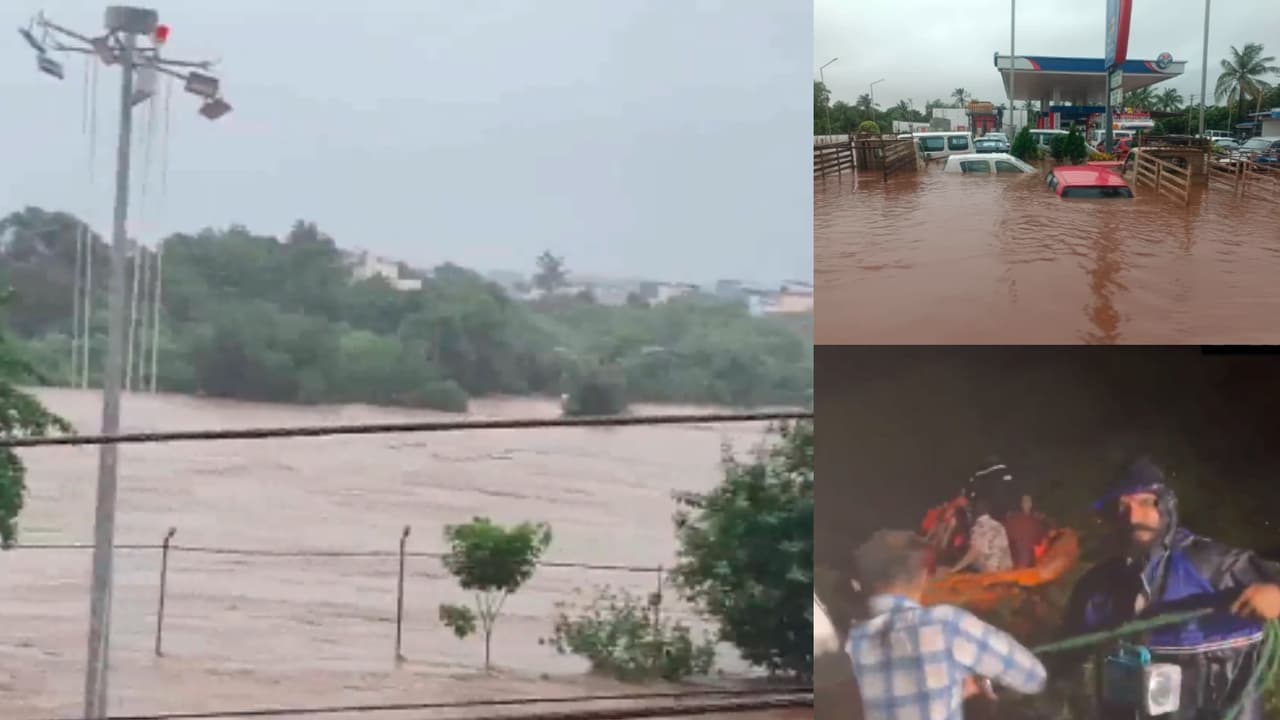
What is PDO: What is PDO i.e. Pacific Decadal Oscillation? Know how the Pacific Decadal Oscillation affects the Indian monsoon and how it relates to the record rainfall and floods in Gujarat.
PDO impact on Gujarat Flood: The record-breaking rainfall in Gujarat this time has made it clear that it is not enough to understand the monsoon only on the basis of El-Nino or La-Nina. Many areas received rainfall ranging from 424mm to 552mm within a few hours, causing rivers to swell, roads to submerge and normal life completely disrupted. A big alert is also issued for July 24. In such a situation, now one name is most discussed in the world of meteorology – Pacific Decadal Oscillation (PDO). The question is whether this large ocean pattern played an important role in strengthening the heavy rain situation in Gujarat?
What is PDO and why does it matter?
- PDO i.e. Pacific Decadal Oscillation is a decade-long change in the surface temperature of the Pacific Ocean.
- This is a climate pattern similar to El-Nino and La-Nina, but its effects can last for 20 to 30 years, not just a few months.
- It has two phases – positive and negative.
- At present, PDO is considered to be in a strong negative phase, the effect of which is being seen on many weather systems of the world.
Read this also- Red alert in Gujarat: Dangerous whirlpool stopped at one place, danger of heavy rain, next 24 hours important
How does negative PDO increase the strength of monsoon?
- During negative PDO, winds carrying moisture towards India may become more active.
- The moisture coming from the Arabian Sea and the Indian Ocean gives additional energy to the monsoon system.
- This may sometimes lead to more than normal rainfall and extreme rainfall in some areas.
- Western India, especially Gujarat, feels the direct impact of such moisture.
Why do many weather models miss PDO?
- Most weather forecasts are based more on short-term factors such as El Nino and La Nina.
- Models cannot fully capture long-term patterns like PDO.
- This is the reason why in some initial estimates the rainfall was expected to be below normal, whereas the actual situation was exactly the opposite.
Read this also- Flood caused havoc in Gujarat, see the devastation in 7 photos…people leaving their homes
What lesson was learned from Gujarat floods?
- Heavy rainfall is not the result of any one weather system.
- Large ocean patterns, local topography, continuous moisture from the Arabian Sea and changing climate can all combine to create extreme rainfall conditions.
- Experts believe that for better future weather forecasting, equal importance will have to be given to PDO, Indian Ocean Dipole (IOD) and other major climate indicators.
The recent floods in Gujarat are a reminder that understanding weather is more complex than ever. Just keeping an eye on El Nino or La Nina is not enough. Long-term climate patterns like PDO also play an important role in deciding the direction and strength of the monsoon. Understanding such indicators better in a changing climate could prove to be the key to more accurate forecasting and effective disaster preparedness. See the flood situation in Gujarat in the video below-
Scroll to load tweet…
Scroll to load tweet…