Gandharv Tongia, Group CFO of (SAMIL), said the company remains on track to achieve its $108 billion revenue target by 2030, supported by expansion in non-automotive businesses, acquisitions and continued growth in its core automotive operations.
| ₹573.90 | 87.10 | 17.89 |
As on May 21, 2026 3:59 PM
Tongia said the company expects consumer electronics, aerospace and other non-auto businesses to contribute a significantly larger share of revenue over the next few years. The non-auto segment currently contributes around 5% of revenue.
An Indian multinational manufacturer of automotive components based in Noida is also continuing to pursue acquisitions after completing one deal last year and announcing two more transactions set to close in the first half of the current financial year. “We continue to monitor and assess wherever we have good opportunities,” he said, adding that market volatility often creates acquisition opportunities.
Tongia said the company expects to manage the impact of rising copper, polymer and freight costs through pass-through arrangements with customers.
He said SAMIL remains engine agnostic and supplies components across ICE, hybrid and electric vehicles (EVs) platforms. EV programmes currently account for 22% of the company’s booked business but contribute 11% of revenue. He said the company’s $96 billion order book remains strong despite changes in global EV adoption trends.
While inflationary pressures linked to global conflicts could affect OEMs and suppliers in the near term, Tongia said medium- to long-term demand for commercial and light commercial vehicles remains positive, particularly in emerging markets such as India and China.
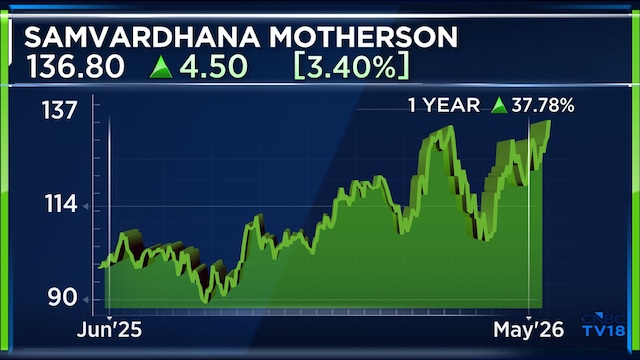
SAMIL currently has a market capitalisation of ₹1,44,749.17 crore. The stock has gained more than 37% over the past year.
This is an edited transcript of the interview.Q: You did indicate that Q1 could see a higher impact on account of copper, polymer, and freight inflation due to pass-through with a lag. So, just for the near term, what is the kind of margin pressure should investors realistically expect before recovery starts flowing through?
A: This was the best-ever performance in the history of the company. We were able to achieve a top line of ₹1.25 lakh crore. On your question on inflation and commodity prices in our businesses, generally, if there’s a change in commodity prices, we are able to pass it on to the end customer with a little bit of a lag. So, we believe that over a period of time, we should be able to maintain our margins. As far as other inflation costs are concerned, those are a matter of negotiation and discussion. Generally speaking, through give and take, we should be able to recover those costs as well from the end customer.
Q: Is there a number or a range you could give us?
A: In the case of copper prices, our arrangement with customers is to pass on the increases between a quarter and two, and therefore, if we were to take an annualised view, we don’t expect that margins will have a significant impact. It’s quite possible in a quarter or two, for temporary reasons, there is some softness in the margins, but if you were to take an annualised view, it should not have a material impact.
Q: The consumer business achieved EBITDA profitability in , and now GF3 is expected to drive the next phase of your scale-up. When do you expect the electronics business to contribute meaningfully at the consolidated EBITDA level? What timeline and even the number?
A: Our non-auto business is a reflection of our core capabilities in design, engineering, manufacturing, assembly, and logistics. This was the first full year of our consumer electronics operations, and the team has delivered a stellar performance. The top line grew between FY25 and FY26. We believe non-auto businesses should have a meaningful contribution over time. Today it’s around 5%, with consumer electronics, aero and other non-auto businesses put together.
By 2030, we believe that this number will be meaningfully higher, but at the same time, the auto business will continue to grow. We want to achieve a growth turnover of $108 billion by 2030, so it’s ambitious. We believe both businesses will contribute to the growth of the organisation.
Q: So non-auto contribution by FY30 goes up from the current 5% to?
A: It will be meaningfully better, but at the same time, the auto business will continue to grow. But it’s going to be good fun to watch.
Q: You don’t want to share some numbers?
A: The top line is $108 billion, which is what we are targeting, and all of us are collectively trying our level best to achieve it sooner rather than later.
Q: You’ve also mentioned the acquisition pipeline remains very strong. So, are you looking to acquire in the non-auto side of business? Is the auto side also a focus? Because now your leverage is also very comfortable versus the threshold that you have accepted in the company that you can go up to. So, is there an acquisition pipeline? And what are you looking at?
A: We would have done almost 50-plus acquisitions in the last 20-25 years. Your reading of the balance sheet is absolutely right. We are at the lowest leverage ratio of 0.8x. Our financial policy allows us to go right up to 2.5x. We have already done one acquisition last year, which has been consolidated at Sumitech. We announced two more, which will be consummated in the first half of this year. As an acquisitive company, we continue to monitor and assess wherever we have a good opportunity, generally speaking, on the basis of the customer, and we believe that we’ll have meaningful opportunities in the times to come. Whenever we have something closer to the deal, we’ll come back to you with an update.
Q: In FY27, is there going to be an acquisition?
A: That is what we do, that is what we have been doing over the last several years. Over the last 20 years, we have done all those 50-plus acquisitions, so we’ll try our best to do whatever is possible, even in the current financial year.
Q: The EV programme is now 22% of your booked business, but only 11% of the revenue. Has there been any slowdown in EV adoption globally? Are OEMs shifting sourcing preference more towards hybrids and ICE platforms?
A: It’s a mixed bag; it will differ from country to country, from consumer to consumer. It’s also dependent on how countries are trying to promote EVs. There are a few countries where there’s subsidy available, but ours is engine-agnostic. We supply to all types of OEM customers. We can supply ICE, hybrid as well as EV, and that is where the order book is extremely solid. We have a $96 billion order book today, and we don’t necessarily believe that any change in the colour of the order book will have a bearing on our performance. We’ll be guided by what our customers want us to manufacture, and we will manufacture and meet their expectations.
Q: Any demand impact in the near term on account of the war?
A: Not yet. It’s quite possible there is some inflationary impact on the performance of the OEMs or the auto ancillary companies, but if we were to take a medium- to long-term view, generally speaking, there is growth potential in the light commercial vehicle segment. The expectation is that the CAGR is going to be around 1.2% over the next five years. In the case of commercial vehicles, it should be around 3%, and most of the growth should come from the emerging markets like India and China.
For the full interview, watch the accompanying video
Q: When you have that big aspiration – $108 billion of revenue by 2030, What’s the biggest risk for you? Demand, supply, competition? What do you think?
A: It’s an ambitious target. This is our seventh five-year plan. We have achieved our target in almost all the five-year plans, except the one which got impacted by COVID. We have our arms and ammunition in place. We have our risk management in place. It is, of course, dependent on several external factors, but we believe that whenever the volatility is high and uncertainty is high, Motherson gets the opportunity to acquire businesses. This is what we have done over the last 25 years, and we believe that in the next three to four years, we’ll get enough opportunities to grow both organically and inorganically to achieve a $108 billion top line.