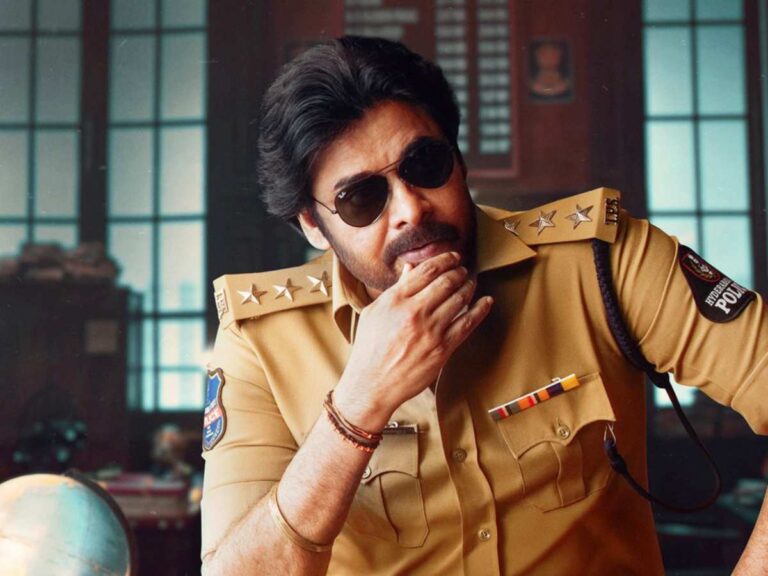
Ustaad Bhagat Singh (Pawan Kalyan) is an orphan raised by a government teacher, Chandrasekhar Rao (KS Ravikumar), during his posting in a forest region. It is he who names the boy and shapes his future. Years later, Chandrasekhar Rao rises to become the Chief Minister of Telangana, while Bhagat Singh grows up to be an IPS officer. However, after an attack leaves Chandrasekhar Rao hospitalized, Chandala Marri Nalla Nagappa (Parthiban) assumes power as the new Chief Minister.
In the present, Bhagat Singh lives a reclusive life in the Nallamala forests. When Nagappa’s younger son enters the forest, he mysteriously goes missing. Initially believed to have vanished while searching for ganja, it is soon revealed that Bhagat Singh is behind the abduction.
Why did Bhagat Singh orchestrate this kidnapping? Is there a deeper connection between Nagappa’s political rise and Bhagat Singh’s personal past?
Analysis
“Ustaad Bhagat Singh” marks the second collaboration between Pawan Kalyan and after their 2012 blockbuster “Gabbar Singh.” Beyond the common factor of Pawan Kalyan playing a cop, there is little similarity between the two films. In fact, the story here feels reminiscent of several earlier commercial entertainers.
Harish Shankar places his focus squarely on presenting Pawan Kalyan in a vintage, crowd-pleasing avatar. He constructs scenes and situations primarily to elevate the star and cater to his fan base.
The film opens with a childhood episode, establishing how the protagonist gets his name and identity, before moving into the political backdrop and eventually introducing Pawan Kalyan with a stylized entry, complete with a “you know he is” title card. His police station introduction, dressed in a cowboy getup, sets the tone, clearly indicating the director’s intent to recreate familiar fan-favorite moments.
With the entry of Raashi Khanna, the film shifts into lighter territory. One such stretch involves a comedic take on “dance steps,” where Pawan Kalyan grooves to popular songs of Chiranjeevi and Mahesh Babu. These moments are designed purely for fans. The eventual “Collar Ey Etthara” song further adds to this celebratory tone. Overall, the first half is largely a mix of such episodes, songs, and routine villain tracks.
It is only in the second half that the film finds its actual footing. The narrative delves into Bhagat Singh’s past: his tenure as an ACP in Hyderabad’s Old City, his love story with radio jockey Leela (Sreeleela), and his conflict with the local MLA Nagappa. This portion carries the core emotional weight of the film. While still formulaic, it offers a few engaging moments. The love track works to an extent, and the use of “Ee Manase” (from “ ”) adds a nostalgic charm. There are also a handful of genuinely enjoyable scenes here.
However, once the flashback concludes and the film returns to the present timeline, it slips back into a predictable pattern. The inclusion of jihadi elements feels forced and disconnected from the main plot. Additionally, several dialogues appear tailored to reinforce Pawan Kalyan’s current political image, which further disrupts the narrative flow.
Throughout the film, there is a consistent effort to project Bhagat Singh as a larger-than-life figure: a selfless leader, a champion of the people, and someone capable of challenging political authority. As a result, the film oscillates between being a commercial cop drama and a political statement. This blend might have worked better with a more cohesive and engaging screenplay.
In the end, the film holds attention mainly during moments where Pawan Kalyan indulges in his trademark mannerisms and lighter sequences. But it tends to falter whenever it leans heavily into routine, formula-driven storytelling.
Pawan Kalyan delivers in his trademark style, and his multiple looks are sure to please fans. Sreeleela, as Leela, gets relatively better scope and makes a good impression. Raashi Khanna’s role, however, feels out of place and lacks continuity, eventually fading away from the narrative.
Parthiban, despite having a strong screen presence, is let down by weak characterization. KS Ravikumar fits well in his role, while the supporting cast performs as required.
Cinematographer Ayananka Bose lends the film a visually rich texture, maintaining consistency. Devi Sri Prasad’s songs are decent. is serviceable but doesn’t elevate the film significantly.
As a writer, Harish Shankar shows flashes of his signature touch in certain dialogues and moments. However, a stronger focus on fresher ideas would have made a significant difference. That said, he deserves credit for assembling the film coherently despite working with limited dates of Pawan Kalyan due to his political commitments.
Bottom line: “Ustaad Bhagat Singh” offers fan-pleasing moments and showcases Pawan Kalyan in a vintage avatar. But beyond that, the film remains largely formulaic, with a predictable structure and no novelty.