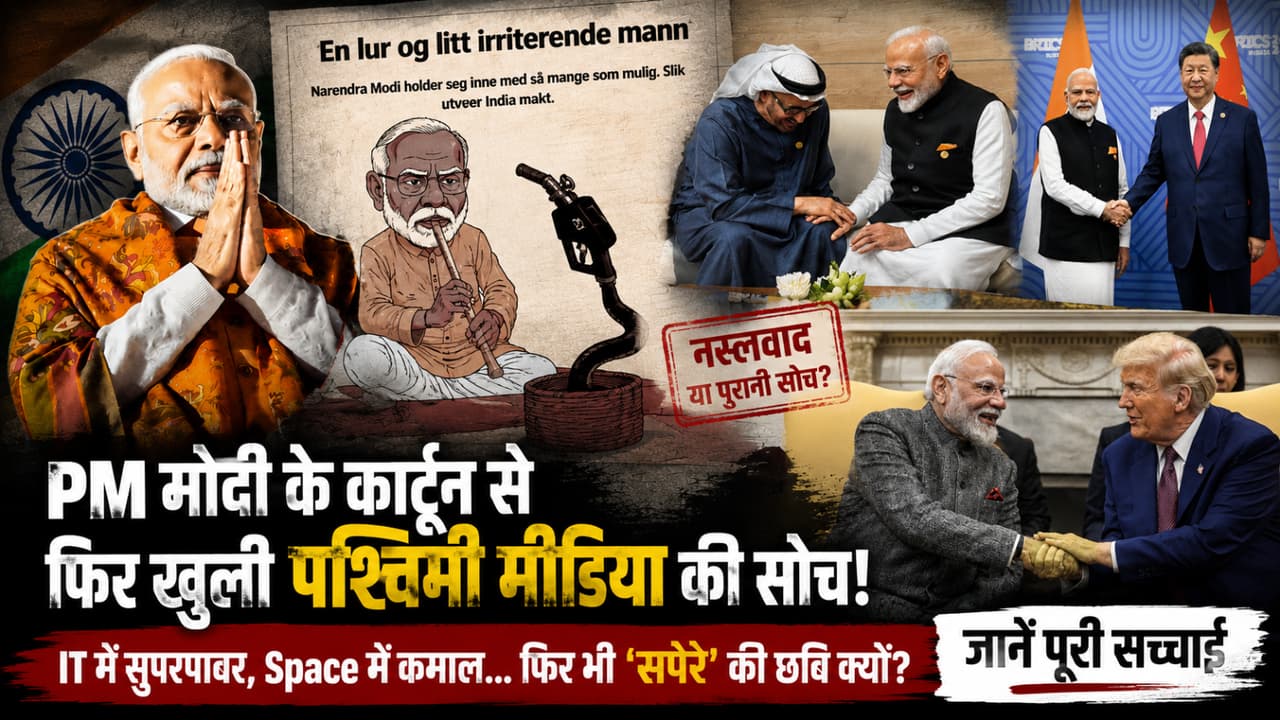
PM Modi Snake Charmer Cartoon: Why does the western media still show India, which has dominated the world on the basis of IT, Space and digital power, as a ‘country of snake charmers’? After Norway’s controversial cartoon, big questions arose again on racism and colonial thinking.
The world is changing rapidly and so is India. Today, India has become one of the most powerful voices in the world, not only on the basis of population but also on the basis of technology, space, digital economy and global diplomacy. Indian companies are making their mark in the global market, Indian-origin CEOs are leading the world’s largest tech companies and ISRO is making new records in space.
But despite all this, a part of the western media still seems to be trying to look at India through the same old prism, in which India has been shown associating it with ‘serpents’, ‘witchcraft’ and backwardness. A cartoon in a Norwegian newspaper showing Prime Minister Narendra Modi as a snake charmer has revived this debate.
Why was there controversy over Norway’s cartoon?
In a cartoon published in Norway’s leading newspaper ‘Aftenposten’, PM Narendra Modi was shown as a snake charmer. Instead of a snake, a petrol pipe was shown. An editorial was also published along with this cartoon, after which sharp reactions started emerging on social media. Former Foreign Secretary Kanwal Sibal reacted strongly, calling it an insult to India. He said that this is not just a cartoon but a reflection of the western mentality regarding India. Even on social media, a large number of people called it an example of racist and colonial thinking.
Scroll to load tweet…
Also read: PM Modi gave ‘Melody’ to Georgia Meloni, Rahul Gandhi got angry; You said a big thing!
India has changed, but the thinking has not changed?
This question becomes bigger because today’s India is not the India of 20-30 years ago. India is among the top economies of the world today. India is leading the world in digital payments. Many countries are trying to adopt the UPI model. Indian IT sector has become the backbone of the world’s tech industry.
People of Indian origin are holding top positions in companies like Google, Microsoft, Adobe, IBM. In the space sector, India surprised the world through Chandrayaan and Aditya missions. Successful space missions at low cost have become the identity of India. Made in India technology is no longer just a slogan but is becoming a global reality. Despite this, when the western media shows India as snake charmers or a backward society, it is not just a satire but raises questions on the mentality.
Western media have already been accused of racism
This is not the first time that such depictions of India have surfaced. Indian crew members were shown in a very objectionable manner in a US web comic in 2024, when the Baltimore Bridge disaster occurred. Earlier, the German magazine ‘Der Spiegel’, while comparing India and China, had linked Indians with overcrowding and chaos.
In 2014, the New York Times also had to apologize after a controversial cartoon on India’s space mission. In that cartoon, India was shown as a rural and backward country, which is knocking on the door of the “Elite Space Club”. If we look at history, even during the British colonial period, Indians were often shown as symbols of snake charmers, superstition and poverty. Experts believe that many stereotypical images from that era are still present in some parts of Western media.
After all, why this viewpoint regarding India?
Experts believe that there could be many reasons behind this. The first reason is colonial mentality. For decades, Western countries created images that portrayed Asian and African countries as “inferior.” The second reason is also considered to be the rapid rise of India. The country which was once considered a developing and weak economy, has today become a major force in the global supply chain, technology, pharma and space sectors. The third reason could also be cultural bias. A section of Western society is still accustomed to seeing India in the same old frame, which included images of poverty, crowds and snake charmers.
Scroll to load tweet…
Is global perception changing?
However, the picture is not completely the same. A large part of the world is now looking at India with a new eye. From hosting the G20 to the Digital India model, India’s global image has been strengthened. Foreign investment has increased and India is seen as an economic powerhouse of the future. But it is also true that old stereotypes about India still surface from time to time on social media and global media platforms. This is the reason why after every such controversy, a sharp reaction is seen in India.
India’s new identity versus old thinking
Today’s India talks about AI, semiconductor, space technology, digital infrastructure and startup ecosystem. India’s youth population is considered to be the world’s biggest strength. At such a time, if any country or media organization tries to show India only as “the country of snake charmers”, then this debate is not limited to just a cartoon. This becomes a question on that thinking, which still wants to see the changing India from the old perspective.
Also read: America was about to attack Iran, but Saudi-UAE played a big game!