Recently an OTT series is being shown on Jio Hotstar – “Brothers and Sisters”. In this, love has been shown between cousins living in Tamil Nadu, in South India, not between real brothers and sisters, but beyond this, the tradition of marriage between cousins has been old.
This still continues in some communities here. Although these have reduced to some extent but have not ended. Let us know what are those traditions here, in which marriage between siblings other than real siblings is acceptable.
Many films have already been made on this theme in South cinema. In the popular 1989 Malayalam film ‘Kiridam’, Mohanlal’s character ‘Sethumadhavan’ falls in love with his maternal uncle’s daughter Parvati. In the same year, another film ‘Oru Vadakkan Veeragadha’ came out, in which Mammootty played the mythological character of Chandu, who is in love with his cousin Unniyarcha. In the previous years too, many such films were released in which cousins were shown in love. This was a rule that was not questioned for generations. It was followed in some religions and castes.
Many films have been made on the marriages of cousins in South India (ai news)

In Kerala, marriage between siblings is a legal offense and is not valid, but marriage between cousins or siblings of similar relation is given legal status, although it should be an old tradition of that community. Although in South India such marriages are less in Kerala but more in Tamil Nadu, Karnataka and Andhra Pradesh.
Highest number of such marriages in Tamil Nadu
Statistics show that 4.4 percent of such marriages are still taking place in Kerala. 28% in Tamil Nadu, 27% in Karnataka and 26% in Andhra. According to the Hindu Marriage Act 1955, marriage between real brothers and sisters is prohibited, but if it is the custom of the community, marriage between cousins and similar marriages is acceptable.
So this series named “Brothers and Sisters” is the story of a Tamil family. It should be said that the rates of cousin marriage in South India are many times higher than in North India, the reason behind which are mainly cultural, historical and legal reasons. Statistics also say that the national average of marriages between cousins is 11 percent. This happens in certain communities in North India too, but it is only 9 percent, which is much less than the national average, whereas the average in South India is 23 percent.
Reason for such marriages in South India
So what is the reason for such marriages in South India? Actually, the reason for this is said to be the Dravidian fraternity system, which gives priority to cross-cousin marriage in South India. In South India, traditionally it is considered appropriate to marry one’s maternal uncle’s daughter. This tradition is more than 2000 years old there.
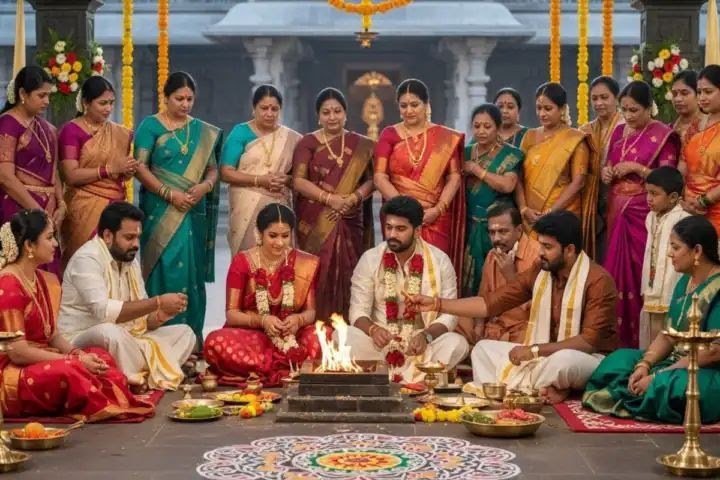
The practice of such marriages in South India is attributed to the Dravidian fraternity system, which gives preference to cross-cousin marriages in South India. This tradition is more than 2000 years old there. (AI image)

Marriage within the same Gotra is strictly prohibited in North but there is no restriction on it in South India. In South India, the main reason for marriage in inter-relationships is said to be the property remaining in the family. Less dowry has to be given because the family is already familiar. Centralization of economic resources remains. A popular belief in Kerala about marriage between blood relatives is that the basic reason for this is to keep the property within the family and not let it go into the hands of any outsider. The marriage of daughter and nephew was done so that the property remained in the family.
Tradition of marriage among cousins in all religions
In South India, there is a tradition of marriage between cousins in all three communities, Hindu, Muslim and Christian. Although Muslims do this more. Although there is a ban on such marriages in the Hindu Marriage Act 1955, but if it is the custom of any community then it is valid. This is considered a valid tradition in South India. However, now cousin marriage has reduced in urban areas, highly educated people and rich families. There has been a decline in South India.
It is argued that this type of marriage may have developed in primitive societies, when men mostly went to war. It was difficult for him to form relationships with people outside his family. This practice was prevalent among Hindus and Muslims, people of Tamil Nadu and even in Sri Lanka.
Now such marriages are decreasing
In the last few years, the practice of marrying cousins has declined drastically. This may perhaps be related to the many studies that have shown that marriage between blood relatives can cause health problems and genetic disorders in the children.
An article published in “The Hindu” mentions a detailed study conducted on 11,000 children born out of wedlock between blood relatives. In this study, congenital deformities were found in 386 such children. The literacy rate in Kerala has been increasing for decades. Perhaps this is why these studies would have been taken seriously when considering marriages between cousins. However, this practice has not ended completely yet. In many families, cousins have been willingly marrying each other for generations.
Where and in whom such marriages still take place?
Tamil Nadu – Marriage with maternal uncle’s daughter is very common. Popular in many Vellala, Nadar, Thevar communities.
Andhra-Telangana – Common to maternal uncle’s daughter or aunt’s daughter. Such marriages have been done in the Reddy community to keep property.
Karnataka – Such marriages are most common on the mother’s side. In some communities uncle and niece also.