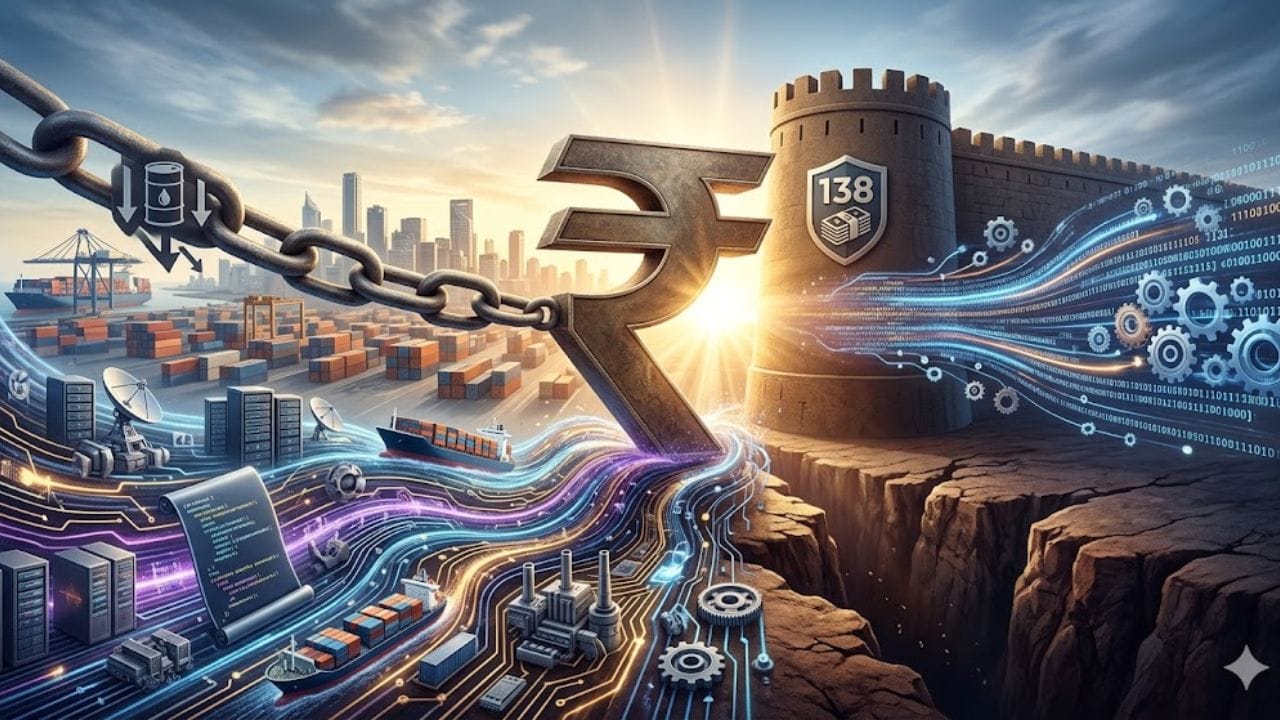
The rupee has reached a life time low of 96.47 against the dollar. If the situation remains the same, the rupee will touch the 100 mark against the dollar by the end of the year. On the other hand, the pressure created by oil prices is threatening to increase the current account deficit from 0.9 percent in FY 2026 to an estimated 2.3 percent of GDP by FY 2027. Now the biggest question is what solution should be found to manage the money and current account deficit. RBI has also done short selling of dollars worth several thousand crore rupees to manage the rupee.
According to experts, the roads are not closed for India yet. India is looking towards an export which can not only save the Indian currency from sinking. In fact, it can also help in keeping CAD under control. That is the export of the people of the country. The government is actively planning this. The Ministry of External Affairs has asked the Ministry of Skill Development and Entrepreneurship to expedite the deployment of skilled workers to Israel through secure government-to-government channels, ET reports.
By systematically reducing deployment timelines and improving quality control, India aims to convert its huge demographic dividend into a premium export. This strategic initiative to encourage migration is designed to provide access to the best talent to capital-rich but labor-starved countries, creating a strong remittance safety net that can withstand major economic shocks.
The changing geopolitics of global labor mobility
A structural change is occurring in the global migration map, as traditional destination countries in the Western world are increasingly restricting their immigration policies. For decades, the United States, Canada, the United Kingdom and many countries in Western Europe have been prime targets for both skilled professionals and student immigrants from India.
However, the growing sense of preference for people from one’s own country, local political pressure and increasing strictness of visa rules is completely changing the way international labor flows work. This tightening of regulations in the West is forcing human resources to find new ways, turning a historic challenge into a diverse geopolitical opportunity.
Fortunately, as access decreases in one part of the world, opportunities are expanding unprecedentedly in another. While on one hand, developed Western economies are creating bottlenecks, on the other hand, economies with aging populations and capital-rich, but facing acute labor shortages, are opening their doors more than ever.
India is in a unique position to take advantage of this systemic change. It can modernize its regulatory framework through the proposed ‘Overseas Mobility Bill’. This new bill, brought with the aim of replacing the old ‘Immigration Act’ of 1983, tries to create a modern and comprehensive system. This system ensures secure employment, fair treatment and systematic rehabilitation of citizens working abroad upon their return to the country.
This initiative of the government ensures that global geopolitical tensions do not block the way for India’s talent to go abroad, but rather divert them to new economic partners that give more importance to structural cooperation in the field of human resources, rather than just importing labourers.
Speeding up the corridor to Israel
The immediate focus of this improved strategy is West Asia, where acute shortages of domestic goods have created an urgent need for reliable foreign workers. Following the signing of three new implementing protocols between the two countries in February, Israel has promised to employ 50,000 Indian workers over the next five years. This wave of recruitment extends to essential domestic sectors like trade, manufacturing, services and restaurants. The reason for this demand is the need to maintain the economic momentum in the region, making timely arrival of vetted, qualified people to the region has become a top priority for the host country.
To rapidly meet this demand, the National Skill Development Corporation has taken up the direct responsibility of screening potential candidates to ensure strict quality control and adherence to norms. India’s emphasis on simplifying the recruitment process is to remove government barriers that have previously created barriers to cross-border employment.
According to Israel’s Population and Immigration Authority, 48,881 Indian citizens are already living in the country. This current number includes 6,700 construction workers and 50 caregivers who have been successfully dispatched through government-to-government (G2G) channels. The Ministry of External Affairs’ strong efforts to reduce logistics delays show that India wants to prove that sending Indian workers can be very fast and completely safe, thereby setting a precedent for future bilateral labor corridors.
Taking advantage of the lack of demography in Russia and Japan
Beyond West Asia, India is establishing deep and long-lasting human capital collaborations with countries that are facing serious and long-term demographic crises. Russia is fast emerging as a major destination for Indian technical and industrial talent. The Russian Labor Ministry has estimated a huge shortage of 3.1 million people in the domestic workforce by 2030. The manufacturing sector alone is in urgent need of at least 800,000 workers to maintain industrial production. Although early estimates by some regional business leaders, which called for the immediate arrival of 1 million experts, were a bit overly optimistic, the structural pathways for this are now largely opening up.
To bridge this huge gap, Russia has increased its quota of qualified foreign specialists by 1.5 times to 230,000 by 2025, and has also launched a highly specific visa program. The initiative offers three-year temporary or permanent citizenship to skilled foreign nationals without any stringent language requirements or strict local quotas. Bilateral agreements signed during the Modi-Putin summit last year have paved the way for Indian experts to fill critical vacancies in Russia’s IT, machinery, construction, engineering and electronics sectors.
At the same time, Japan is also relaxing its traditionally conservative stance on immigration to deal with its demographic imbalance. The ‘India-Japan Action Plan on Human Resources’ is a major success, which aims to facilitate the movement of 500,000 persons over a period of five years. This target includes 50,000 skilled and semi-skilled Indian workers. Japan is actively trying to take advantage of India’s demographic dividend to maintain its overburdened hospitality, healthcare, manufacturing and caregiving industries.
Corporate Agility and Decentralization of Tech Talent
With traditional immigration processes becoming stricter, there has also been a change in the way multinational tech companies handle the best Indian talent. Rather than struggle with the instability and long delays of Western visa processing systems, global technology companies are transforming their corporate structures under a new operational theory — build teams where talent already exists. The old model of bringing engineers to the project is now being replaced by decentralized hubs, which help companies remain agile despite increasing protectionism.
This strategy is clearly visible in last year’s IIT placement cycle. While premier institutes like IIT Kharagpur had zero direct job offers from US-based offices due to visa related uncertainties, the overall decline at the international level was compensated by high salary offers from Netherlands, Singapore, United Kingdom and Japan.
Additionally, the highest salary packages are now being offered mostly for roles that are either within India or based in these alternative regional hubs. By transferring roles to flexible geographic locations, technology companies are ensuring that they continue to have access to India’s top engineering talent without disruption due to changes in Western political sentiments.
Remittance support
The structural boom in human resource exports provides an essential macroeconomic safety net to the Indian economy. At a time when the rupee is under continuous downward pressure and the goods trade deficit keeps fluctuating due to fluctuations in global commodity prices, the inflow of foreign currency remitted by the Indian diaspora around the world provides an unmatched financial cushion. Remittances act as a strong force that moves against the economic cycle. Often, its inflows increase during times of domestic economic crisis and it provides immediate cash to millions of families.
The weakening of the rupee encourages Indians living abroad to send more money to India because they get more rupees in return. In the future, a huge increase in the number of Indian workers working abroad can provide immediate support to the rupee when it weakens due to sudden shocks.
According to the Economic Survey 2025-26, India received $135.4 billion in remittances in the financial year 2025, making it the highest remittance receiving country in the world for the second consecutive year. During the same period, the total FDI (Foreign Direct Investment) inflow into India was approximately $47 billion. Indian workers working abroad sent home almost three times more money than foreign investors invested in India.
This huge inflow of foreign capital has proved capable of withstanding structural shocks. This has protected India’s ‘Balance of Payments’ from frequent geopolitical crises, sudden spikes in energy prices and external trade fluctuations. Unlike foreign institutional investment (FII)—which can exit rapidly when panic spreads in global markets—remittance inflows remain remarkably stable.
By transforming its huge working population into a formalized, highly organized and globally dispersed workforce, India can successfully move from the role of a mere ‘passive supplier of labour’ to a ‘strategic builder of international human resource networks’. This will ensure long-term stability of his ‘Current Account’.