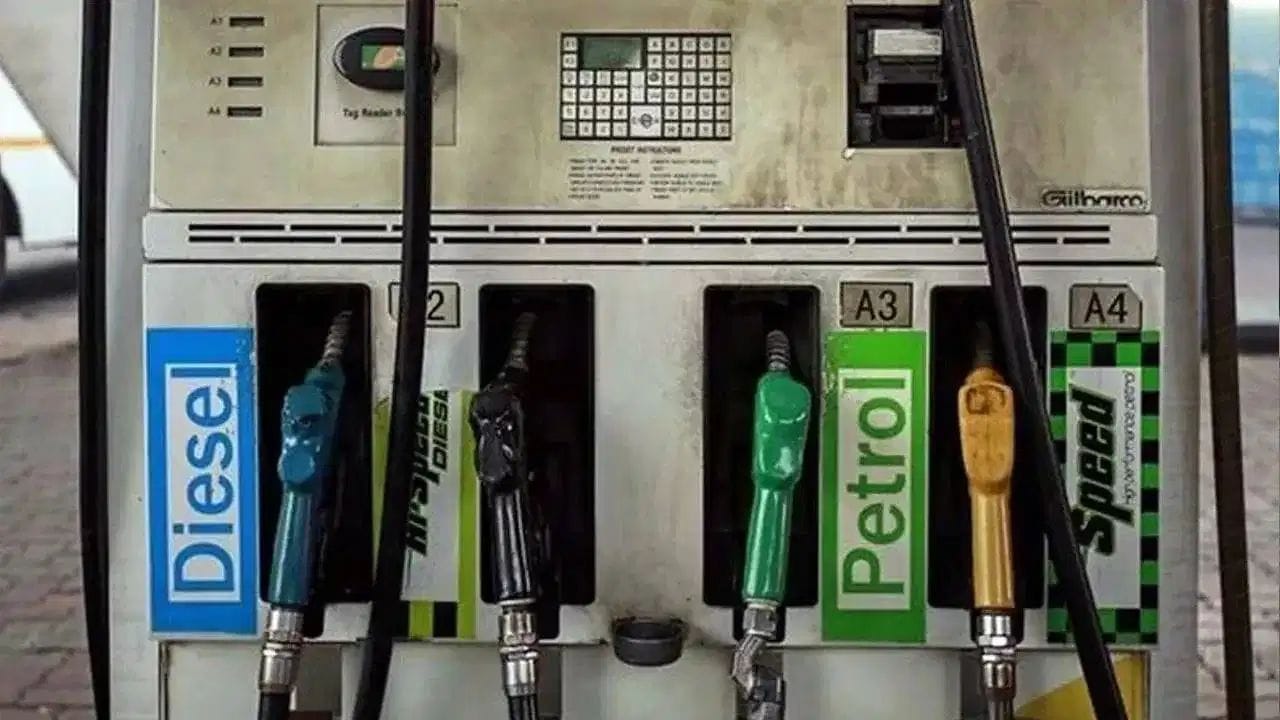
If experts are to be believed, there may be an increase of Rs 25 per liter in the prices of petrol and diesel.
Even after the government increased petrol and diesel prices by Rs 3 per liter last week, Indian fuel retailers are still incurring losses. According to experts, fuel retailers are not able to meet their costs. According to analysts, they need to increase prices by another Rs 25 per liter to break even on marketing margins. These analysts estimate that oil marketing companies (OMCs) are incurring a daily loss of Rs 1,380 crore.
According to calculations done by Nomura analyst Bineet Banka, oil marketing companies are currently incurring a loss of Rs 25 per liter on petrol and diesel (on an average basis). If LPG is also included in this, then their daily loss is increasing to a shocking level of Rs 1,380 crore.
The brokerage firm estimates that if losses continue at this rate without any pause, Indian Oil Corporation (IOCL), Bharat Petroleum (BPCL) and Hindustan Petroleum (HPCL) will lose the entire equity (capital) of their balance sheets within 10, 4 and 2 years respectively.
Which company will suffer the most loss
HPCL is at greatest risk. Nomura wrote that the integrated margin has been most impacted for HPCL because it has a higher share in marketing. The firm estimates that the company is currently incurring a loss of $19 per barrel on an integrated basis. In comparison, IOCL is losing $4 per barrel and BPCL is losing $8, whereas just before the current oil crisis began, all three companies were making profits of $12-14 per barrel.
Gagan Dixit of Elara Capital also pointed towards this weakness. He said that HPCL is the riskiest OMC as its share in retail marketing is higher than in refining capacity. The first quarter of financial year 2027 may be challenging, because crude oil prices are high, product prices are low and there is a lot of volatility in the market.
Elara estimates that an increase of Rs 3 per liter will reduce the annual integrated loss on petrol and diesel by about Rs 34,500 crore. Dixit said that unless crude oil prices improve, further increases in retail prices or additional financial assistance from the government will be required.
As prices increased in 2022
This increase may be just the beginning. Nomura has made a direct comparison with 2022. When Russia invaded Ukraine, fuel prices remained stable for almost a month, while the price of Brent crude increased from about $94 to $110 per barrel.
Subsequently, prices were increased by approximately Rs 0.80 per liter daily for about 15 days, resulting in a total increase of Rs 10 per liter. At that time, OMC’s marketing margins had become extremely negative—losses of around Rs 18 per liter on diesel and around Rs 14 per liter on petrol.
Nomura said the current increase of Rs 3 per liter could be the beginning of a sustained increase in fuel prices – similar to what was seen during the Russia-Ukraine war in 2022. If crude oil prices remain high, prices may start rising gradually further to support OMC margins.
Problems increased due to LPG
Loss of auto-fuel is not the only problem. Losses (under-recovery) in LPG have reached a record high. HPCL management recently told in an analyst call that they are incurring a loss of Rs 670 on each cylinder. According to Emkay, based on current Saudi contract prices ($750 per metric tonne), this figure is Rs 420 per cylinder, but Emkay also believes that the management’s estimate is higher due to the spot cargo premium. Emkay estimates that on a daily basis, there is a loss of Rs 200400 crore in LPG alone. Aviation Turbine Fuel (ATF) is also under pressure. Its rates for domestic scheduled airlines have not changed from April 2026, causing additional losses (under-recovery) in this segment as well.
Re-implemented SAED system
To compensate for OMC’s losses, the government reimposed the system of ‘Special Additional Excise Duty’ (SAED) on standalone refiners on 26 March. This simply means that an upper limit of refining margin has been fixed for companies whose retail sales are low.
On May 15, the SAED on diesel was increased to Rs 16.5 per liter—this was the third time it had been changed. With this change, OMC will compensate to some extent the loss (under-recovery) of about Rs 27.6 per liter on diesel, but this benefit will be available only on that diesel which has been processed more than the capacity of their own refinery.
In March, a reduction of Rs 10 per liter in excise duty on petrol and diesel was also announced. However, Nuvama has warned that this relief may be for some time only. The excise duty cut of Rs 10 per liter on petrol and diesel in March may have to be withdrawn later – especially when oil prices start falling. This means that marketing margins may not return to the levels they were before the war so quickly.
IOCL is in the best position
Of the three OMCs, most analysts agree that IOCL is the least risky company. Nuvama said that given the strong ‘crack margin’ (profit from refining) of diesel and ATF, and the lowest share in fuel marketing compared to refining capacity, we believe IOCL will be in the best position in the current circumstances. Nuvama also said that with the increase in refining capacity in the future, IOCL’s position can become even stronger compared to other companies.
In the case of city gas, the increase in liquid fuel prices has created scope for increasing the prices of ‘Compressed Natural Gas’ (CNG). Both IGL and MGL have increased retail prices by Rs 2 per kg. Emkay estimates that this will improve the EBITDA per standard cubic meter by about Re 1 for each company, which will increase the figure to about Rs 5.5 for IGL and Rs 78 for MGL.
Beating the valuation crisis
Despite the severity of the losses, OMC shares are trading at higher valuations than those seen at the beginning of the Russia-Ukraine war. Nuwama considers this to be an unusual thing. HPCL, which is the most affected among the three, is trading at a valuation nearly 77 per cent higher than its pre-war levels, while facing the highest integrated loss.
Emkay is adopting a cautious approach towards OMC and city gas distributors. The brokerage said that we believe that as the crisis continues, auto-fuel retail prices may increase further, but this increase will be gradual. The brokerage has maintained ‘Add’ ratings on IOCL, BPCL, HPCL, IGL and MGL, while terming price volatility and high levels as a significant risk.