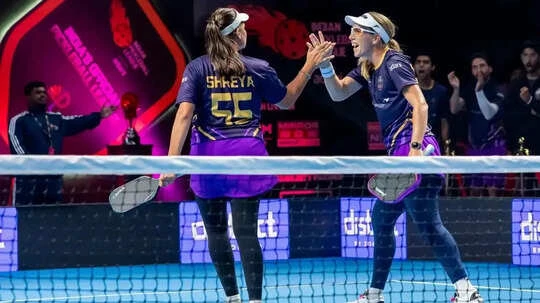
The rallies may last only seconds, but for many Indian pickleball players, the biggest lessons were learned between points when they interacted with global stars.
Inside practice sessions, recovery rooms and tactical discussions, Indian players found themselves sharing space with professionals who had spent years competing on the global circuit. What followed was more than just a league season. It became an accelerated education in how elite pickleball operates.
For India star Shreya Chakraborty, training alongside American star Megan Fudge (during the Indian Pickleball League) changed the way she viewed the sport.
“Megan changed the way I think about points,” Shreya said in an exclusive chat with Sports Now. “Earlier, I used to focus only on finishing rallies quickly. She taught me how to construct points patiently, how to reset under pressure and how to stay calm during long exchanges. Even the way she warmed up before matches was different. Everything had purpose.”
That shift from instinctive play to structured tactical thinking has emerged as one of the IPBL’s biggest changes.
Learning The Soft Game And Mental Discipline
For years, Indian pickleball players relied heavily on athleticism and fast hands. The arrival of international professionals exposed them to a more calculated version of the sport, built around transition play, patience, and percentage-based decision-making.
Several Indian players admitted that they were surprised by how little panic foreign professionals showed during difficult moments.
“The emotional control stood out,” recalled Tejas Gulati while speaking on the sidelines of the Kolkata Open. “Even after losing three or four points in a row, they stayed completely composed. There was no frustration. They just reset mentally and continued.”
Lucknow Leopards star Mihika Yadav said the league had transformed her understanding of professional pickleball.
“You know, first of all, it’s an honour, like it’s a privilege to be part of the Indian Pickleball League. I was just so happy to be part of India’s first official league, and then my team believed in me and allowed me to go out and compete in singles, showing faith in my ability,” Mihika said.
“So just positives, and just, you know, I’ve learned so much over the past seven days being part of a team with such experienced players like Ryler DeHeart and Shelby Bates, who are competing at the highest level. So nothing but a big learning experience, and I think I’m going to walk out a new, different player after the league.
Beyond Matches: Recovery, Routine And Professional Habits
What Indian players are learning, however, extends well beyond tactics.
Foreign professionals introduced routines that many younger Indian athletes had never experienced firsthand. Recovery schedules, hydration tracking, mobility work and nutrition planning quickly became a part of conversations. Players who once left courts immediately after matches were now stretching for 30 minutes, discussing paddle balance or reviewing video clips between fixtures
“The biggest surprise was how seriously they treated recovery,” Shreya said. “Ice baths, stretching, food timing, sleep schedules. Nothing was random. It made us realise that pickleball at the top level is no longer casual.
That professionalism is beginning to influence India’s wider pickleball culture.
The league’s team structure also created learning opportunities rarely available in individual tournaments. Young Indian players suddenly found themselves travelling, training and competing alongside experienced international professionals every day.
Those interactions often became informal classrooms.
The impact has been particularly significant for women players, who now see clearer pathways emerging within the sport. Mihika believes the league’s visibility could encourage a new generation of girls to take up pickleball.
“Definitely. You know I’ve always said this is something I’ve spoken about time and time again,” she said. “I really, really hope that more women and more young girls get into sports because the potential is immense, and we have it in us to play at the highest level.
“We have to believe in ourselves. With the right support and with the awareness that the league has created, I think that’s going to motivate and inspire people to pick up a paddle and play.
That wider cultural shift may ultimately become the IPBL’s biggest contribution.
India already had players with athletic ability and competitive instinct. What the league offered was exposure to systems, habits and standards that accelerate development much faster than isolated tournaments can.
While the gap between Indian players and established international professionals has not disappeared. But within the IPBL, many players believe they finally saw what elite pickleball truly looks like up close. And perhaps more importantly, they now believe they belong there too.