By Mr. Sudheesh AvikkalUnited Nations Representative, AWWG — UN ECOSOC & Sports Entrepreneur
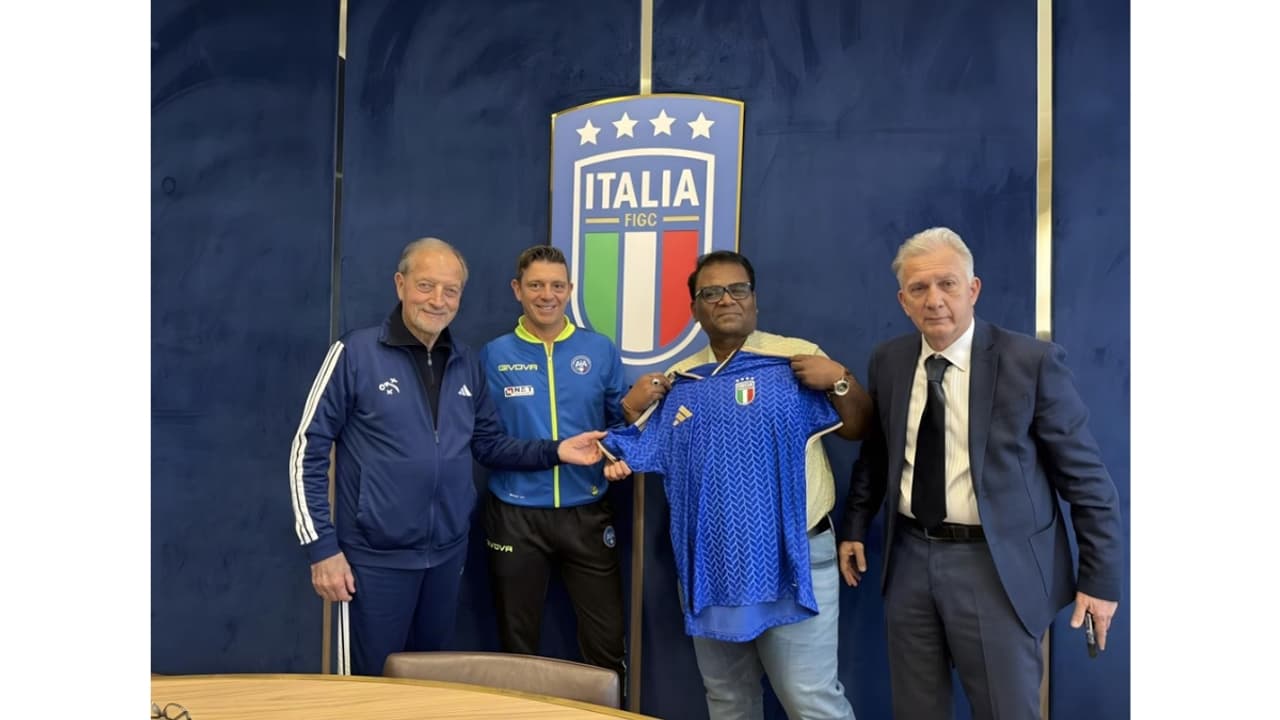
Sudheesh Avikkal With Renzo Ulivieri (Italian football Managers association) and Fredi Fiorentini
When the world discusses development, we usually speak the language of finance, infrastructure, governance, education, health, and security. Rarely do we speak with equal seriousness about sport. That omission is costly.
“Sport is not a distraction from development; it is one of the most overlooked tools for achieving it”
Sport is often placed in the category of leisure. It is something we celebrate during the Olympics, debate during World Cups, and consume as entertainment. But for millions of people — especially young people in fragile and unequal societies — sport can be much more. It can be a school of discipline, a source of health, a shield against violence, a platform for gender equality, and a bridge between divided communities.
The United Nations has long understood this potential, which is why 6 April is observed as the International Day of Sport for Development and Peace. Yet sport still remains underused in global development strategy. It is acknowledged symbolically, but not always funded seriously. It is praised in speeches, but not consistently integrated into national plans, donor priorities, or SDG implementation frameworks.
This gap must be closed.
Few human activities possess the universal reach of sport. It crosses language, religion, nationality, and class. A child does not need a policy document to understand a game. A community does not need ideological agreement to gather around a match. A team can bring together people who might otherwise never share the same space.
Nelson Mandela understood this with extraordinary clarity. When South Africa won the Rugby World Cup in 1995, the victory became an act of national healing. Mandela’s use of the Springboks as a symbol of unity showed that sport can sometimes do what politics alone cannot: speak to the emotional imagination of a nation. It helped South Africans see, even briefly, the possibility of shared belonging after the trauma of apartheid.
The evidence today confirms that such moments are not isolated miracles. According to figures cited from the UN Office on Sport for Development and Peace, sport-based programmes have reached over 60 million youth across conflict-affected and developing regions. The economic argument is equally persuasive. Findings cited by the Commonwealth Secretariat estimate that every US$1 invested in sportbased youth development in fragile states yields US$3.8 in measurable social and economic value.
In other words, sport is not merely inspiring. It is cost-effective.
The SDG Case for Sport
Its contribution to the Sustainable Development Goals is direct and practical.
Consider SDG 3 — Good Health and Well-Being. Physical inactivity is a global crisis with a major economic cost. The Lancet figures cited in the original article estimate that physical inactivity costs the global economy US$54 billion in direct healthcare expenditure annually, along with an additional US$14 billion in lost productivity. Making sport accessible at community level is therefore not a luxury. It is one of the simplest preventive health measures available to governments.
Consider SDG 4 — Quality Education. Education is not only about literacy and examinations; it is also about concentration, confidence, cooperation, and character. UNESCO research cited in the original article finds that children engaged in regular physical activity show up to 40% improvement in cognitive performance and concentration. Across Sub-Saharan Africa, South Asia, and Latin America, sport-inschool frameworks are being used to improve attendance, reduce dropout rates, and build skills such as teamwork and discipline. These are not secondary benefits. They are essential foundations for citizenship and employability.
Consider SDG 5 — Gender Equality. Sport is one of the most visible arenas in which gender norms are challenged. Women’s participation in the Olympics has risen from under 30% in 1992 to nearly 49% at Paris 2024. That progress did not happen by accident. It was the result of deliberate policy, institutional pressure, and changing public expectations. At the grassroots level, sport can be even more transformative. Programmes for adolescent girls in marginalised communities have been shown to improve school retention, reduce child marriage rates, and build the confidence needed to participate in public life.
Now consider SDG 10 and SDG 16 — Reduced Inequalities and Peace, Justice and Strong Institutions. In divided societies, sport can create a rare form of equal encounter. A well-governed sports programme can bring together people separated by ethnicity, income, geography, or past conflict. Community sport leagues in post-conflict zones have reduced inter-communal violence. In Rwanda, government-supported grassroots football programmes have been formally documented as contributing to reconciliation after the 1994 genocide.
Why Sport Belongs in Development Policy
Of course, sport is not a magic solution. A football match cannot replace justice. A school sports programme cannot substitute for economic reform. A community league cannot by itself end structural inequality. But this is the wrong standard by which to judge sport. No serious development tool works alone. Health, education, peacebuilding, and economic inclusion all require multiple interventions. Sport should be one of them.
The real question is not whether sport can solve every problem. The question is whether we can afford to ignore a tool that improves health, strengthens education, empowers girls, supports reconciliation, and produces measurable economic returns.
As the United Nations Representative of AWWG to the UN ECOSOC, my view is that sport must be moved from the ceremonial margins to the operational centre of development policy. Governments should invest in community sports infrastructure. Schools should integrate physical activity into learning strategies. Donors should fund sport-based youth development. Civil society should design inclusive programmes for girls, marginalised communities, and conflict-affected youth. Multilateral institutions should measure sport’s contribution to the SDGs with the same seriousness applied to other development interventions.
From Applause to Policy
The world does not lack evidence. It lacks urgency.
Sport is already doing development work in communities across the world. It is keeping children in school, helping young people avoid violence, improving public health, and creating spaces for reconciliation. What it needs now is not applause, but policy.
The whistle has blown. The world must stop treating sport as a side event — and start recognising it as one of development’s most powerful playing fields.
Author: Mr. Sudheesh Avikkal is the United Nations Representative of AWWG — UN ECOSOC.