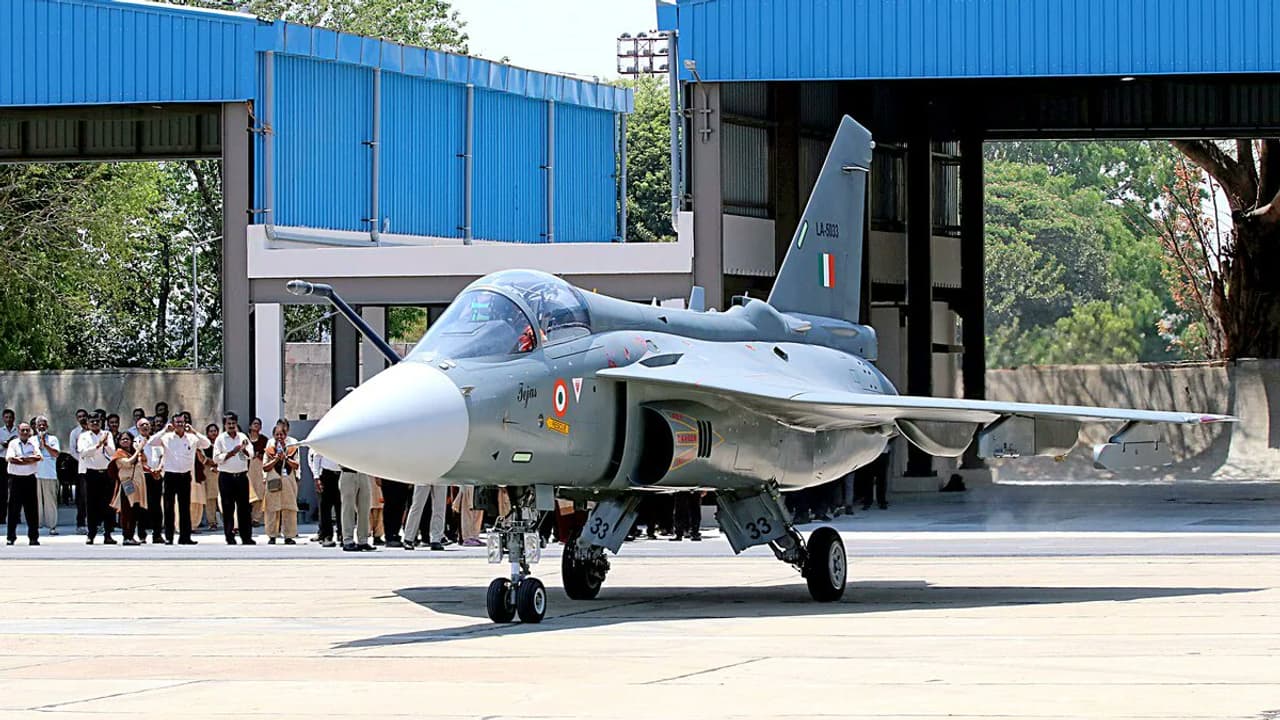
The delivery of HAL’s Tejas-MK1A aircraft has been delayed by more than 2 years. Due to engine and software problems, there is now a new promise of delivery from August-September 2024. The Air Force will accept only fully certified aircraft.
New Delhi: Ravi Kota, the new Chairman and Managing Director of Hindustan Aeronautics Limited (HAL) has met the Chief of the Indian Air Force (IAF), Air Chief Marshal AP Singh. In this meeting, he presented a new schedule for the delivery of the long pending Tejas-MK1A light combat aircraft.
According to defense sources, the meeting held in New Delhi clearly reflected the growing urgency regarding this program, which has been continuously missing its target since the historic contract of 2021. HAL has promised that it will start deliveries between August and September this year. Whereas as per the original schedule, the Air Force should have had two full squadrons of Tejas-MK1A jets by now. This program has been delayed by more than two years and till mid-May not a single aircraft has been handed over to the Air Force. Whereas according to reports, HAL already has more than 20 airframes and six GE F404 engines.
New chief, old problem
Ravi Kota is known as the “LCA Man” in the defense sector due to his long association with the Tejas programme. But his appointment to the top post of HAL has come with a big test. The organization he now leads has failed to fulfill the promises made to the country’s Air Force for the last three years.
A formal program review meeting between HAL and senior Air Force officials is scheduled for June 2026. Vice Chief of Air Staff, Air Marshal AK Bharti and test pilots will also be included in it. This meeting was to be held last month.
The main agenda of this meeting will be integration of the Active Electronically Scanned Array (AESA) radar with the electronic warfare system of the aircraft, completion of missile firing trials and certification of the entire weapon package. The Air Force has made it clear that none of these things will be considered optional. Before including any aircraft in operational service, all of them are required to be certified.
How the deadlines kept slipping
The IAF had signed a contract worth Rs 48,000 crore for 83 Tejas-MK1A fighter jets in February 2021. This was the largest indigenous defense procurement in India’s history at that time. Deliveries were to begin by March 2024. The first delay occurred when the supply of F404-IN20 engines from General Electric (GE) was disrupted, pushing the delivery date to March 2025.
This was followed by a second delay due to software validation challenges and non-completion of radar trials, pushing the target beyond March 2026. Now the delivery of the entire order of 83 aircraft has been extended to 2031. Engine availability still remains a major concern. GE missed an important target for delivery of the batch of F404-IN20 engines in March 2026, which directly impacted HAL’s production line.
To add to the problem, engineers faced major problems in software integration between the aircraft’s radar system and the indigenous ‘Astra’ beyond-visual-range missile. Due to this, a lot of work had to be done before resuming flight trials.
IAF’s declining combat strength
This delay has a strategic cost that cannot be ignored. The Air Force currently has only 29 fighter squadrons against the sanctioned strength of 42 squadrons. Defense planners call this a serious operational shortcoming given India’s two-front security environment.
The Air Force has retired older MiG-21 variants in recent years without any true replacement. Due to this, it has become more dependent on platforms like Sukhoi-30MKI and Dassault Rafale to maintain its strength.
The IAF has clearly stated that it will not accept any aircraft which does not meet all the required operational standards. According to sources, there will be no compromise on the Air Force’s insistence on complete certification before inducting the aircraft.
indigenous radar
On the technology development front, flight trials of the indigenously developed ‘Uttam’ AESA radar are going on at a rapid pace. The current production batch of Tejas-MK1A is fitted with the Israeli Elta EL/M-2052 AESA radar, which provides advanced target detection and tracking capabilities. However, there are plans to switch to the ‘Uttam’ system in future production lots. Defense planners consider this step necessary to reduce India’s dependence on foreign avionics suppliers. DRDO has described the ‘Uttam’ program as being in an advanced stage, although it is yet to be integrated with production aircraft.
Big roadmap of Tejas
Tejas-MK1A is part of a larger and ambitious roadmap. HAL is also developing Tejas-MK2, a heavier and more capable variant equipped with the GE F414 engine. Its purpose is to fill the role of a medium-weight fighter. Additionally, the IAF has ordered 97 more Tejas LCA Mk1A variants, work on which is also underway.