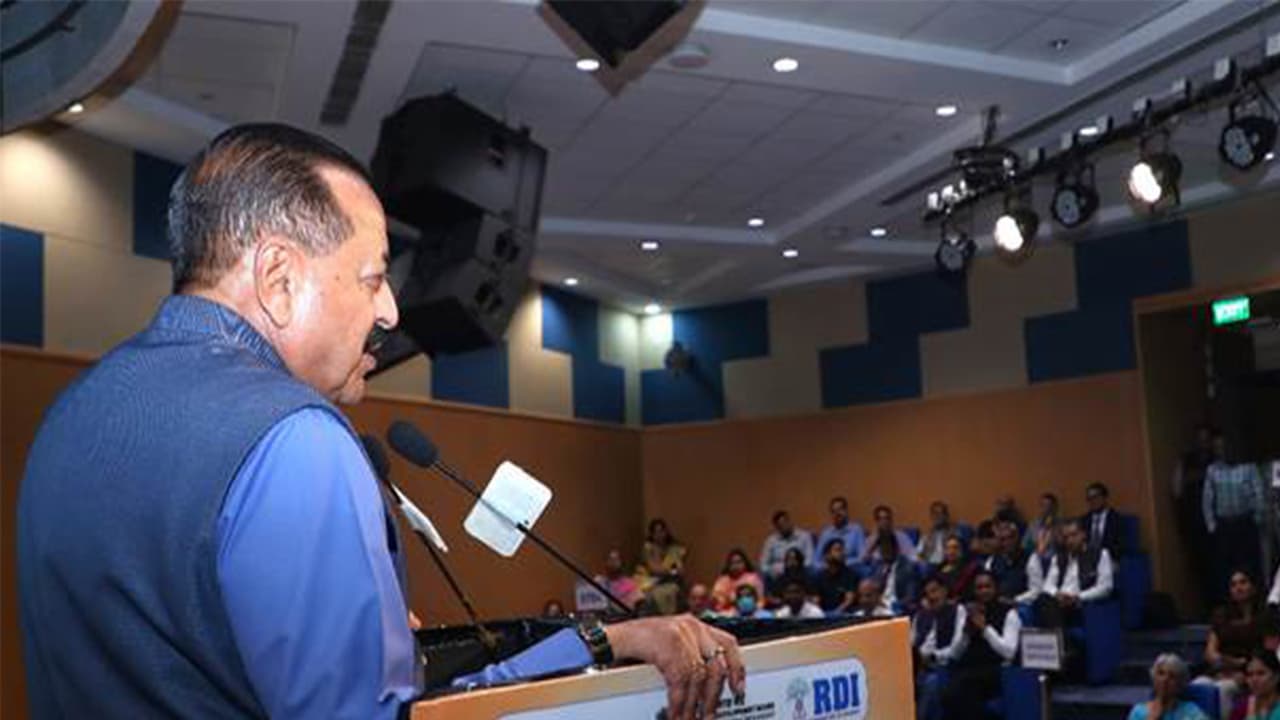
Union Minister Jitendra Singh said quantum and AI sovereignty will drive India’s growth. The govt launched the RDI Fund Scheme to boost private R&D, with the first fund disbursement of Rs 50 crore going to M/s Eyestem Research Private Limited.
Union Minister of State (Independent Charge) Jitendra Singh on Saturday said that quantum and Artificial Intelligence (AI) sovereignty, along with indigenous ecosystems, will define India’s next-generation growth.
According to a press release issued by the Ministry of Science & Technology, the Minister said India’s future growth in deep-tech sectors will depend on the country’s ability to adopt a trusted integrated approach, and this is precisely what prompted the launch of the “Research, Development and Innovation (RDI) Fund” Scheme, which is aimed at accelerating private sector participation in research and development.
RDI Fund Launch and Key Initiatives
Addressing a programme organised by the Technology Development Board (TDB), Department of Science and Technology, at Ambedkar International Centre, New Delhi, Jitendra Singh highlighted that India is moving towards a new phase of innovation-driven growth through coordinated initiatives in quantum technologies, deep-tech financing and industry-led research ecosystems.
During the programme, agreements for five projects under the RDI Fund Scheme were signed, the first electronic fund disbursement under the scheme was released, a compendium on the status report of the RDI Scheme was launched, and a report on “Quantum-Safe Ecosystem in India” was formally released.
Marking another major milestone under the RDI framework, TDB also carried out the first electronic fund disbursement under the scheme. As part of the initial tranche release, Rs 50 crore was electronically transferred to M/s Eyestem Research Private Limited to support the advancement and commercialisation of its indigenous cell therapy platform.
Compendium on RDI Scheme
As per the official release, “A Compendium on the Status Report of Technology Development Board (TDB) as the Second Level Fund Manager (SLFM) under RDI Scheme till April 2026 was also released during the programme. The compendium presents the progress achieved by TDB in operationalising the RDI Fund, encompassing details of proposals received, sector-wise distribution, project evaluation and appraisal mechanisms, approved projects, funding trends, and the Board’s sustained efforts towards enabling the commercialisation of high-impact cutting-edge indigenous technologies across strategic sectors.”
“The publication further highlights the emerging innovation landscape under the RDI initiative by showcasing projects spanning deep-tech, biotechnology, artificial intelligence, space technologies, healthcare, energy transition, climate technologies, and digital infrastructure, thereby reflecting the growing momentum of India’s research-to-commercialisation ecosystem,” the release said.
A Proactive Approach to Foster Innovation
Highlighting the importance of the RDI initiative, Jitendra Singh said that the Government, under Prime Minister Narendra Modi, has adopted several out-of-the-box approaches to strengthen India’s innovation ecosystem and create enabling conditions for private investment in research and development. He noted that, unlike conventional models where governments expect industry participation independently, India has adopted a proactive approach by creating institutional and financial support mechanisms for private-sector-led innovation.
The Minister said the initiative reflects the Government’s commitment to creating an ecosystem where startups, MSMEs and industry can emerge as long-term innovation partners. Referring to the broader reforms undertaken in sectors such as space and deep technology, he said the Government has consistently encouraged institutional openness and stakeholder participation. He noted that reforms in the space sector have demonstrated how strategic policy interventions can unlock innovation and public participation in advanced technology sectors.
Focus on Quantum Technology and Cybersecurity
Jitendra Singh also highlighted the growing significance of quantum technologies and said India is now among the select group of countries actively investing in quantum communication, quantum computing, quantum sensing and quantum materials under the National Quantum Mission. He noted that India had originally set a target of achieving 2,000 km quantum-secure communication capability in eight years, but the country has already achieved nearly half that target in less than four years, reflecting the pace of progress under the Mission.
Emphasising the importance of future cybersecurity preparedness, the Minister stated that emerging quantum computing capabilities may pose significant challenges to existing cryptographic systems currently used in banking, governance, telecom and strategic infrastructure. He noted that post-quantum cryptography, quantum key distribution and quantum-safe infrastructure will become critical for long-term national security and trusted digital governance. He also stressed the need to make technical knowledge more accessible through digital platforms, AI-enabled outreach tools and simplified communication formats for innovators and startups.
Expert Commentary on Deep-Tech and Quantum Preparedness
Principal Scientific Adviser to the Government of India, Prof. Ajay Kumar Sood, described the RDI Fund as a potentially transformative initiative capable of catalysing large-scale private investment in deep-tech research and innovation. He highlighted that the implementation of the initiative within a relatively short time reflects the Government’s commitment to speed and scale in policy execution.
Referring to the release of the “Quantum-Safe Ecosystem in India” report, he said the country must prepare proactively for the “Q-Day” scenario when current encryption systems could become vulnerable to quantum computing capabilities. He emphasised the need for national preparedness in post-quantum cryptography, quantum-safe communication systems and secure digital infrastructure across sectors such as finance, healthcare and governance.
Secretary, Department of Science and Technology and Chairperson, TDB, Abhay Karandikar, highlighted that the RDI initiative represents one of the most significant government interventions aimed at strengthening private-sector-led R&D in India. He said the implementation process involved extensive collaboration among experts, investment committees, scientific institutions and industry stakeholders working voluntarily over several months to operationalise the initiative. He expressed confidence that the RDI framework would help crowd in private capital investment, strengthen deep-tech innovation and support the development of globally competitive technologies and startups in the country.
Secretary, TDB, Rajesh Kumar Pathak, highlighted the rapid operationalisation of the RDI initiative and stated that TDB became the first Second Level Fund Manager to launch project proposal calls, sign agreements and release funds under the scheme. He informed that the initiative received 124 project proposals within a short period, representing project demand worth more than Rs 25,000 crore. He also noted that the selected projects span startups, MSMEs and listed companies across sectors, including health, energy, quantum technologies and advanced manufacturing.
“The 22 companies selected by TDB for funding under the Research Development and Innovation (RDI) Fund are some of the best startups in the country, and some of them (15) have been selected through a nationwide search as part of the Bharat Innovates 2026, a global showcase of India’s Technology Innovation, scheduled to be held in Nice, France in June,” he added.
The programme also included the release of a compendium on the RDI Scheme status report and discussions on strengthening India’s quantum-safe ecosystem through indigenous innovation, secure communication systems and collaborative technology development frameworks.
The event concluded with a renewed commitment towards accelerating India’s deep-tech innovation ecosystem in line with the vision of Atmanirbhar Bharat and Viksit Bharat 2047. The event was attended by Principal Scientific Adviser to the Government of India, Ajay Kumar Sood; Secretary, Department of Science & Technology and Chairperson, TDB, Abhay Karandikar; Secretary, TDB, Rajesh Kumar Pathak; senior officials, members of the TDB Board, investment committee members and representatives from industry, startups, and research institutions. (ANI)
(Except for the headline, this story has not been edited by Asianet Newsable English staff and is published from a syndicated feed.)