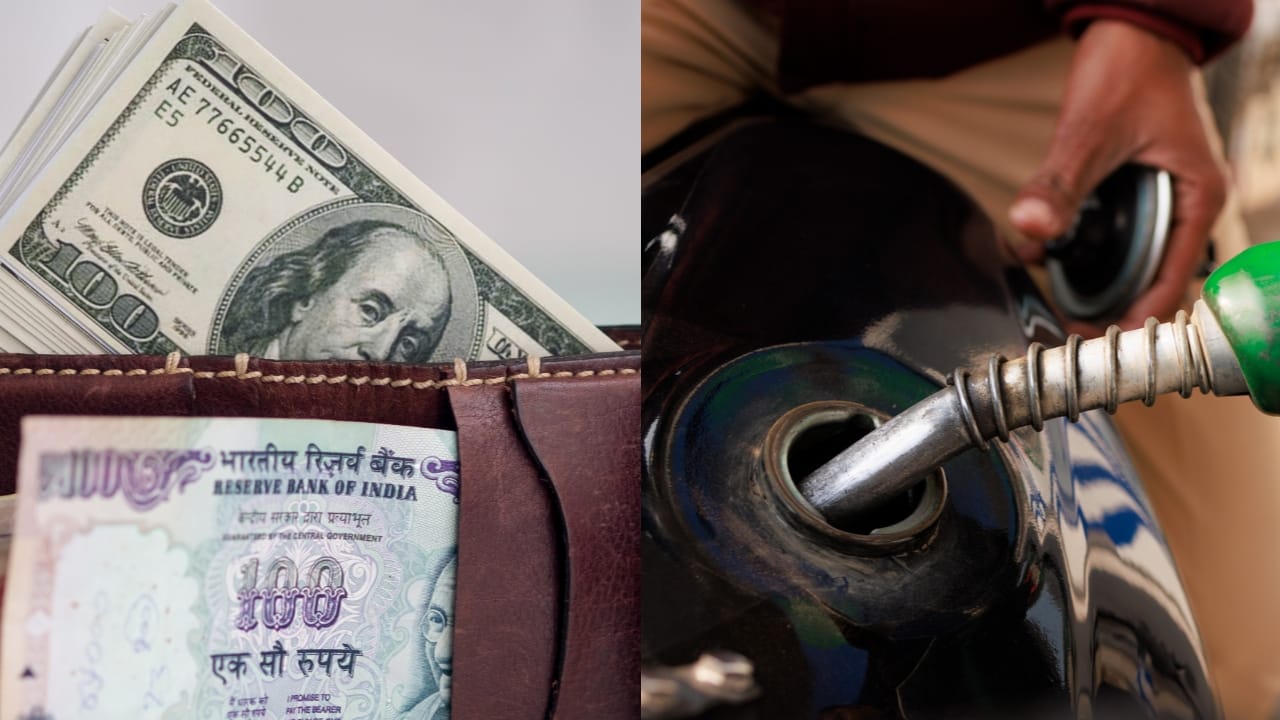
Kolkata: The rupee has sunk to a new low against the dollar and the continuing decline in the value of the rupee packs in an ominous possibility — that the gains of the oil marketing companies from the rise in retail prices of petrol and diesel effected from May 15 can quickly evaporate. In a report SBI Research, the policy research wing of the State Bank of India, has mentioned that any further depreciation of the rupee will result in a complete surrender of the gains from the retail price rise. “Our calculations show that even an additional depreciation of Rs 2 in the rupee (from FY27 current average at Rs 94 stays put) raises the effective crude oil price, pushing the landed import cost, which fully offsets the gains from the current fuel price hike,” wrote SBI Research in its report.
While the government wants to rein in the fall in the value of the rupee desperately, on May 15, the Indian currency dived past the 96 mark against the US dollar for the first time. It recovered slightly at close and closed at a historic low of 95.81 against the US dollar.
Rupee reaches a critical depreciatrion threshold
“The rupee has already approached a critical depreciation threshold, beyond which further currency weakness could substantially erode the intended benefits of domestic fuel price revisions,” the SBI Research report added. It also mentioned that IEA (International Energy Association) thinks “crude will continue to remain under pressure owing to the depleting inventories. Assuming flows through the Strait gradually resume from June, IEA projects global oil supply to decline by 3.9 mb/d on average in 2026, to 102.2 mb/d. Meanwhile, world oil demand is forecast to contract by 420 kb/d y-ory in 2026, to 104 mb/d, 1.3 mb/d less than the pre-war forecast.”
Modi’s appeal to curb consumption
It is to arrest the fall in the value of the rupee that PM Modi urged the people to curb consumption of petrol, diesel, edible oils, fertilisers and gold — items that need to be imported in large quantities. The import of these raise the demand of US dollars in the country, which in turn, drive down the vaue of the rupee against the dollar.
Another impact of the falling rupee is the heavy selling of Indian stocks by FIIs (foreign institutional investors). The offloading of equities by FIIs also creates a big demand for US dollars which keeps lowering the value of the rupee, which again fuels more selling. Thus a vicious cycle is created.