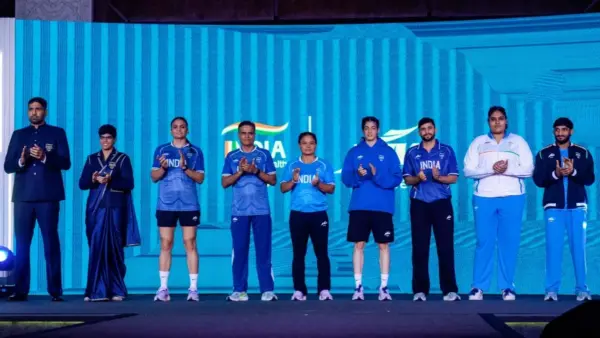
When India announced its 126-member squad for the 2026 Commonwealth Games (CWG 2026), the focus naturally centred on the athletes selected.
But as Glasgow prepares to stage the leanest edition of the Games in more than three decades, a bigger question looms over the Indian contingent.
Can India extend its remarkable streak of top-five finishes despite losing nearly half of its traditional medal opportunities?
At the 2010 CWG hosted in New Delhi, hosts India had a 495-athletes-strong contingent winning a total of 101 medals. For the 2014, 2018 and 2022 Games the country sent 215, 218 and 210 athletes respectively, returning with 64, 66, and 61 medals respectively.
Since Manchester 2002, India have finished among the top five nations at every Commonwealth Games, evolving into one of the competition’s most consistent performers. That consistency, however, faces its sternest examination yet.
The 2026 edition has been drastically trimmed after Victoria’s withdrawal as host forced Glasgow to rescue the Games at short notice. Only ten sports feature on the programme, with wrestling, badminton, table tennis and shooting all omitted – disciplines that have formed the backbone of India’s Commonwealth success for years.
Those four sports alone contributed 25 of India’s 61 medals in Birmingham 2022, including a significant share of the country’s gold medals. Without them, India’s medal equation changes dramatically.
Athletics shoulders unprecedented responsibility
If India are to remain among the Commonwealth’s elite, athletics will likely determine the outcome. The country has fielded the maximum permissible 32-member athletics squad, its largest contingent across all sports, highlighting where expectations lie.
Leading the charge is Olympic double medallist Neeraj Chopra, though unlike previous major championships, he enters Glasgow without the tag of overwhelming favourite.
Sri Lanka’s Rumesh Tharanga has emerged as the season’s biggest surprise after breaching the 92-metre mark, while Pakistan’s Olympic champion Arshad Nadeem remains a formidable rival.
Yet India’s hopes extend far beyond Chopra.
National record-holder Sarvesh Kushare has steadily established himself among Asia’s best in the high jump. Long jumper Murali Sreeshankar returns to another major championship with expectations of another podium finish, while Praveen Chithravel has become one of India’s most reliable performers in the triple jump.
The men’s and women’s 4x400m relay teams also arrive as genuine medal contenders after consistently producing strong performances over the past few seasons.
Athletics contributed eight medals in Birmingham. Matching that number would significantly strengthen India’s chances of another top-five finish.
Mirabai Chanu remains India’s safest bet
Few Indian athletes have been as dependable at the Commonwealth Games as Mirabai Chanu. The Olympic silver medallist returns seeking a third successive Commonwealth gold, and despite a trimmed Indian weightlifting squad, she remains one of the country’s strongest gold-medal prospects.
Weightlifting has traditionally been India’s richest hunting ground at the Commonwealth Games, but this edition presents fresh challenges.
Several positive dope tests during the national camp forced a reduction in India’s squad, limiting medal opportunities in a discipline that has consistently delivered double-digit returns.
That makes every remaining lifter’s performance even more significant.
Boxing expected to fill the void
Boxing could emerge as India’s biggest medal contributor. Olympic bronze medallist Lovlina Borgohain headlines a talented squad aiming to compensate for the absence of wrestling and badminton. The Assam pugilist will also be the flag bearer of the Indian contingent at the opening ceremony.
World champion Jaismine Lamboria enters Glasgow with genuine gold medal aspirations after settling for bronze four years ago, while Asian champion Preeti Pawar, Sakshi Chaudhary and Arundhati Choudhary strengthen India’s women’s challenge.
Among the men, heavyweight Narender Berwal and World Cup medallist Sachin Siwach are expected to spearhead India’s medal hunt.
If the boxers convert their opportunities into multiple podium finishes, India could significantly offset the medals lost from the omitted sports.
Lawn bowls and judo could once again deliver surprises
One lesson from Birmingham 2022 was never to underestimate India’s so-called smaller disciplines.
The historic women’s lawn bowls gold became one of the defining moments of the Games, while the men’s team also reached the podium.
Judo quietly added three medals four years ago and will once again look to outperform expectations.
Even a handful of medals from these disciplines could prove decisive in the overall standings.
Para athletes gain greater prominence
For the first time, para events are integrated across six sports, providing India’s para athletes with a larger platform.
Having enjoyed consistent success across para competitions in recent years, India expects another healthy medal contribution from this contingent.
Those medals may ultimately become crucial in the battle for a top-five finish.
A different kind of Commonwealth challenge
Unlike previous editions, India’s success in Glasgow may not be judged purely by the final medal tally. The reduced programme means matching Birmingham’s haul of 61 medals is virtually impossible.
Instead, the benchmark will be whether India can maintain its place among the Commonwealth’s leading sporting nations despite losing four of its biggest medal-producing sports.
If athletics, boxing and weightlifting perform to expectations, supported by contributions from lawn bowls, judo and para events, another top-five finish remains within reach.
But Glasgow 2026 presents perhaps the toughest Commonwealth Games challenge India has faced in more than two decades-and overcoming it would underline the country’s growing strength across Olympic sports.