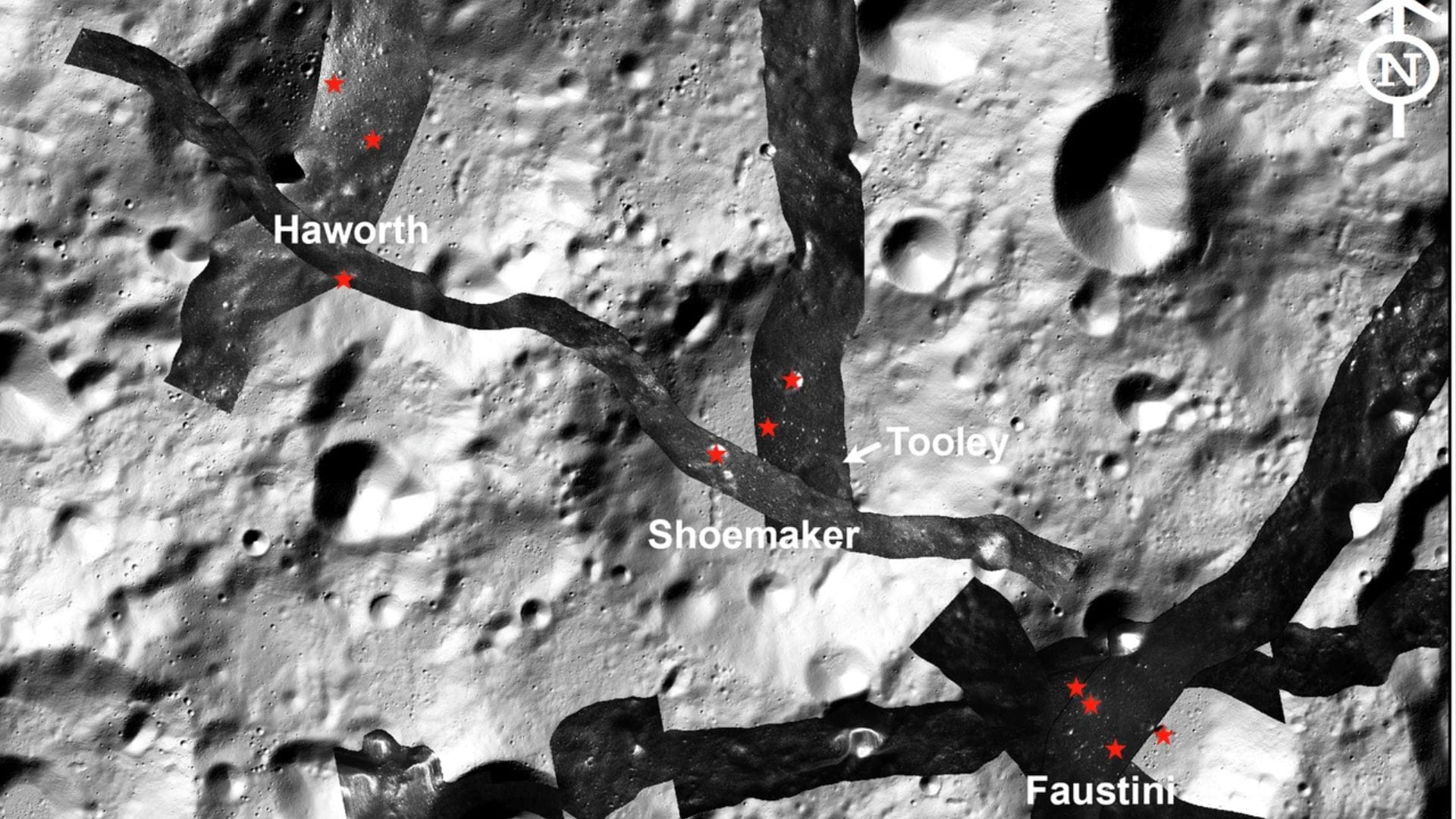
New Delhi: Scientists from the Physical Research Laboratory (PRL) in Ahmedabad have found strong signs of buried ice in the coldest craters surrounding the Lunar South Pole. These are doubly shadowed craters nested inside larger permanently shadowed regions. Their raised rims block direct sunlight, and also scatter light and heat from nearby sunlit areas. This keeps their interior temperatures as low as −248 °C, cold enough for ice to remain stable for billions of years. Such ice can provide valuable resource for future crewed missions, as a source of water, oxygen and rocket fuel. Previous radar data had provided mixed results, but the new study using sharper instruments settles the question.
The researchers examined nine doubly shadowed craters inside the larger craters of Faustini, Haworth and Shoemaker using the Dual Frequency Synthetic Aperture Radar on the Chandrayaan 2 orbiter. This instruments sends radio waves in two wavelengths and measures how they bounce back with deflect back with different polarisations. Four craters showed clear signs of buried ice, with volumetric scattering of the radio waves. Here, the radio waves bounced around multiple times inside ice-rich material. Without the presence of the buried ice, a rough surface would have been detected.
Patchy distribution of ice
The strongest evidence is from a roughly kilometre wide crater within Faustini. It displays both the radar ice signature and a distinctive lobale-rim shape, suggesting that the impact dug into a layer of subsurface ice. Three other craters also indicate the presence of subsurface ice, though less dramatically. The findings reveals that the ice on the Moon is not uniform, but occurs in patches. The research also confirms that the doubly shadowed craters are excellent cold traps, and strengthen the case for harvesting lunar ice to support a sustained, long-term human presence on the lunar surface. A paper describing the research has been published in Nature.