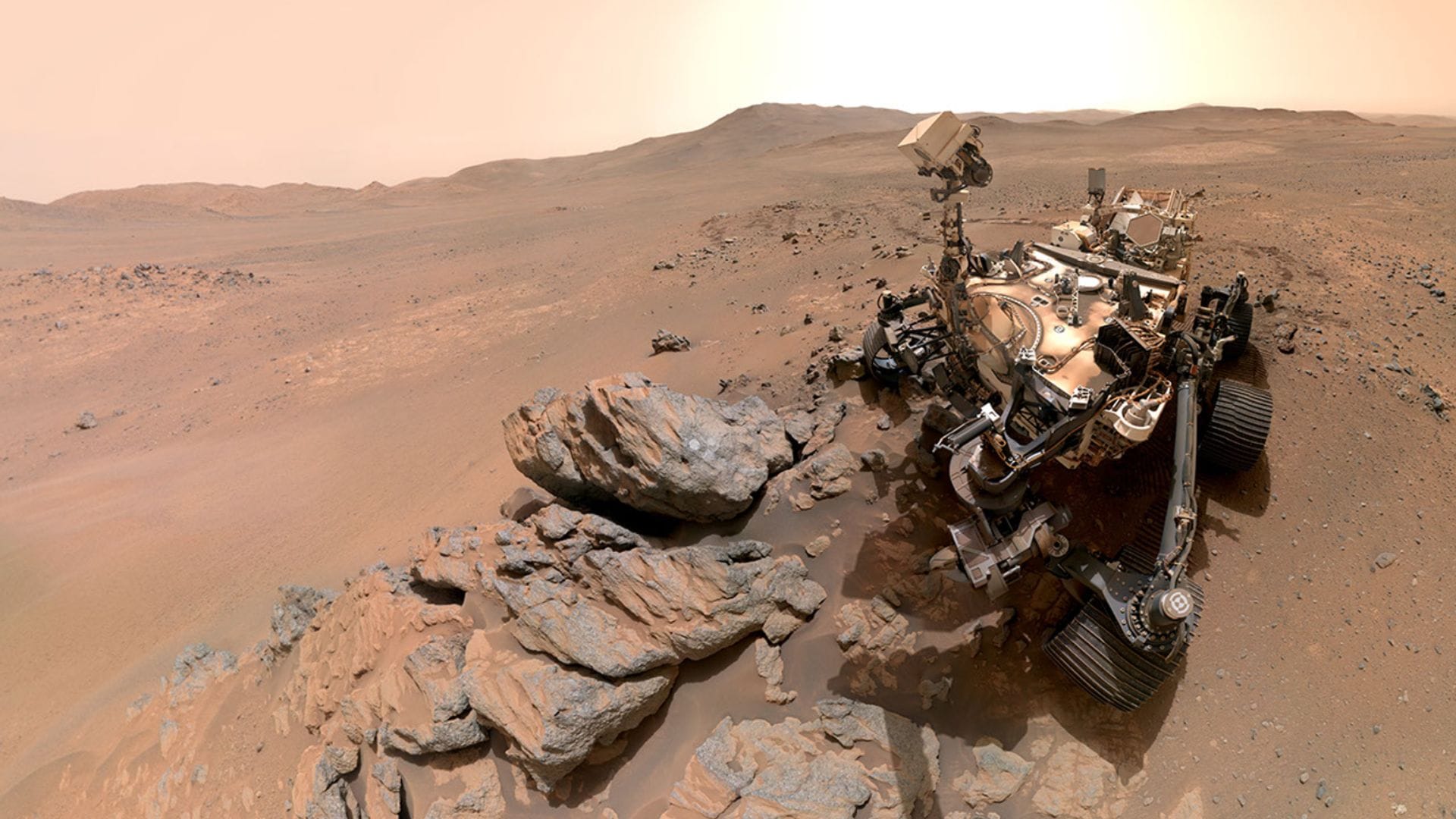
New Delhi: NASA’s Perseverance Mars Rover has captured a selfie on 11 March, 2026 on the 1,797th Martian day or Sol of its mission. The composite image is assembled from 61 individual frames captured by the WATSON camera on board the rover, and shows Perseverance positioned beyond the western edge of the Jezero Crater. Perseverance directed its mast towards a rocky outcrop named ‘Artehusa’ after creating a whitish circular abrasion patch for scientific analysis of Martian material. The western rim of the crater appears in the background. WATSON, mounted on the robotic arm, is part of the SHERLOC instrument used for detecting organic compounds and minerals through Raman and luminescence spectroscopy.
Capturing a selfie involves the rover’s arm extending the camera to photograph the vehicle from multiple angles, relaying the data to Earth, where they are stitched together. Another version depicts the rover facing the camera directly. Perseverance has previously captured selfies in a region named the Witch Hazel Hill, and another at the floor of the Jezero crater, that also included the Ingenuity helicopter in the background. Perseverance and Ingenuity are nicknamed Percy and Ginny. Such selfies also allow the ground teams to assess wear and tear on the rover.
Rover Operations
The WATSON camera was developed by Malin Space Science Systems in San Diego, that jointly operates the instrument along with NASA’s Jet Propulsion Laboratory. Perseverance is built and operated by the Jet Propulsion Laboratory for NASA and managed by Caltech. The rover is on an extended mission to explore ancient Martian terrain, with the Jezero Crater once hosting a river delta and a lake environment, potentially conducive to microbial life. The rover has been traversing westward, collecting rock samples and conducting in-situ analysis. The selfie is captured at its farthest position westward, targeting geological features that may preserve evidence of past habitability. The observations also help improve the scientific understanding of the geological history of Mars, and prepares scientists for a future sample return mission.