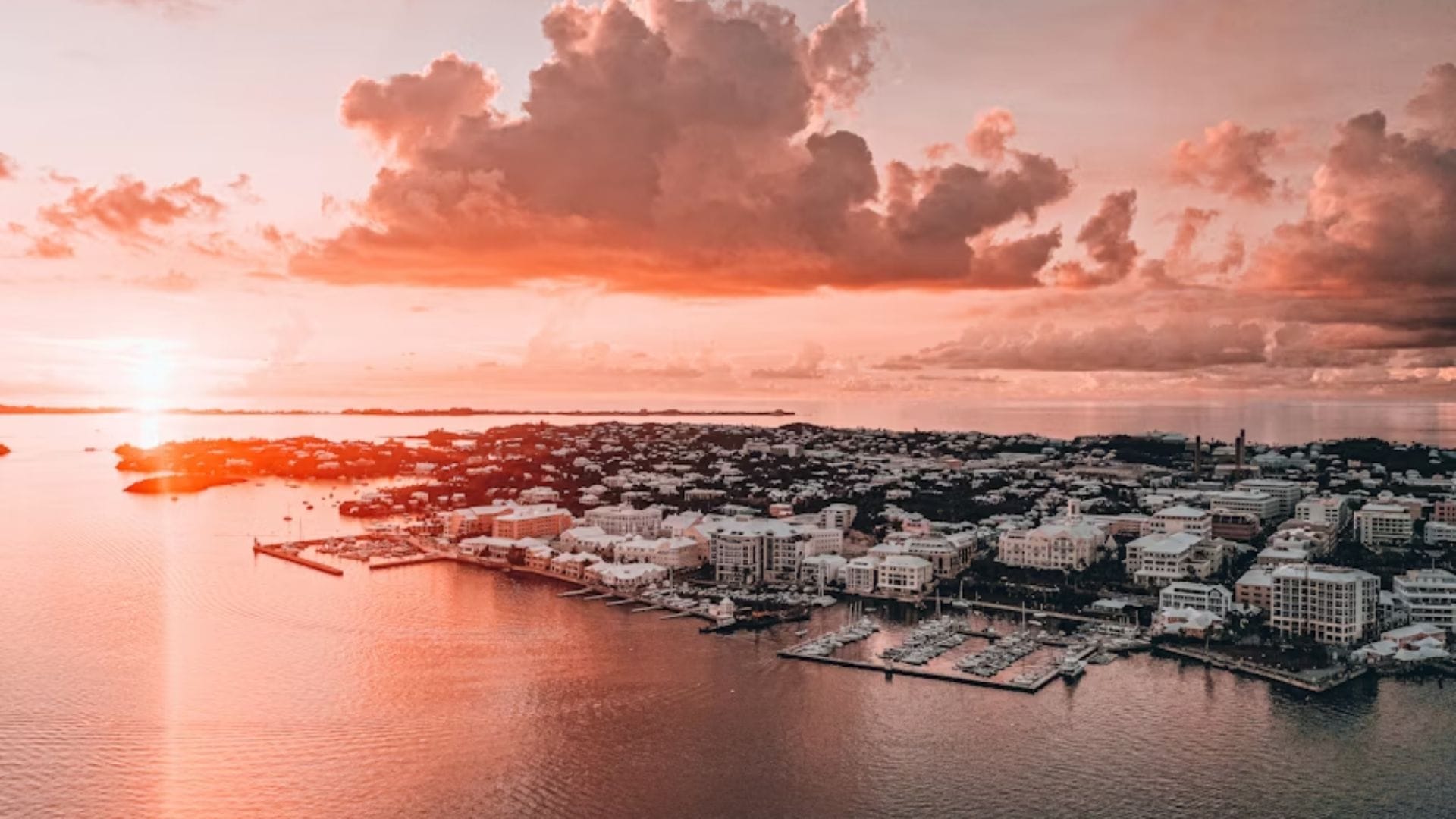
New Delhi: The archipelago of Bermuda rises as a prominent swell in the Atlantic, about 500 metres higher than the surrounding seafloor. Unlike Hawaii, it shows no evidence of a volcano chain, no active eruptions, and no evidence of a deep hot mantle plume. The last volcanic activity in the region occurred 30-35 million years ago, but the swell has not subsided significantly. New seismic analysis from a permanent station on Bermuda provided an explanation. The researchers used high-frequency receiver functions from hundreds of earthquakes to identify sharp interfaces in the shallow lithosphere.
The data reveals normal volcanic and oceanic crust layers. The volcanic layers form an edifice above a fossil feature at a depth of about 10.8 km. This is a fossil ‘Moho’ or an ancient boundary layer between the solid crust and liquid mantle, that is no longer active or forming, and is hence a relic. Beneath this fossil Moho is a thick underplated layer of about 20 km thick, roughly double the thickness observed at many other ocean islands. This layer has properties consistent with modified mantle material emplaced during or shortly after ancient volcanism.
A buoyant slab of rock
The scientists have calculated that the density of the underplated material is about 50 kh per cubic metre less than the lithospheric mantle it replaced. This buoyancy can isostatically support the observed swell topography of 400 to 600 metres, without requiring ongoing injection of material from a mantle plume. The finding fits with the normal heat flow in Bermuda and a lack of deep thermal anomalies. Underplating of this scale may result from volatile-rich magmas that modified the lithosphere more extensively than typical hotspots. Similar, but thinner layers appear elsewhere, but Bermuda’s 20 km thick slab of rock stands out. The research demonstrates that fossil underplating can maintain elevated topography long after the cessation of volcanism. A paper describing the research has been published in Geophysical Research Letters.