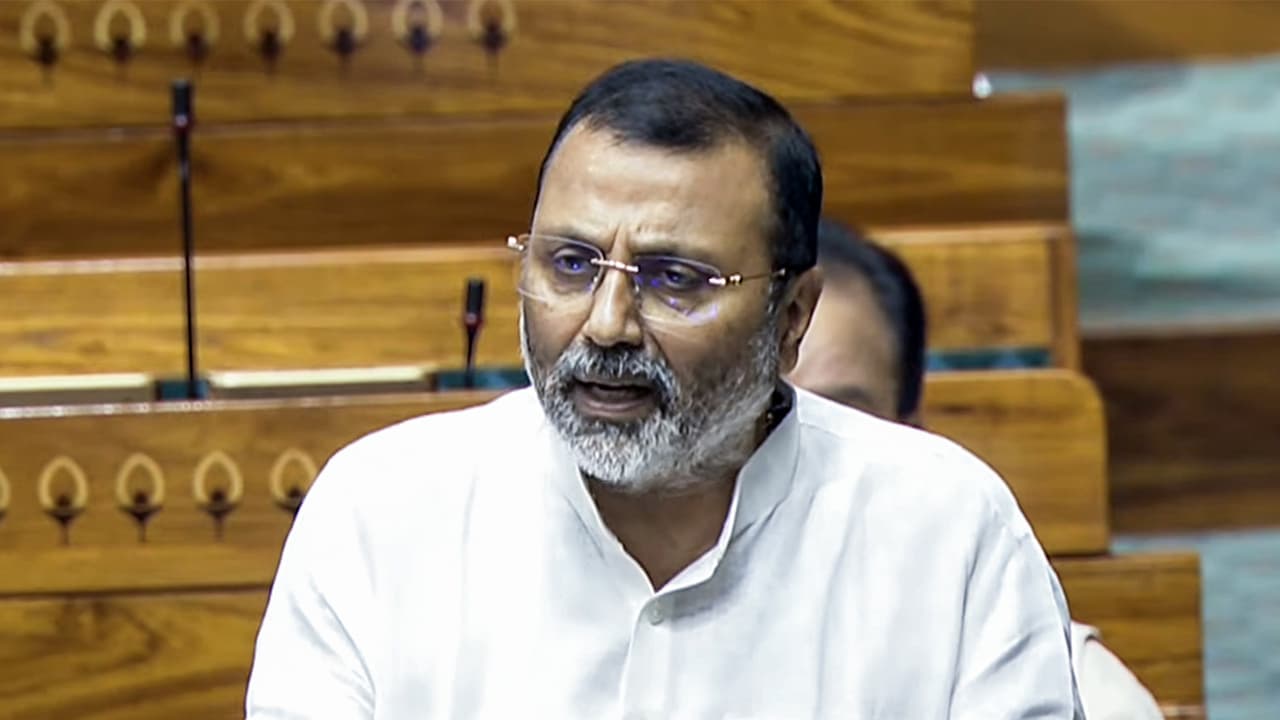
BJP MP Nishikant Dubey hit out at Congress, alleging that water-sharing pacts with Bangladesh under Indira and Rajiv Gandhi compromised the interests of Indian farmers and states, calling the agreements a “dark chapter” in the party’s history.
Bharatiya Janata Party MP Nishikant Dubey on Saturday hit out at the Congress party over the water-sharing Memorandum of Understanding (MoU) with Bangladesh, claiming that decisions taken during the tenures of former Prime Ministers Indira Gandhi and Rajiv Gandhi compromised the interests of Indian farmers and border states.
In a post on X, Dubey described the agreements as a “dark chapter” in Congress’s history and claimed that water from key rivers was shared with Bangladesh at the cost of India’s own needs. “On this very day, May 30, 1982, then-Prime Minister Indira Gandhi had given renewed consent for the sharing of the Ganga River with a Bangladeshi delegation. In 1976, an agreement had been consented to by Indira ji, which was implemented in 1977 for only 5 years. Renewed agreements were then made by Indira ji with Bangladeshi President General Ershad in 1982, and later by Rajiv Gandhi ji in 1985. In 1982, for the first time, we also divided the Teesta River’s water equally, half and half,” Dubey said.
Dubey Alleges Harm to Indian States
The BJP MP alleged that while farmers in Bihar, Jharkhand and Uttar Pradesh faced water shortages, significant river water was being shared with Bangladesh. “Farmers in Bihar, Jharkhand, and Uttar Pradesh are committing suicide without water; silt has accumulated in the Ganga, but the water goes to Bangladesh? The Teesta River is the lifeline of Sikkim–we could generate electricity and irrigation, but the water goes to Bangladesh? The Brahmaputra is the lifeline of Assam and Bengal, but the water goes to Bangladesh?” he said.
Targeting the Congress further, Dubey alleged that the party prioritised vote-bank politics over national interests. “For the sake of vote banks, bringing in Bangladeshi infiltrators and giving shelter to India’s adversaries–in exchange, “Bangladesh Zindabad” is Congress’s guiding principle,” he said.
कांग्रेस का काला अध्याय 75. 30 मई 1982 आज ही के दिन बांग्लादेशी प्रतिनिधिमंडल के साथ तत्कालीन प्रधानमंत्री इंदिरा गांधी जी ने गंगा नदी बंटवारे की दुबारा सहमति दी थी,1976 में एक समझौता इंदिरा जी ने सहमति दी थी जिसे 1977 में केवल 5 साल के लिए लागू किया गया,दुबारा बांग्लादेशी… pic.twitter.com/4HTpAOb0cl — Dr Nishikant Dubey (@nishikant_dubey) May 30, 2026
Background of India-Bangladesh Water Agreements
Dubey’s remarks referred to water-sharing arrangements between India and Bangladesh concerning the Ganga and Teesta rivers. In October 1982, Prime Minister Indira Gandhi and Bangladesh’s then leader Lieutenant General HM Ershad formalised a Memorandum of Understanding (MoU) on the sharing of Ganga waters at Farakka after the expiry of the 1977 agreement.
The 1982 understanding established an interim framework for equitable sharing of water available at Farakka while both countries worked towards a long-term solution to augment river flows. The agreement recognised that inadequate water flow imposed challenges on both nations and called for further technical studies through the Joint Rivers Commission.
Separately, discussions on the Teesta River led to an ad hoc arrangement in 1983 under which India was to receive 39 per cent of the river’s flow, Bangladesh 36 per cent, while the remaining 25 per cent remained unallocated pending further scientific studies. (ANI)
(Except for the headline, this story has not been edited by Asianet Newsable English staff and is published from a syndicated feed.)