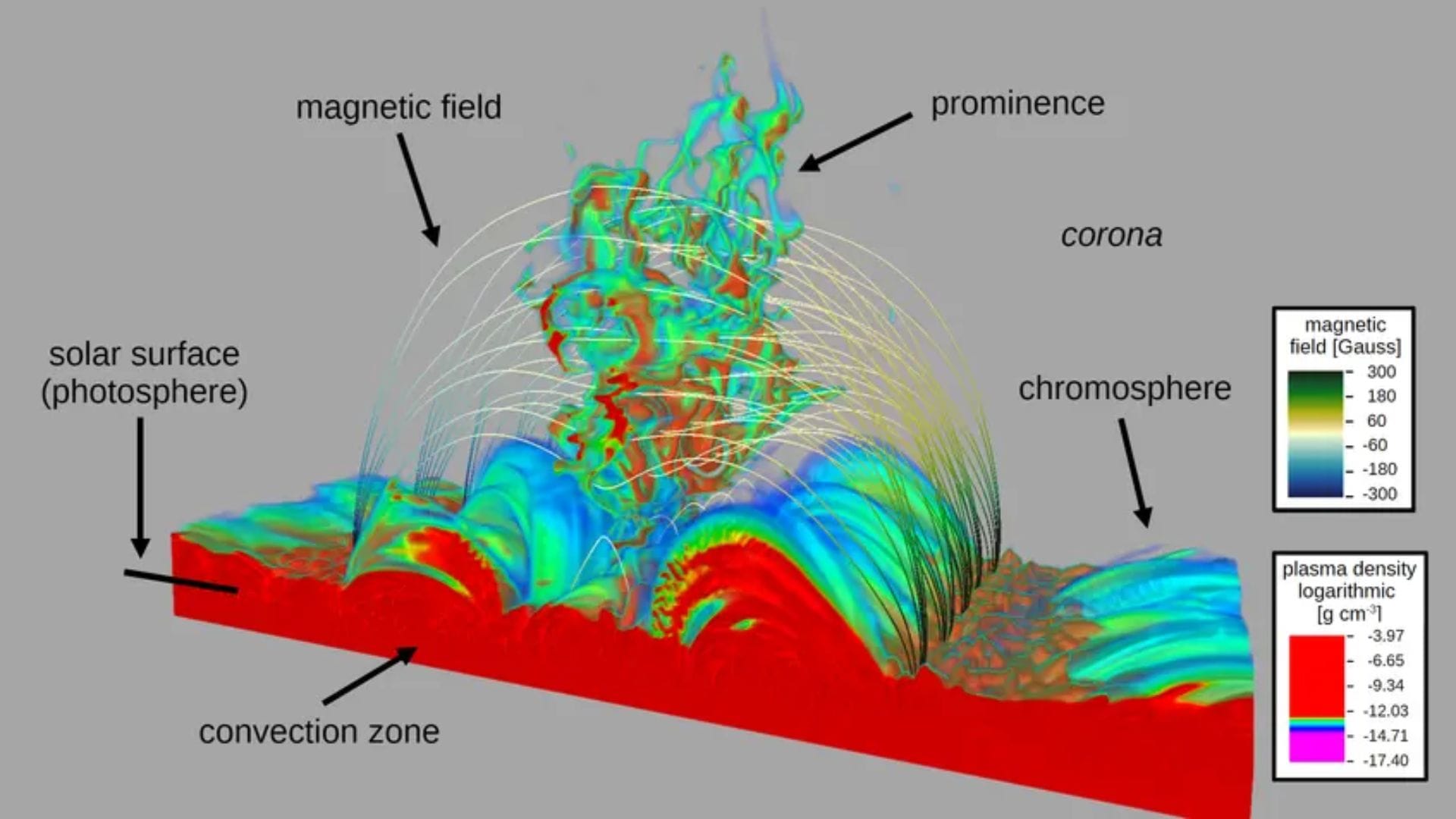
New Delhi: Huge structures of cool plasma appear within the corona, or outer atmosphere of the Sun, known as prominences. These can span several thousand kilometres, and resemble flickering flames. They can take on a variety of shapes, and despite their tenuous appearance, they are chunks of matter, with densities exceeding that of the surrounding corona by over a hundred times. Prominences can remain stable for weeks, and even months. The prominences can fade away quietly, or erupt spectacularly, where the charged particles are hurled outwards through interplanetary space, in the form of coronal mass ejections, inducing geomagnetic storms if they encounter the Earth.
Researchers from Germany have investigated how prominences form, and how they can persist for so long. The findings indicate that multiple processes are at work, constantly supplying material to the prominences. The scientists used sophisticated computer simulations to model the interactions between magnetic fields of the Sun and its plasma. They considered the Sun’s atmosphere, where the prominences manifest, but also the deeper, cooler layers of the star for the first time. Beneath the visible surface of the Sun, turbulent flows of plasma generate the complex, dynamic magnetic field of the Sun that extends into the corona.
A focus on smaller prominences
For the research, the scientists focused on the smaller prominences that extend only 20,000 km into the corona. The simulations indicated an injection process that sets the prominence in motion, driven by turbulent, small-scale movements of the magnetic field. The chromosphere or middle atmosphere of the Sun ejects bursts of cool plasma, that remains trapped in the magnetic field dip in the corona. Some of the cool plasma returns to the surface of the Sun in the form of coronal rain. To a lesser extent, hot plasma also flow along the magnetic field lines into the dip, and condense there. A paper describing the research has been published in Nature Astronomy.