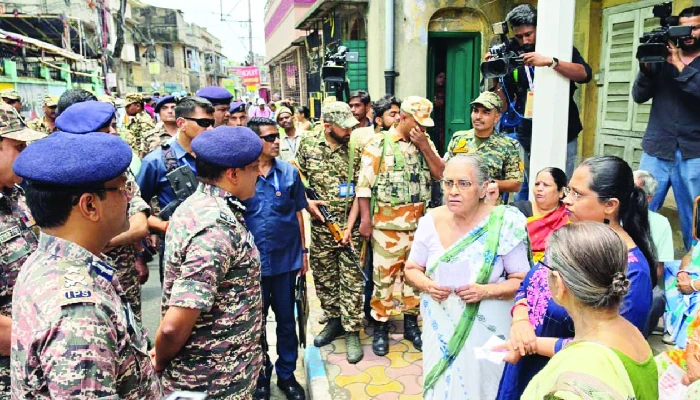
On 29th April (Wednesday), the Election Commission announced that 700 companies of the Central Armed Police Forces (CAPFs) will remain stationed in the West Bengal until further orders for security arrangements and law and order duties are issued.
The deployment plan was released on 19th March. Meanwhile, the highly contested state assembly election awaits the final verdict on 4th May (Monday).
The electoral body maintained that the move is in response to that occurred in the state during the 2021 assembly elections and the TMC government had failed to prevent it. “The forces will be stationed in sensitive areas and will assist the state administration in maintaining normalcy,” an EC official informed.
The panel’s directives were issued just one day after Central Reserve Police Force (CRPF) Director General GP Singh reaffirmed prior instruction from 25th April that 500 Central Armed Police Forces (CAPF) companies would be in the state following the election, pending further guidelines.
These included, 200 CRPF companies, 150 BSF companies alongside 50 companies each of ITBP, CISF and SSB. “We remain committed to free, fair and transparent second phase of polling as well in West Bengal Assembly Election 2026,” Singh conveyed.
Amit Shah, the Union Home Minister, also mentioned that central forces would be present in Bengal for 60 days post the election. Officials declared that future about the extent and duration of deployment would be made in light of security agency input and assessments conducted on the ground.
CAPFs have been told to keep a close eye on counting centres and establish control rooms at the EC headquarters in New Delhi as well as the office of the West Bengal Chief Electoral Officer (CEO). According to insiders, election officials, candidates and counting agents will receive QR code-based photo identity cards to prevent unauthorised individuals from entering counting centers, reported The Tribune.
They noted that the last assembly elections witnessed organised, widespread and targeted violence based on political affiliation across numerous districts, necessitating the heavy mobilisation of CAPF personnel in West Bengal. The EC added that the police and those in positions of authority were implicated in the unrest that broke out following voting and the outcome of the results in 2021.
It pointed out that the National Human Rights Commission’s inquiry team from DGP West Bengal had reported 1,934 cases, including murder (29), sexual assault (12), grievous hurt (391), arson or vandalism (940) and intimidation (562). However, just 1,345 of the 9,304 perpetrators were taken into custody.
Likewise, 52 killings and 11 rape cases were reported by a fact-finding committee set up by the court. The EC charged that the panel forwarded 3,384 complaints to the state government but almost 1,000 received no response. It also highlighted that the committee’s spot inspections revealed that FIRs were not filed in 60% of cases.
The Calcutta High Court had acknowledged that the EC is in charge of civil or police administration during elections in order to guarantee free and fair elections. However, this is not an indication for the police to stop carrying out their regular responsibilities to uphold law and order. The court pointed out that there were signs of systemic nexus, organised violence and a complete collapse of the rule of law.