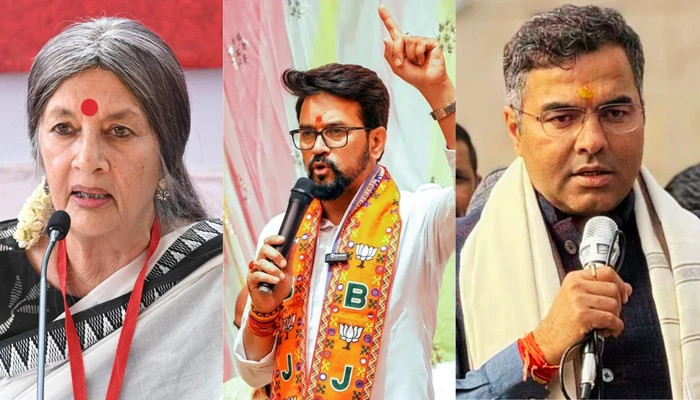
The Supreme Court on Wednesday (29th April) held that no cognizable offence was made out against BJP leaders Anurag Thakur and Parvesh Sahib Singh Verma, who were accused of making hate speeches in January 2020. The decision was made by a Bench of Justices Vikram Nath and Sandeep Mehta on a plea filed by CPI(M) leader Brinda Karat, challenging a Delhi High Court order passed on June 22, 2023, which refused to direct the filing of an FIR against the two leaders.
The Delhi High Court had dismissed the writ petition filed by Karat and upheld the decision of the Additional Chief Metropolitan Magistrate (I), Rouse Avenue Court, dated August 26, 2020. The trial court had declined to issue a direction for registration of an FIR against the leaders under Sections 153A, 153B, 295A, 504, 505 and 506 of the IPC, citing a lack of prior sanction for prosecution.
Allegations made by Brinda Karat
In her plea, Karat alleged that in speeches made by the two politicians, they threatened to use force to remove protestors, who were holding protests at Shaheen Bagh against the Citizenship Amendment Act (CAA). It also alleged that their speeches promoted hatred and enmity against Muslims by portraying them as invaders who will enter houses and rape and kill people.
Karat referred to the speech made by Anurag Thakur on January 27, 2020, where he allegedly raised the slogan “desh ke gaddaron ko, goli maaron saalon ko” (Traitors should be shot dead). She also referred to a speech made by Parvesh Verma on January 27-28, 2020, while campaigning for the BJP and a subsequent interview given to the media.
Background of the case
A complaint was submitted on January 29, 2020, to the Commissioner of Police, Delhi, seeking registration of an FIR against the two politicians. Subsequently, on February 2, 2020, a communication was made to the Station House Officer, Parliament Street Police Station, New Delhi, reiterating the request for immediate registration of an FIR. When no action was taken, the appellants filed a complaint under Section 156(3) of the CrPC before the trial court. In the status report submitted before the trial court, the investigating agency said that no cognizable offence was made out based on the material placed on record.
The trial court dismissed the complaint filed by the appellants, holding that it was maintainable because there was no prior sanction from the competent authority to prosecute the accused. Thereafter, the appellants approached the Delhi High Court via a writ petition filed under Articles 226 and 227 of the Constitution of India, read with Sections 482 and 483 of the CrPC, and challenged the verdict of the trial court. The High Court also dismissed the writ petition, upholding the reasoning of the trial court, which stated that a direction for the registration of the FIR and investigation under Section 156(3) of CrPC could not be exercised in the absence of prior sanction.
What the Supreme Court said
The Supreme Court examined the record and declined to interfere with the Delhi High Court’s order on the merits. However, the apex court disagreed with the legal reasoning given by the High Court in making the order. The court observed that even though it did not find any ground to interfere with or overturn the High Court’s decision, it found fault with the High Court’s observation that prior sanction is required before a Magistrate can order registration of an FIR under Section 156(3) CrPC.
Explaining the point of law, the Supreme Court said that the power exercised by a Magistrate under Section 156(3) of CrPC falls at the pre-cognisance stage and does not require prior sanction. “The scheme of CrPC does not contemplate any embargo on the direction for registration of an FIR or the conduct of investigation at the pre-cognisance stage. To hold otherwise would amount to introducing a restriction not envisaged by the legislature,” the Supreme Court said.
However, after examining the case on the merits, the Supreme Court categorically held that no cognizable offence was made out against the two politicians. “Upon a careful consideration of the material placed on record, including the alleged speeches, the status report dated 26th February, 2020, submitted before the Trial Court, and the reasons recorded by the courts below, we are in agreement with the conclusion that no cognizable offence is made out,” the Court stated, adding that their speeches were not directed against any specific community.
“The High Court has, on an independent assessment, held that the speeches in question do not disclose the commission of any cognizable offence, observing that the statements were not directed against any specific community nor did they incite violence or public disorder,” the top court observed.
“Accordingly, while we disapprove of the reasoning adopted by the High Court on the issue of prior sanction, we find no ground to interfere with the ultimate conclusion. The appeal against the impugned judgment dated 13th June, 2022, therefore, stands partly allowed to the aforesaid extent,” the Supreme Court held.