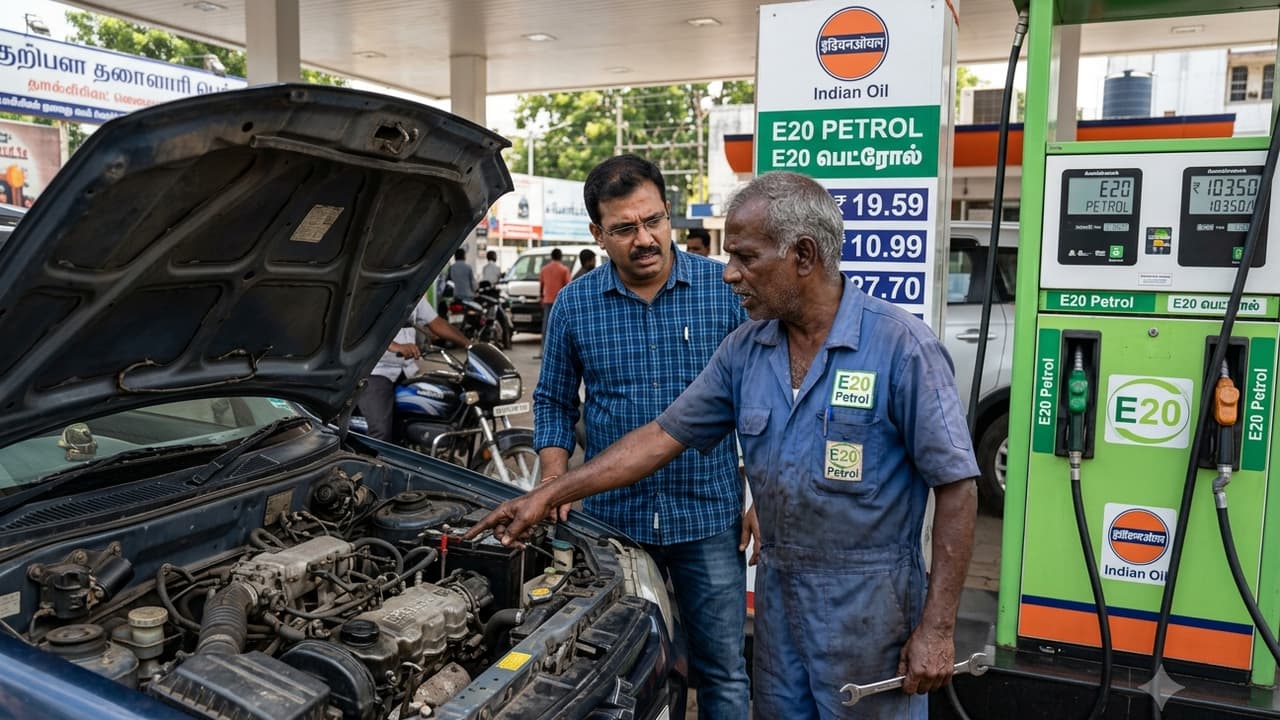
With terms like E20, E30, and Flex Fuel being used frequently, it’s easy to get confused. Here’s a simple breakdown of what each term means, and what the government’s official policy on ethanol blending is right now.
Let us start with the most important point. The Indian government officially states that E20 is the maximum authorised ethanol blend for fuel in the country. Despite what you may have heard, there has been no decision to offer E30 or higher mixes for public consumption. So, now that we’ve cleared everything up, what exactly does the alphabet soup of E20, E30, and E85 mean? It’s not as complicated as it sounds. The ‘E’ stands for ethanol, and the number that follows simply represents the proportion of ethanol in the fuel. This is a straightforward ratio.
Decoding the Numbers
E20 gasoline, the current norm, is a combination of 20% ethanol and 80% petrol. This is the gasoline becoming more commonly available, and current cars are being designed to be compatible with it. Following the same logic, E30 would be a mixture of 30% ethanol and 70% petrol. A greater mix, such as E85, is utilised in some other nations and contains 85% ethanol and only 15% petrol. However, they are not allowed for usage in India.
So, what is ‘Flex Fuel’?
The debate now switches from the gasoline to the engine of the car. A ‘Flex Fuel’ car is equipped with an engine that can operate on a variety of ethanol-petrol mixtures. It is not limited to a specific ratio. Essentially, you could fill a Flex Fuel vehicle with pure petrol, E20, E85, or any combination in between, and the engine would automatically adapt to operate efficiently. This is somewhat different from a conventional petrol vehicle, which is only approved to operate safely on a certain mix, such as E20. What’s the bottom line? While technology for higher mixes and flexible-fuel cars exists, E20 gasoline is the reality for Indian consumers. For the time being, it is the only number that matters at the pump.