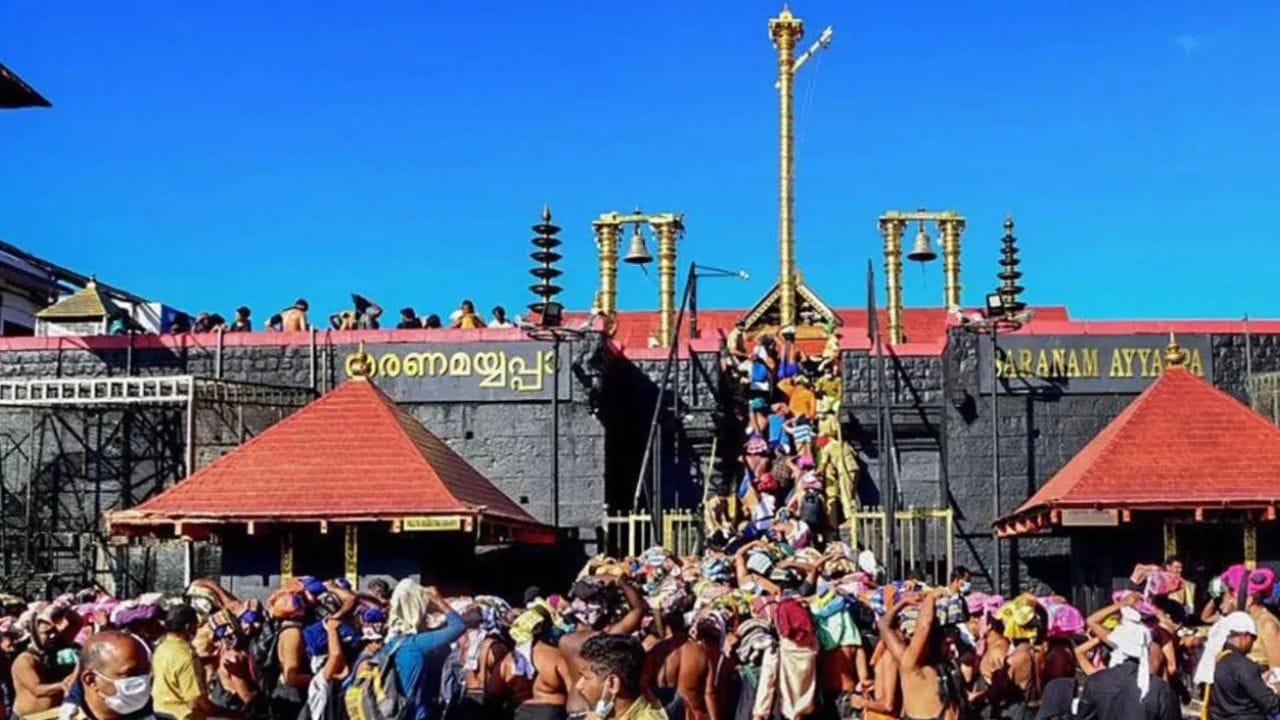
New Delhi: The Supreme Court on Tuesday observed that there cannot be anarchy, and the right to manage a religious institution cannot mean the absence of structure, while hearing petitions related to discrimination against women at religious places, including the Sabarimala Temple in Kerala.
There has to be a modality and devised norms for its well-functioning, said the nine-judge Constitution bench. The court also adds that the regulation is necessary for the orderly functioning of the institution and scope of religious freedom practised by multiple faiths.
Who are the judges hearing the case?
The nine-judge bench comprised of Chief Justice Surya Kant and Justices B V Nagarathna, M M Sundresh, Ahsanuddin Amanullah, Aravind Kumar, Augustine George Masih, Prasanna B Varale, R Mahadevan and Joymalya Bagchi.
While presenting the case, advocate Nizam Pasha argued that a dargah is not just a building but a sacred site of deep reverence in Sufism. He said, “Within Islam, there are differing views regarding the status of saints after death, but in the Sufi system of belief, there is deep reverence attached to the place where a saint is interred.”
Pasha added, “The Sufi system of belief in India consists of several major orders, including the Chishtiya, Qadriya, Naqshbandiya and Suhrawardiya. The present case concerns the Chishtiya order.This system, I submit, clearly constitutes a religious denomination. If one looks at the teachings attributed to Hazrat Nizamuddin Auliya, there is emphasis on adherence to Islamic practices such as roza, namaz, hajj, zakat, and above all, faith.”
He contended that the right to regulate entry in a religious institution is part of management.
Court’s stance on regulation
The judge agreed that management is necessary but set clear boundaries. Justice Amanullah noted that the right to manage cannot mean the absence of structure, and that for everything, there has to be a modality.
“There cannot be anarchy. Take a dargah or a temple. There will be elements associated with the institution, the manner of worship, the sequence in which things are done. Somebody has to regulate that.”
He added that it cannot be that everyone says I will do whatever I want or that the gates remain open at all times without any control. So the important question is: who is the body that will manage it?
He says that is exactly where protection comes in, because regulation is necessary. At the same time, it cannot transgress constitutional limitations as there cannot be discrimination on the broad constitutional parameters.
Justice Amanullah clarifies that every institution must have norms and it cannot be individually determined by each person.
Can a judicial forum define parameters?
The apex court earlier said that it was very difficult, if not completely impossible, for a judicial forum to define parameters to state a particular religious practice as essential or non-essential.
Well, a five-judge Constitution bench, back in September 2018, by a 4:1 majority verdict lifted a ban that prevented women between the ages of 10 and 50 years from entering the Sabarimala Ayyappa temple and held that the centuries-old Hindu religious practice was illegal and unconstitutional.
With the hearings underway, its need to be seen whether the bench will uphold the same verdict or give a new order.