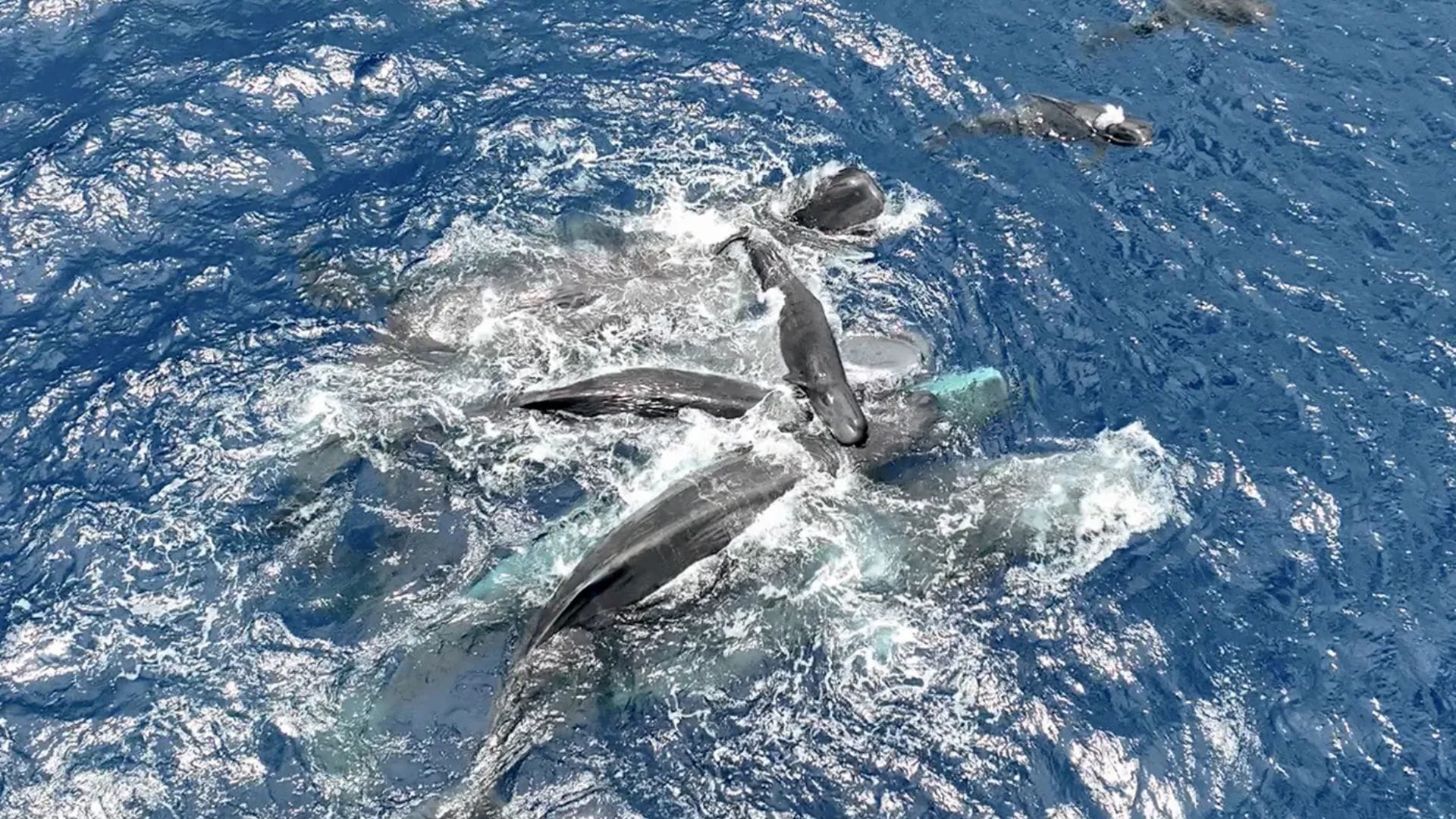
New Delhi: In a discovery that highlights the remarkable similarities between the social lives of humans and cetaceans, researchers have captured detailed footage of sperm whales from two different family pods cooperating to ensure the survival of a newborn calf. The event was recorded in July 2023 in the Eastern Caribbean using drones, and reveals sophisticated cross-family assistance previously believed to be rare outside human communities. Human births involve doctors, nurses and midwives, with scientists now discovering that sperm whales assist non-related mothers during childbirth.
Unlike most marine mammals, sperm whale calves are born with negative buoyancy, and will sink immediately after birth. The newborn calf will drown without immediate support. During the four-hour birthing process, 11 whales from two distinct pods gathered hours in advanced. Non-related females actively participated by slingshotting the newborn to the surface, and forming a living raft with their bodies to keep the calf afloat until it could swim independently. Adult and juvenile females provided direct assistance, while elderly females patrolled the perimeter, guarding against threats by pilot whales and sharks.
Whale songs are crucial for survival
The level of inter-pod cooperation observed was highly unusual, as sperm whale units typically maintain distance across vast stretches of ocean, and rarely interact so closely. The coordinated effort, involving complex communication and planning, highlights the advanced social intelligence of the species, and suggests that intricate whale communication systems evolved as critical survival mechanisms. Staying the near the surface for extended periods represents a significant metabolic cost, especially when aiding non-kin, challenging traditional evolutionary expectations of ‘selfish’ behaviour.
Sperm whales possess the largest brains on Earth, nearly six times heavier than a human brain. They live in tight-knit matriarchal pods with rich cultural practices, accumulated wisdom on foraging and migration, and nuanced vocalisation. The observed ‘all fins on deck’ assistance mirrors human births. Project CETI used drones, underwater microphones, and buoy-mounted cameras to map the movement of individual whales and their relationship, confirming non-kin interactions. A lone male, named Allan was eager to help and lingered nearby, but was largely ignored by the group. A paper describing the research has been published in Science.