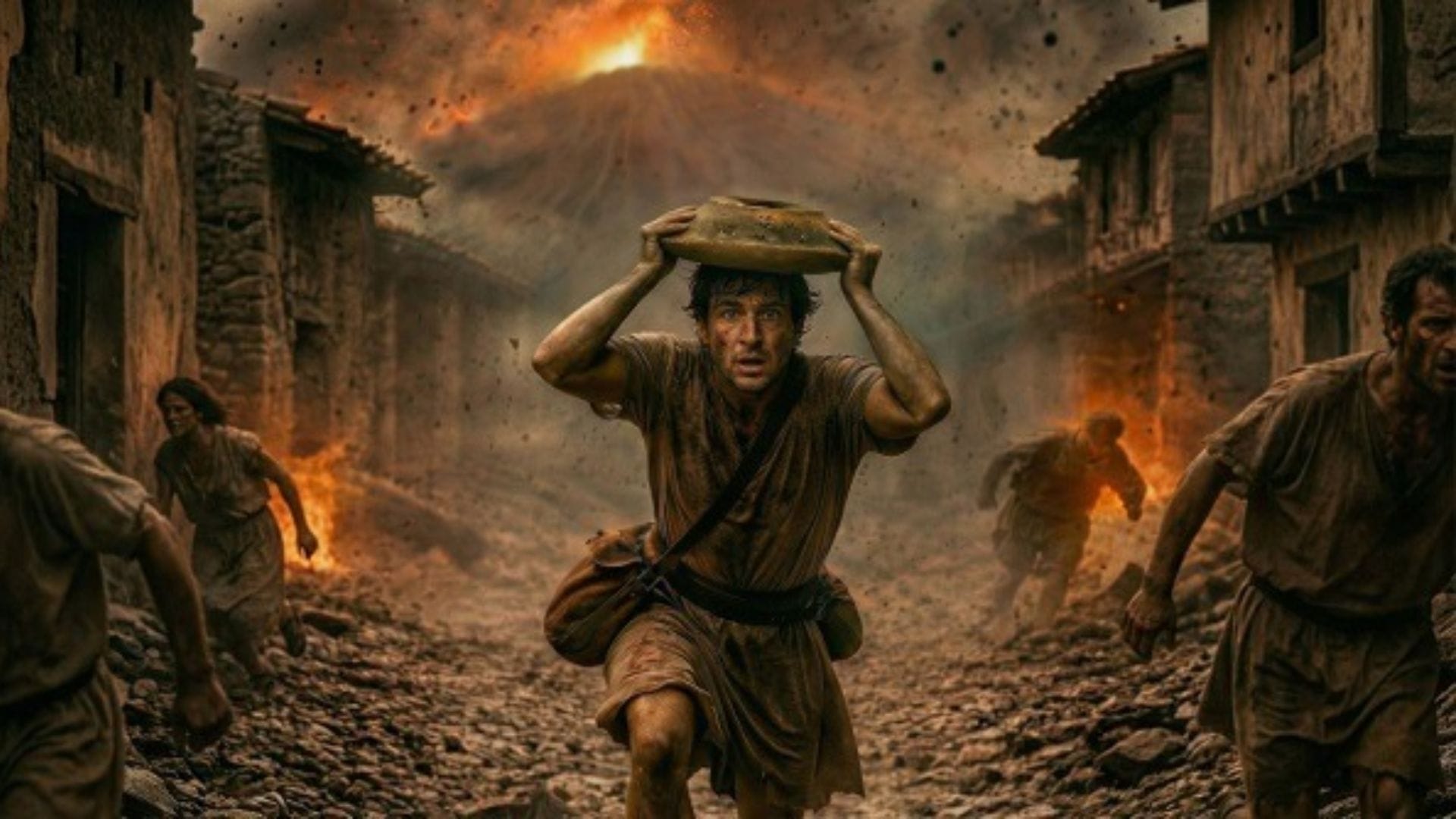
New Delhi: The remains of two men who died during the eruption of Mount Vesuvius in 79 CE were uncovered during recent archaeological excavations of the Porta Stabia necropolis in Pompeii. The older victim was found with a terracotta mortar placed over his head in an attempt to protect himself from falling volcanic debris. This physical evidence aligns with historical accounts from Pliny the Younger, who described fugitives using pillows or objects as shields against the rain of stones. Besides the older victim, the archaeologists discovered a ceramic lamp intended for navigation in low visibility, a small iron ring on his finger, and ten bronze coins.
The Archaeological Park of Pompeii used artificial intelligence for a digital reconstruction of the older victim, in a technical collaboration with the Digital Cultural Heritage Laboratory of the University of Padua. The experimental reconstruction integrates archaeological data with AI software and photo-retouching techniques to produce a scientifically grounded visualisation accessible to a non-specialist audience. The project highlights the increasing role of AI in managing and interpreting the vast quantities of data generated at Pompeii. Researchers emphasise that while AI serves as a powerful tool for generating imperative models and immersive communication, it remains a supplement to human expertise.
AI makes archaeology more accessible
The reconstruction has been documented in a paper published in the E-Journal of the Excavations of Pompeii. The methodology aims to preserve cultural heritage while making complex archaeological findings legible to a global audience. The discovery was made during investigations of a tomb, and provides new data on escape attempts made by residents during the final hours of the city. The two victims died at different stages of the volcanic event, with the younger individual likely killed by a pyroclastic flow, a cloud of hot ash and toxic gas that moves at high speeds. The older victim died earlier, during the heavy fall of lapilli, which are pyroclastic volcanic fragments or tephra.