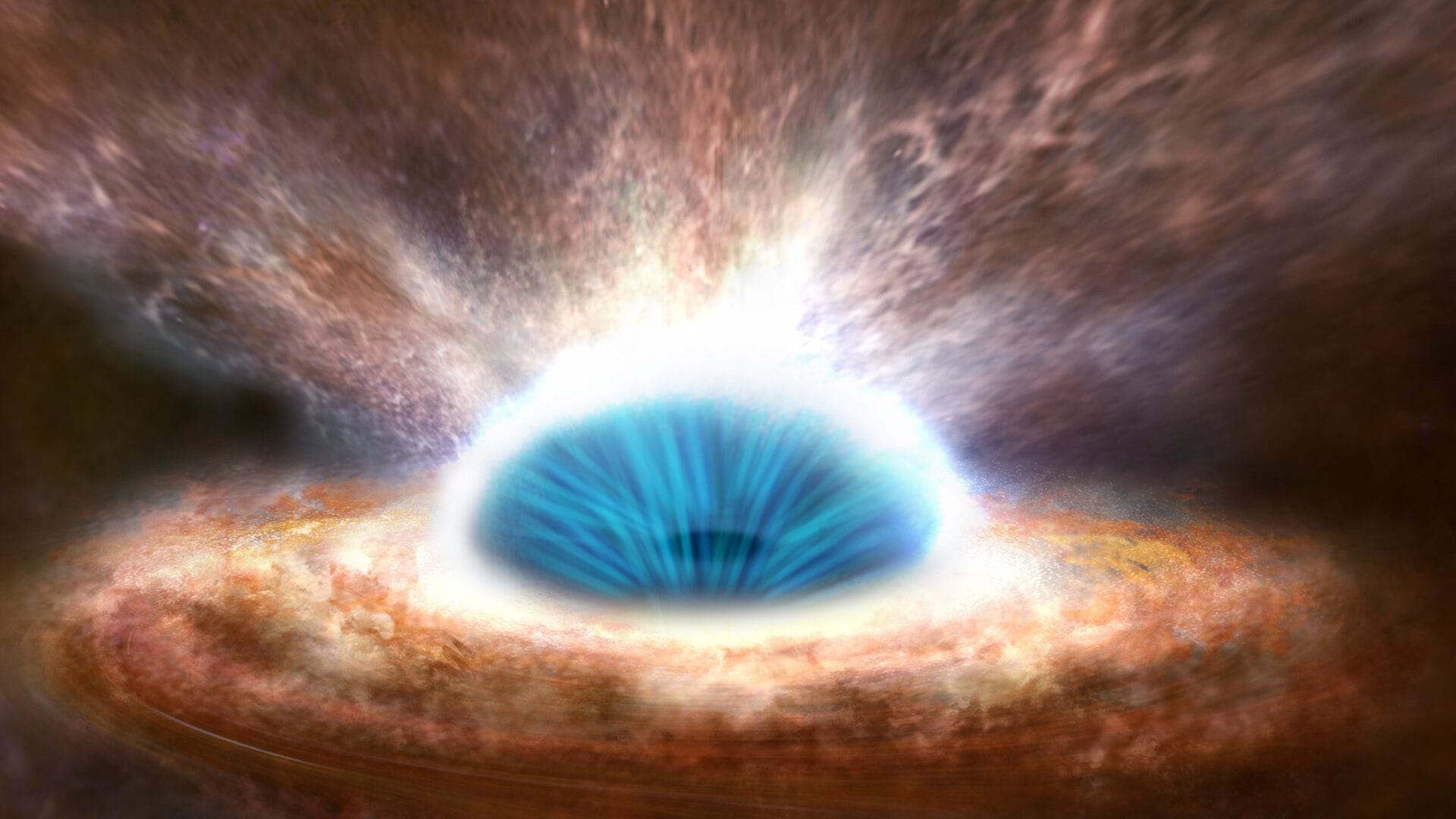
New Delhi: Astronomers have discovered gargantuan black holes, at times containing as much mass as a billion Suns, that emerged within the first billion years after the Big Bang. The James Webb Space Telescope has spotted unusually large black holes in the early universe. According to conventional theories, black holes simply cannot form so rapidly. Now, scientists have suggested that dark matter decays could provide an explanation for the early formation of these supermassive black holes. Energy released by the decay of dark matter could alter the chemistry of early galaxies enough, to cause some of them to directly collapse into black holes without forming stars first.
Dark matter is a mysterious substance that does not interact with light, but does exert gravitational influence. About 85 per cent of the universe is made up of dark matter. The researchers demonstrated that if dark matter decays, it can leak a small amount of energy into the gas, and supercharge the rate of direct collapse. Each decaying dark matter particle only needs to inject an amount of energy that is about a trillionth of the energy of a single AA battery. The researchers discovered that dark matter, given the right properties, could produce the conditions to seed direct collapse black holes.
Direct Collapse Black holes are Coincidence
A paper describing the research has been published in the Journal of Cosmology and Astroparticle Physics. Lead author of the study, Yash Aggarwal says, “Our study suggests that decaying dark matter could profoundly reshape the evolution of the first stars and galaxies, with widespread effects across the universe. With the James Webb Space Telescope now revealing more supermassive black holes in the early universe, this mechanism may help bridge the gap between theory and observation.” The researchers were able to demonstrate that the right dark matter environment can create the coincidence required for direct collapse black holes much more likely.