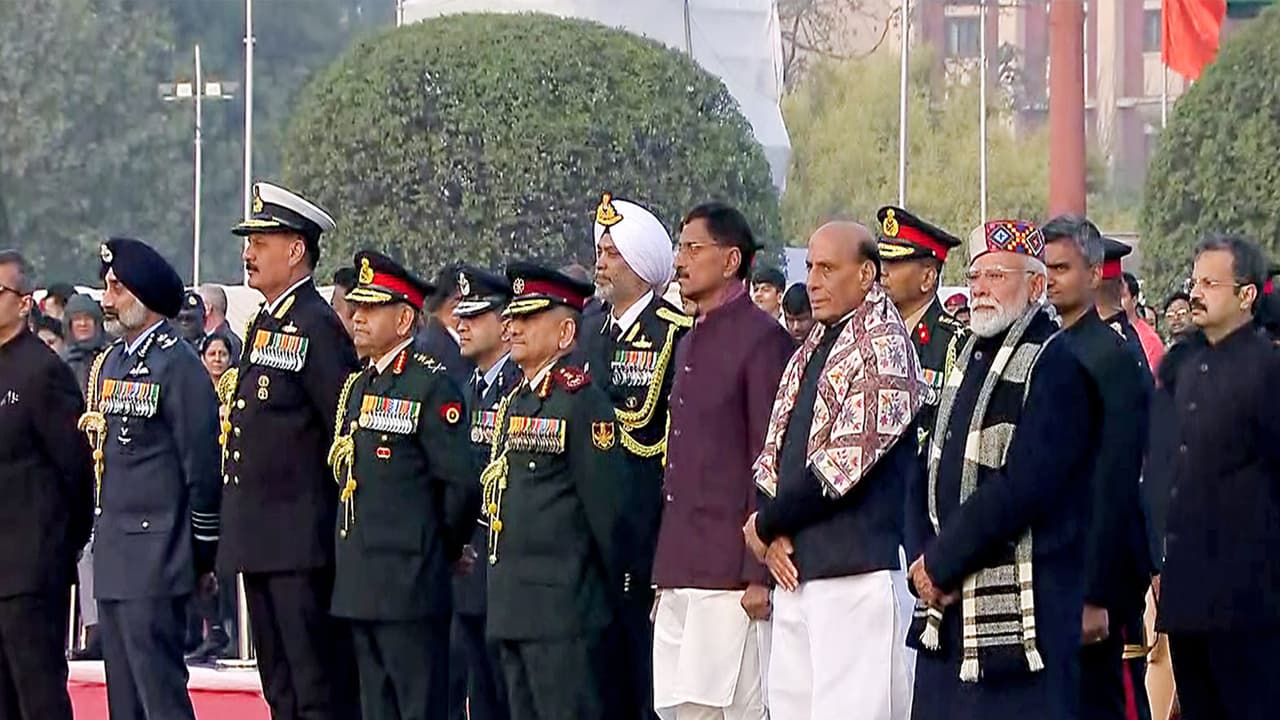
PM Modi praised the Beating Retreat ceremony in his ‘Mann Ki Baat’ address, noting the increased use of Indian music. He announced the ceremony’s music is on WAVES OTT and urged people to listen and feel proud of the Armed Forces’ traditions.
PM Modi on ‘Mann Ki Baat’
Prime Minister Narendra Modi on Sunday reminisced about India’s Festival of Republic that takes place from January 23 to 30, emphasising the significance of the Beating Retreat ceremony and lauding the prowess of the country’s army and security forces. The Prime Minister announced that a highly commendable initiative has been undertaken, and the music of Beating Retreat is available on WAVES OTT. He said this will be available on other platforms as well in future and urged people to listen to the performance and feel proud of the Armed Forces and their traditions.
Addressing the nation in the 133rd episode of ‘Mann Ki Baat’, PM Modi recognised the ceremony as an integral part of the celebrations. He shed light on the increase in the inclusion of Indian music during the ceremony. Calling this year’s ceremony memorable, PM Modi said that the Air Force, Army, Navy and Central Armed Police Forces delivered excellent performances.
“In our country, from January 23rd, i.e., from Netaji Subhas’ birth anniversary, to January 30th, i.e., Gandhiji’s death anniversary, the Festival of the Republic is celebrated. An important part of this festival is the Beating Retreat. Today, I am discussing Beating Retreat with you because there is a special reason behind it…,” he said.
“This ceremony showcases diverse musical traditions with different bands. In a few years, the inclusion of Indian music has increased, and it is also being liked by the people of the country. This year’s Beating Retreat ceremony was quite memorable. The bands of the Air Force, Army, Navy, and C.A.P.F. gave excellent performances…,” he added.
Beating Retreat 2026 Highlights
The iconic Vijay Chowk reverberated with captivating Indian tunes during the Beating Retreat ceremony on January 29, 2026, marking the culmination of the 77th Republic Day celebrations. The bands of the Indian Army, the Indian Navy, the Indian Air Force and the Central Armed Police Forces played an array of foot-tapping melodies before a distinguished audience, comprising President Droupadi Murmu, Vice-President CP Radhakrishnan, Prime Minister Narendra Modi, Raksha Mantri Rajnath Singh, other Union Ministers, senior officials and the public.
The ceremony began with the Massed band’s ‘Kadam Kadam Badhaye Ja’, followed by melodious tunes by the Pipes & Drums band such as ‘Atulya Bharat’, ‘Veer Sainik’, ‘Mili Jhuli’, ‘Nritya Sarita’, ‘Marooni’, and ‘Jhelum’.
The Central Armed Police Forces bands played ‘Vijay Bharat’, ‘Hathrohi’, ‘Jai Ho’ and ‘Veer Seepahi’.The tunes played by the band of the Indian Air Force included ‘Brave Warrior’, ‘Twilight’, ‘Alert’, and ‘Flying Star’, while the Indian Navy band played ‘Namaste’, ‘Sagar Pawan’, ‘Matribhumi’, ‘Tejasvi’, and ‘Jai Bharati’.
It was followed by the band of the Indian Army playing ‘Vijayee Bharat’, ‘Aarambh Hai, Prachand Hai’, ‘Aye Watan, Aye Watan’, ‘Anand Math’, ‘Sugamya Bharat’, and ‘Sitare Hind’.
The Massed Bands then played the tunes ‘Bharat Ke Shaan’, ‘Vande Mataram’ and ‘Drummers Call’. The event came to a close with the ever-popular tune of ‘Sare Jahan Se Acha’ played by the Buglers, a release stated.
Conductors and Special Arrangements
The principal conductor of the ceremony was Squadron Leader Leimapokpam Rupachandra Singh. The Indian Army Band conductor was Subedar Major Prakash Joshi, while M Antony, MCPO MUS II and Warrant Officer Ashok Kumar were the conductors of the Indian Navy and the Indian Air Force bands, respectively. The conductor of the Central Armed Police Forces band was INSP Chetram.
The Pipes & Drums band played under the instructions of Subedar SP Chourasia, while the Buglers performed under the leadership of Subedar Manoj Kumar.
This year, the seating enclosures at Vijay Chowk for the ceremony were named after Indian instruments, i.e., Bansuri, Damaru, Ektara, Esraj, Mridangam, Nagada, Pakhawaj, Santoor, Sarangi, Sarinda, Sarod, Shehnai, Sitar, Surbahar, Tabla and Veena.
(Except for the headline, this story has not been edited by Asianet Newsable English staff and is published from a syndicated feed.)