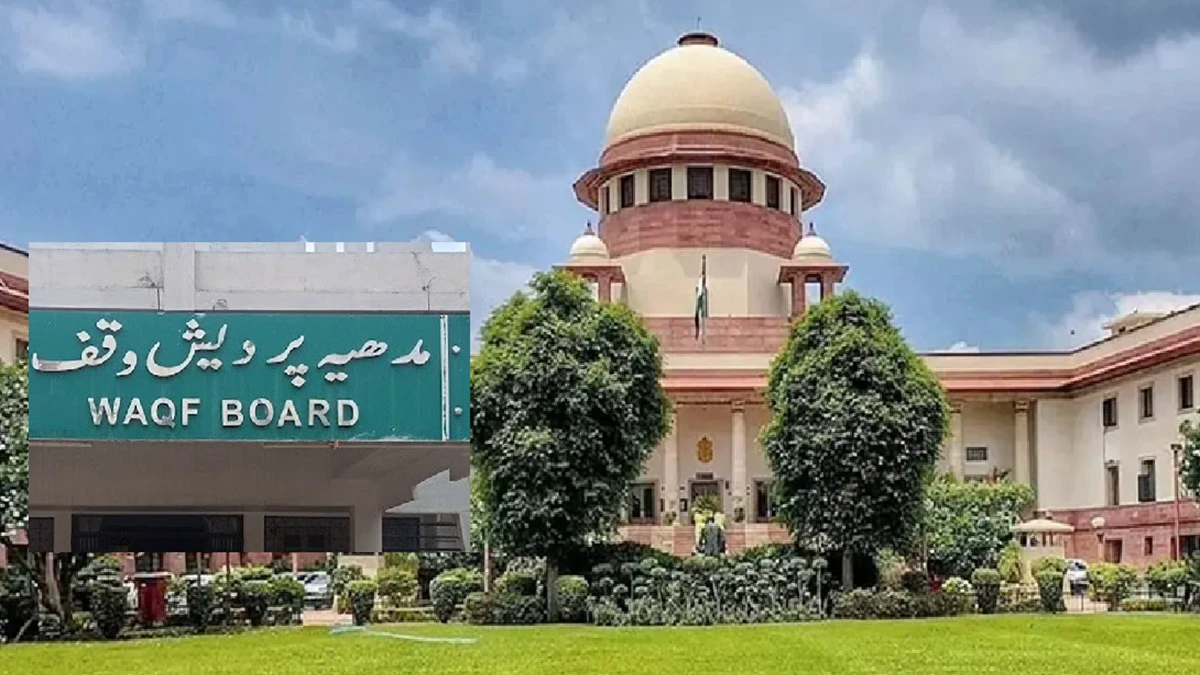
Waqf Land Case: The Supreme Court pronounced a ruling that lands linked to mosques, known as “seva inams,” are part of the Waqf property and cannot be sold.
The apex court, while hearing a case from Andhra Pradesh, said it is undisputed that lands given as “seva inams” for religious or charitable purposes become donated property and are vested in a public or religious trust, preventing their sale or transfer to anyone else.
SC Overrules Andhra Pradesh High Court’s Order
A bench of Justices MM Sundaresh and AG Masih, delivering this ruling on an appeal by the Andhra Pradesh Waqf Board, overturned the Andhra Pradesh High Court’s decision and reinstated the Waqf Tribunal’s decision.
What Was The Land Case?
The current case is related to three acres of land in the Kurnool district, Andhra Pradesh. The central question was whether the land was considered Waqf property (a service reward) granted for religious purposes at the Budha-Budhi Mosque and stables, and therefore, could not be sold, or whether the land was private property (a private reward) legally sellable through a sale deed.
The original plaintiff in the case, Janaki Basappa, filed a suit in the Waqf Tribunal, claiming ownership based on sale deeds executed in 1985 and 1996, seeking the right to peaceful use of the land and a permanent injunction against any interference.
On the other hand, the Waqf Board, claiming the land was Waqf property, argued that it was originally granted for religious purposes and was registered as a service reward, which could not be sold. The Waqf Board had allotted the land to the Jamaat Ahle Hadith for the construction of an Eidgah. The crucial evidence in the case was a 1945 Partition document that described the land as a service reward. The Waqf Tribunal dismissed Janaki Basappa’s suit.
The case went to the High Court, where the High Court overturned the Tribunal’s decision, stating that the Waqf Board failed to prove ownership of the land. Following this, the Waqf Board appealed to the Supreme Court, which has now reached this decision.
Why Is The Case Significant?
The Supreme Court’s ruling is a landmark, which laid a framework to resolve land issues linked to the Waqf Board. The case will guide several land cases, which are similar in nature, pending in the courts.
The Supreme Court cited a previous decision, Syed Ali vs. AP Waqf Board, which clearly stated that land granted for the purpose of providing religious or charitable services does not vest absolute ownership in an individual, and that such land, granted for purposes deemed sacred, religious, or charitable under Muslim law, confers “Waqf” status on the property.
The court stated that this principle fully applies to this case, where the partition document itself clearly states that the land is a “seva inam” (service inam) associated with a mosque. The Supreme Court stated that the High Court erred in interpreting the partition document as granting independent ownership and failed to properly examine its contents.