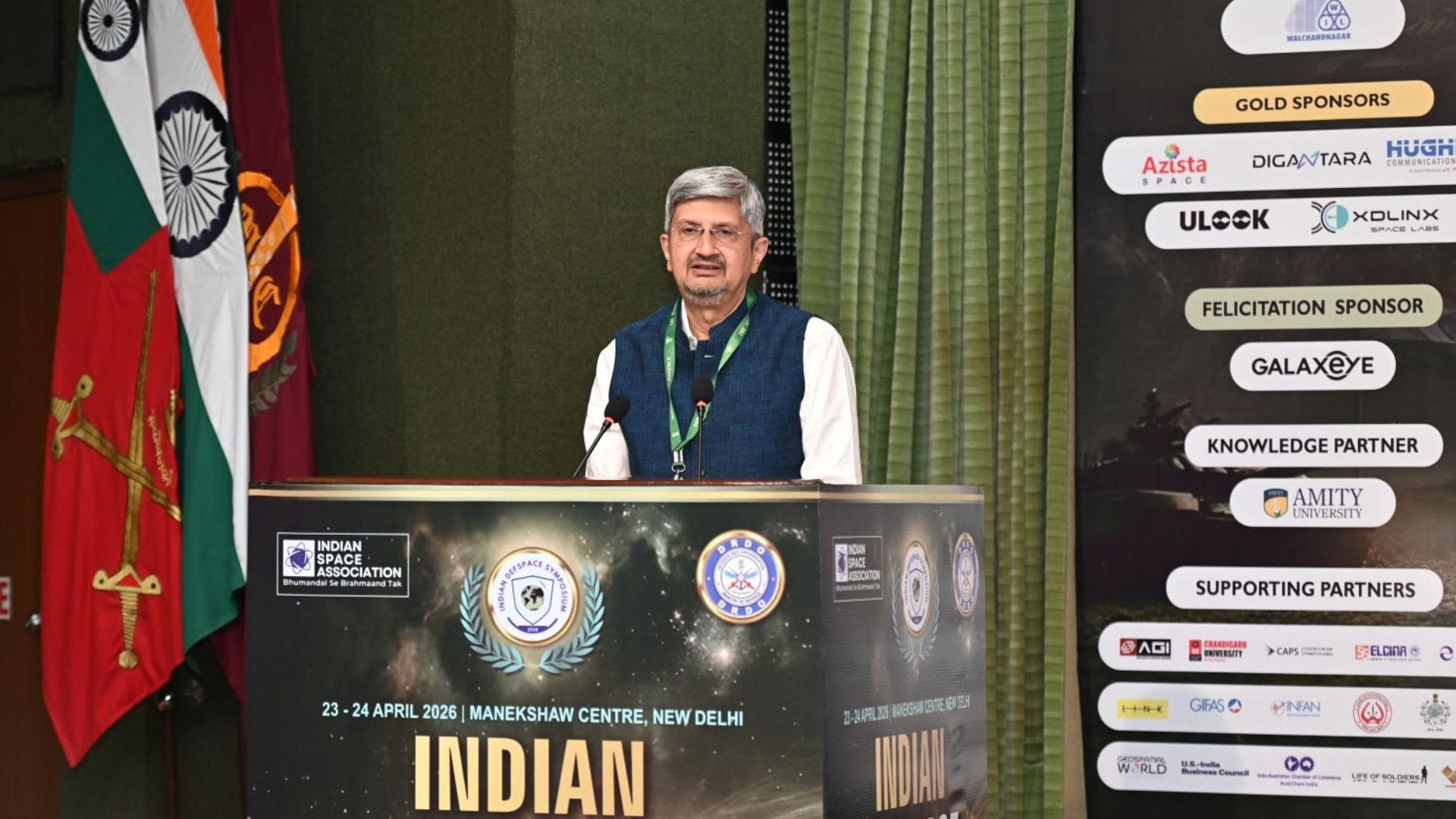
New Delhi: At the Indian DefSpace Symposium 2026 in New Delhi, top defence officials highlighted the shifting nature of warfare, and the increasing reliance of terrestrial operations on space technologies. India’s gross research and development expenditure has remained low, at around 0.65 per cent of the GDP, far below levels in leaving innovation economies. Within the defence budget, allocation to research remains limited, constraining rapid progress in critical areas such as military satellites, space-based intelligence and adversarial capabilities. The Defence Forces Vision 2047, released earlier in the year is a long-term roadmap to transform India’s Military into a technologically advanced, integrated and future-ready force.
Dr Samir V Kamat, Secretary, DD(R&D) and Chairman of DRDO said, “Space is no longer just an enabler. It is the dominant domain which is going to decide the outcome of future battles. For DRDO and the country to catch up, it is going to be a challenge, and this can be done only if we work in a whole-of-nation approach. There are areas where technologies can be sourced externally, but there are other areas where sovereign capabilities are essential, and these are the areas where DRDO is focusing. Today, we spend only 0.65 per cent of our GDP on R&D and only 5 per cent of our defence budget on R&D. What we need is to invest much more in our R&D efforts. We definitely need to scale this up if we have to catch up with our rivals.”
Leaders stress on need for speedy development
Lt Gen Zubin A Minwalla, Deputy Chief of Integrated Defence Staff, (Operations) at HQ IDS said, “India must chart its own path, based on speed, agility and intelligent integration of private industry. Relying solely on one agency would be suboptimal. We must build an ecosystem where all stakeholders complement each other. The Defence Space Agency has articulated the joint military space doctrine and a long-term roadmap under Defence Vision 2047. The Defence Space Agency has grown into a fully operational tri-service entity and in the future will be a fully operational space command. We continue to face dependencies in critical technologies and gaps in high-end indigenous systems. The focus must remain on indigenous development aligned with operational timelines.”