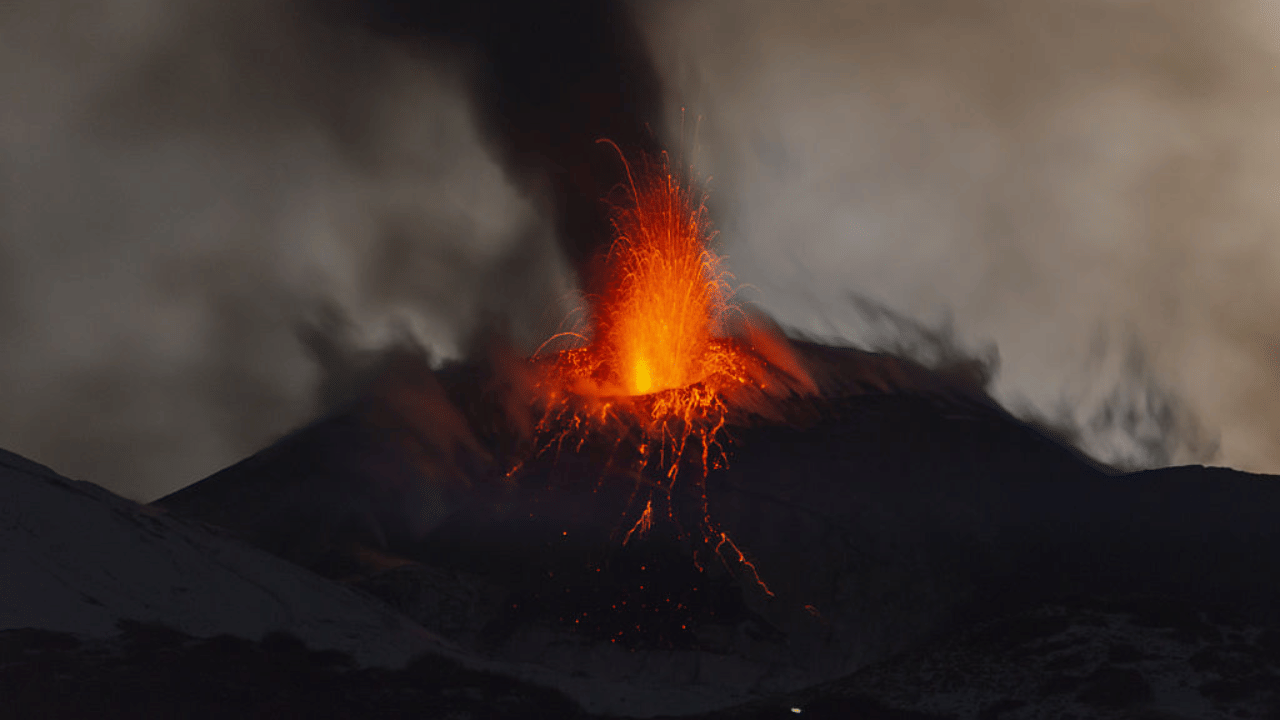
New Delhi: For decades, scientists have struggled to explain the strange behaviour of Mount Etna, Europe’s most active volcano. Rising more than 3,400 metres above Sicily, Etna erupts frequently, sometimes several times a year, but its chemistry is not what geologists would expect of a typical stratovolcano. Its lava is unusually alkaline and seems to be much more plentiful than can be attributed to the normal geological mechanisms.
Recently, there has been a new study in the Journal of Geophysical Research: Solid Earth that hypothesises that Etna could be driven by a relatively uncommon and poorly understood magma system. According to researchers, this process has been hitherto associated only with small underwater volcanoes, and thus Etna becomes a geological outlier and could be a unique location on Earth.
A volcano that breaks the rules
The majority of volcanoes are created as a result of well-known processes, including tectonic plate separation, subduction, or hotspots of the mantle. Etna cannot be easily categorised into either of these. Even though it is located above a subduction zone where the African Plate slides under the Eurasian Plate, its lava is similar to that of hotspot volcanoes such as those that are located in Hawaii.
In order to explain this aberration, scientists examined lava samples over a period of about 500,000 years of the history of Etna. The results showed a surprisingly constant chemical composition even though there were significant tectonic changes in the area. This uniformity indicates that Etna does not receive magma created recently, like most volcanoes, but through an ancient and continuous source just beneath the Earth.
The ‘Petit-Spot’ connection
The research identifies a low-frequency process called a ‘petite-spot’. These are commonly minor volcanic structures that develop as magma escapes out of the pockets that are confined in the upper mantle. It is believed that Etna taps magma in such deep reservoirs, as per the lead researcher, Sebastian Pilet, who says that Etna taps magma that is 80 kilometres underground.
The African Plate may be slipping under, thus squeezing these pockets, which may cause alkaline magma to push up through cracks in the crust – like water squeezed out of a sponge. This may be the reason why Etna generates great masses of alkaline lava without having to form magma quickly.
Why this discovery matters
The results may transform the scientific perception of volcanic systems, in particular, those who are not related to existing models. Etna is of special interest to investigate due to its closeness to highly populated cities such as Catania and Messina. Its magma source might be better understood to enhance hazard prediction and risk assessment.
The study is a strong explanation of one of the longest-running mysteries of volcanology, although further investigations are required. Etna, it seems, is not just another volcano; it may represent a rare geological process unlike anything else on Earth.