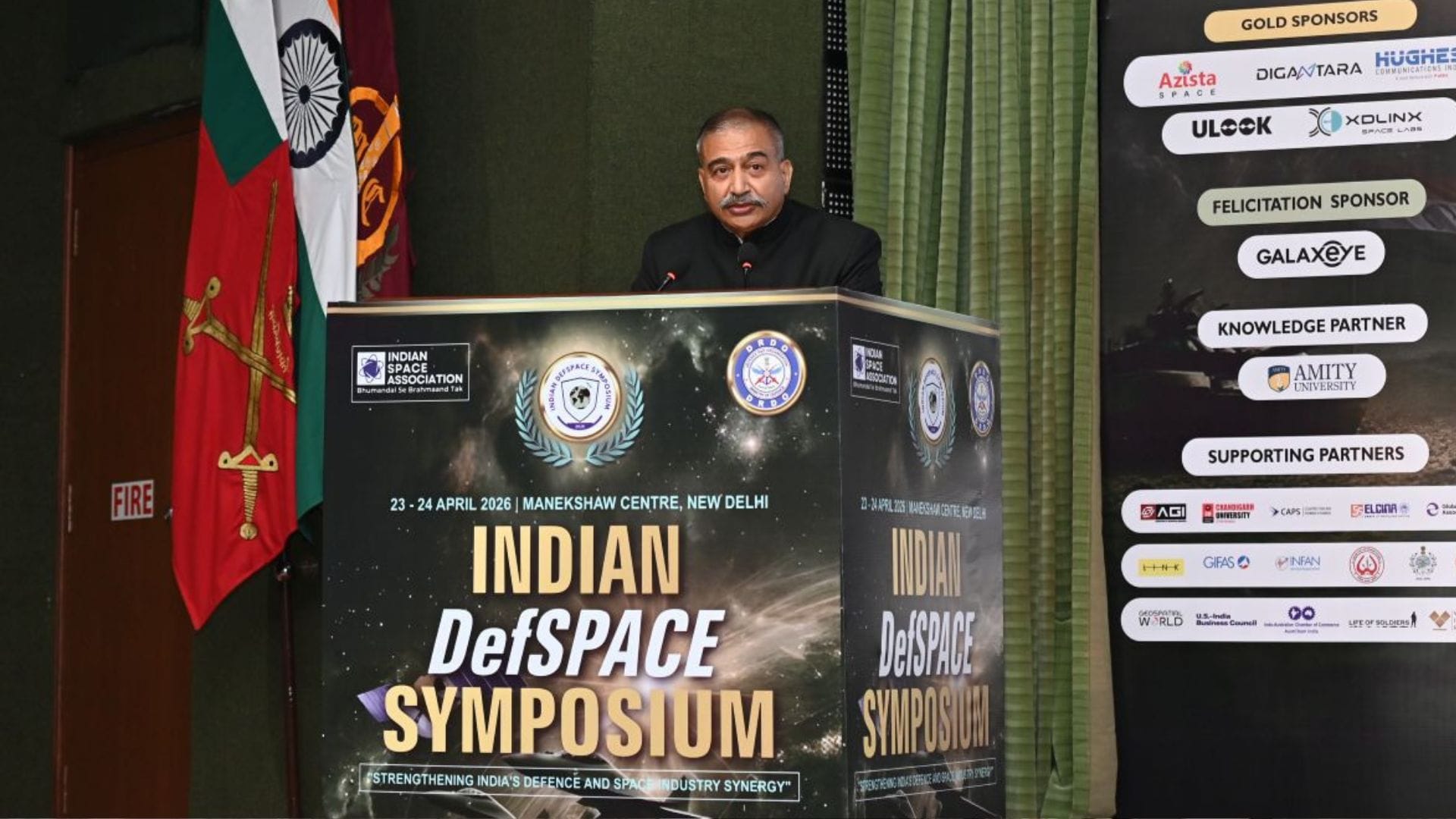
New Delhi: The top defence and space leadership in India highlighted the urgent need to build resilient, sovereign, integrated space capabilities at the Indian Defence Space Symposium 2026, organised by the Indian Space Association (ISPA). The two-day forum is focused on increasing the synergy between the defence and space ecosystems in thee country. The theme of the first day was ‘Commercial Space Operations: Navigating Threats and Military Employment’, where the evolving threat landscape was examined, including global conflicts, adversarial space capabilities, and how commercial space can shape military outcomes. The discussions also focused on the role of space in modern conflict, strategic communications and network-centric operations in contested environments.
Chief of Defence Staff of the Indian Armed Forces, General Anil Chauhan, in his virtual address said, “We must target towards distributed, resilient, and proliferated architectures with redundancy, inter-satellite links, and rapid replenishment capability. Future space capability will not be built by government agencies alone. It will be co-developed with industry, start-ups and technology innovators. We must move from using space as a program to treating it as a continuous operational asset. Our objective is not merely to access space, but to secure operational advantage through space. We must pursue strategic partnerships without compromising our strategic autonomy. We must build space architecture that is resilient, artificial intelligence enabled, quantum secure, cyber hardened, rapidly replenishable, and unquestionably sovereign to us. Anything less will leave us in a reactive mode.”
Publications released at the symposium
There were three publications released at the symposium. The first was a report by OrbitAID and ISPA on In-Space Servicing, Assembly and Manufacturing (ISAM), highlighting its role in enabling the future space economy, and India’s opportunity to to position itself as a leader in in-orbit services. The second was a report by SatSure and ISPA on Geospatial Foundation Models, outlining how AI-driven, reusable intelligence layers can unlock large-scale impact from Earth Observation data. The third report by Amity University captures key discussions and strategic takeaways from the ISPA India International Space Conclave 2025.
Director General of the Indian Space Association, Lt Gen AK Bhatt said, “The Defence Space Symposium has evolved into a key platform for advancing India’s defence space discourse, bringing together operational communities, policymakers, and industry. Achieving this synergy requires deep integration between the armed forces and a capable and responsive industrial base. India’s private sector today is a vital pillar of national capability. However, we must reduce dependence on critical imports and build indigenous capabilities aligned with operational requirements.”